Europe has finally noticed that you cannot regulate your way out of technological dependence, and we have to thank Trump for that (read (So you think you own your AI? | LinkedIn). After years of exporting AI laws, and ethics papers while importing GPUs and producing virtually no innovation at all, the European Union has woken up to the uncomfortable reality that sovereignty in the age of AI is not a values statement, but an engineering problem.
Duh.
But try telling that to roughly sixty thousand bureaucrats (sic!) in Brussels.
So, after Trump waved his middle finger at the International Criminal Court following its decision to label Netanyahu a war criminal, and promptly reminded everyone that Microsoft Office is apparently a geopolitical weapon, Europe began trying to reclaim control over the entire AI technology stack.
And this took a lot of “getting used to”, because this wasn’t about lofty “AI policy goals” or “trustworthy AI frameworks”, but the unglamorous, brutally physical layers too. Ugly things like data centers. Energy. Chips. Training data. Foundation models. Toolchains. Ecosystems. Talent. Capital. Power.
The motivation behind this frantic burst of energy is simple. The United States and China build AI. Europe writes opinions about AI. In 2024, the US produced 40 notable frontier models, and China produced 15, but they’re now launching multiple new models each month.
And the countries in Europe produced three.
That should’ve been a red flag, but instead it’s blue and it has yellow stars.
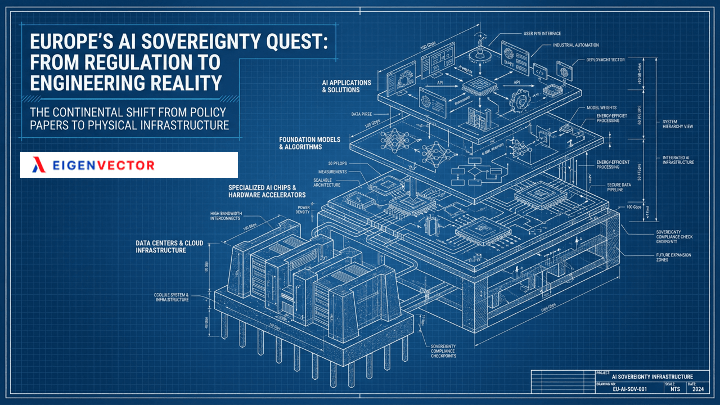
So Europe is now doing what it should have done a decade ago, and that is throwing money, policy (of course), and institutional mass (mostly paper) at the entire stack all at once.
More rants after the messages:
- Connect with me on Linkedin 🙏
- Subscribe to TechTonic Shifts to get your daily dose of tech 📰
- Please comment, like or clap the article. Whatever you fancy.
Why AI sovereignty suddenly matters
Europe’s digital strategy was built on a comforting fantasy that regulation, and “ethical leadership” could compensate for a lack of technological power. The AI Act became the crown jewel of this worldview, but outside of the EU, no one has copied but one sentence from it. And all along, the actual AI stack quietly moved to California, Seattle, Shenzhen, and increasingly, Beijing.
By the mid-2020s, the consequences became impossible to ignore.
European governments run critical workloads on US hyperscalers.
European startups fine-tune US models trained on US-curated data.
European regulators attempt to enforce sovereignty on systems they do not control, host, or meaningfully understand.
And at the same time, the geopolitical context shifted. AI is infrastructure. It shapes military capability, economic productivity, intelligence analysis, media ecosystems, and political persuasion. And thus, “Sovereign AI” entered the lexicon, as damage control.
Sovereign AI means the capacity to develop, host, deploy, govern, and evolve AI systems under your own jurisdiction, aligned with your own legal, economic, and societal constraints. Actually controlled.
And crucially, sovereignty applies to the entire stack, not just the model layer everyone likes to tweet about.
Europe’s late realization has been that AI is a vertically integrated system. You cannot cherry-pick sovereignty at the top and renting everything underneath from an angry neighbor.
A typical AI stack looks like this
- Physical infrastructure → Data centers, energy, cooling, chips, networks, supercomputers.
- Data and training datasets → Language, culture, images, audio, video, structured industrial data. Governed, compliant, usable.
- Foundation models → Large, general-purpose models capable of reasoning, multimodality, and adaptation.
- Ecosystem and applications → Startups, enterprises, open source communities, deployment pipelines, integration layers.
For a long time, Europe focused almost exclusively on layer four. Applications. Innovation hubs. Accelerators. Pitch decks. And layers one through three were quietly owned by someone else.

Data centers
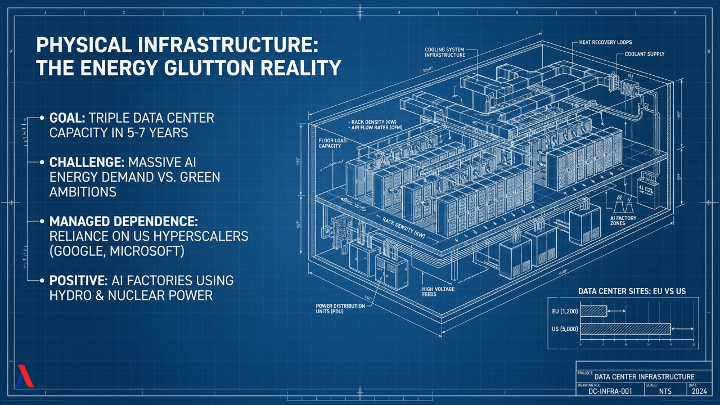
Unfortunately, AI does not run on ethics, inclusion and policies. It runs, however, on electricity, water, silicon, and cooling systems the size of aircraft hangars. Europe discovered this after noticing it had roughly 1,200 data center sites versus 5,000 in the United States.
Then a €100 billion construction frenzy started.
Europe aims to triple data center capacity within 5–7 years for AI workloads that melt GPUs and the ice-cap and have an energy demand that regulators would previously choke on.
The irony makes me want to laugh and cry at the same time.
Europe’s green ambitions now collide head-on with the fact that AI is an energy glutton. So the pitch has become “green sovereign compute” (hahaaaa, sorry). That roughly translates to “we’ll build massive power-hungry facilities but feel morally better about them”. And meanwhile, my McDonalds milkshake straws are still made from paper, and my lips get ripped open every time I unscrew a bottle cap.
Freaking hypocrites.
US hyperscalers are, of course, deeply involved. Not because they love sovereignty, but because Europe is a profitable market with regulatory leverage. Google commits €5.5B in Germany, offering “sovereign cloud” variants that still somehow involve Google. Microsoft puts $10B in Portugal, and they promise that governments can run Microsoft Cloud… on Microsoft terms, but locally.
This is not independence, I call it managed dependence. And again, it’s better than nothing. But it doesn’t shield you from the mango Mussolini.
And what do you need in data centers. Yes. Data
As I call it “the thing Europe has plenty of and still somehow mismanages”.
Europe loves to talk about data, and gorges itself in data-privacy laws until it had its fill. But Europe is also remarkably bad at operationalizing it.
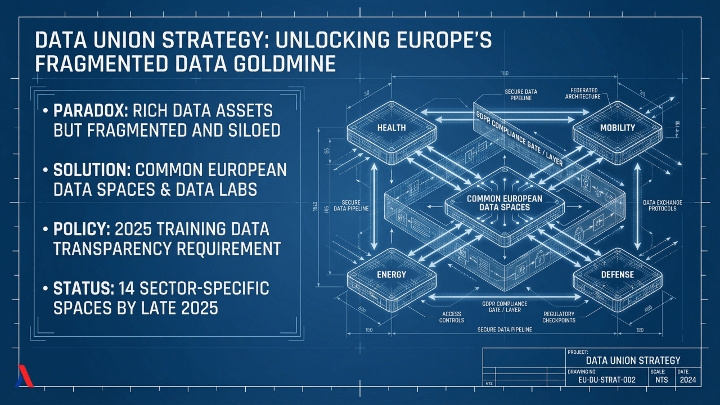
The European continent is rich in multilingual, high-quality, regulated data across industry, government, culture, and science. It is also fragmented, siloed, under-digitized (meaning, lots of paper), and legally paralyzed (non tocare!).
The Data Union Strategy is meant to fix this (yawn) through Common European Data Spaces, sector-specific pools, and public-private Data Labs. €100M here, €100M there.
Ambitious. Necessary. Slow.
By the way, the requirement for training data transparency, which was introduced in 2025, is one of Europe’s few, genuinely smart moves. Mandatory disclosure templates for general-purpose models force a level of accountability that US labs still dodge with “proprietary” hand-waving. But alas, transparency requirements alone doesn’t create datasets. Someone still has to clean them, and annotate them and of course make them usable in a corpus.
This is where private companies like Pangeanic do the real work for the EU. They build GDPR-compliant corpora, with multilingual speech including actual European accents.
This layer is where Europe could dominate if it stopped tripping over its own paperwork because I believe that cultural specificity is a moat, if you bother to dig it properly.
Then there’s the Foundation Models
Yes, the part everyone suddenly wants credit for. Europe’s sudden enthusiasm for sovereign foundation models is… um, telling. For years, it was assumed this layer was “too expensive” or “not Europe’s role”.
Hahaaa… Europe is indeed not known for it’s foresight.
But that opinion evaporated the moment ChatGPT rewired public consciousness. Now every member state wants its own model, preferably open, and ethical of course. Ethical schmetical. Read this before you comment: A European train wreck with AI in the driver’s seat + Amsterdam’s Ethical AI fairy tale went spectacularly tits up
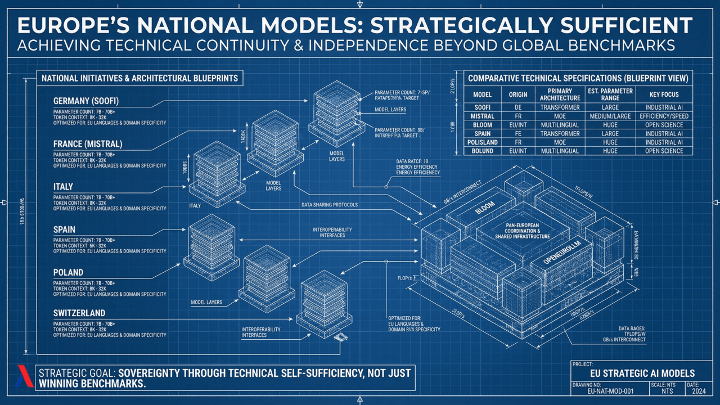
Germany’s SOOFI model has 100B parameters – which is like 10% of DeepSeek’s latest model – but it has industrial relevance. France’s Mistral rockets to a €6.2B valuation after €2,5B investment from ASML, and it secured Blackwell GPUs like a serious player. Italy goes full SPQR with their 335B-parameter ambitions. Spain focuses on multilingual openness. Poland builds a model for administrative reality, and Switzerland does what Switzerland does – they make open, precise, multilingual models like Apertus which are quietly very competent.
These efforts matter. But let’s be honest, most of these models are not frontier leaders. They are strategically sufficient, like good enough to avoid total dependence and embed into government, industry, and defense, and that is the point.
Pan-European efforts like BLOOM and OpenEuroLLM are even more important. They won’t “beat” OpenAI, but they’ll establish technical continuity outside corporate silos.
Because sovereignty is about not being shut off.
Startups, open source, and the talent problem
Europe’s AI ecosystem is no longer a joke. But it is far from being a serious competitor.
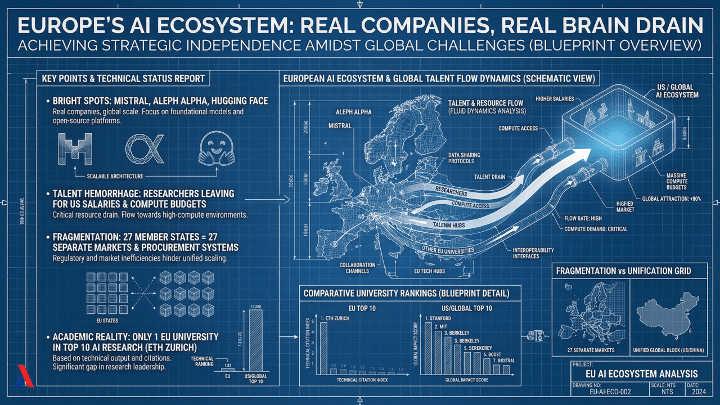
Mistral, Aleph Alpha, EigenVector, Poolside, ElevenLabs, n8n (yes, also Elevenlabs and n8n, you probably didn’t know that did you). These are real companies solving real problems at global scale. Hugging Face remains one of the most strategically important platforms in AI that forms the open-source foundation that everyone else builds on.
But Europe still bleeds talent.
The best researchers still get offers that include California salaries, less taxes (EU is 50%+), stock options, and compute budgets. Europe can’t ever compete with that, and fragmentation between 27 member states doesn’t help either. Twenty-seven member states. That means twenty-seven procurement systems. Twenty-seven interpretations of “innovation” versus one global market that moves fast.
I did a quick rundown on the leaderboard of the top 50 universities that are involved in AI. There’s only one in the top 10 (of which 6 in the USA, 3 in the UK), and that is the ETH in Zurich and the next one on the list is the Paris-Saclay University at place 26 followed by Munich TU. My Alma – Delft University of Technology, takes the 30th place.
Europe funds well, but it deploys poorly.
Until that changes, sovereignty will remain technically possible but economically very fragile.
A bunch of frameworks and a bag of cash, but where’s the vision
Europe’s late-stage immune response to realizing that it outsourced its nervous system, consists of a cocktail of plans, cash and lot’s of goodwill.
But before I go into the mesh of plans, funds, initiatives, and solemnly titled task forces, let me first address the uncomfortable question that nearly every European country (apart from ze Germans) keeps avoiding . . .
What is our AI vision? Um. . . guys?
And I don’t mean the press-release vision, Ursula et al orated in the EU version of the “state of the EUnion” in februari this year in Paris. Not the “values-led, human-centric, sustainable, inclusive” barf-invoking incantations that gets repeated until everyone forgets what problem it was supposed to solve. I mean the operating system-level vision. The thing you can draw on a napkin when you’re drunk and high on cocaine and still recognize as a coherent endgame.
Because when you look abroad, the contrast is quite black versus white. . . .
The United States: “Build God, then figure out the paperwork”
The US vision is not subtle. It never has been, and it doesn’t have to be, because at least they get things done. The American approach to AI can be summarized as “AGI first, consequences later, scale solves the rest”.
The American goal is quite explicit.
It is Artificial General Intelligence. They still believe that dominance in AI means a system that reasons, plans, and generalizes better than us humans, and replaces large chunks of human cognitive labor.
Preferably before anyone else does.
Everything aligns to that gravitational center.
- Frontier models trained at absurd scale
- Compute concentrations that resemble nation-state weapons programs
- “Stargate”-level thinking: massive, centralized compute clusters treated as strategic assets
- Capital deployment measured in hundreds of billions (not grants and vouchers as in the EU)
Regulation exists, and perhaps in the short future even a federal AI law, but only insofar as it doesn’t slow momentum. Ethics are discussed, but usually after deployment. The assumption is simple and very American (and I like it) – if we build it first, we get to define what “safe” means later.
You can hate this vision, or you can fear it, and I’m pretty sure someone in Brussels is writing ten papers about its risks.
But you cannot accuse it of being unclear.
And then there’s China.
To quote uncle Donald (apparently, in Europe we like to either refer to him as ‘daddy’ or as our ‘uncle’). . .
China, China China. “AI everywhere, including places it has no business being (not Beijing)”
China’s vision is different, but no less coherent. And personally, if I were a betting man, I would’ve put my money on their approach.
If the US wants to build a thinking god, China wants to wire intelligence into reality itself. Everything a human touches, observes, consumes, or excretes becomes a data surface.
Smart cities. Smart (dark) factories. Smart classrooms. Smart borders. Smart supply chains. Smart toilets. Yes, even those. If it produces data, AI gets bolted onto it. If it doesn’t produce data yet, sensors will be added until it does.
The objective isn’t philosophical AGI, but total systems optimization.
- AI as infrastructure, not product
- Tight integration between state, industry, and platforms
- Massive deployment at population scale
- Feedback loops that turn daily life into a continuous training signal
It’s messy, invasive, and brutally effective, and again, you don’t have to like it. But their vision is unmistakable as well.
And then there’s the EU . . .
Europe. It’s an immune response, not a north star
Now look at Europe. The land of consensus, where decisions are postponed until everyone is too tired to disagree.
You will never see a hint of a singular vision. What you will only see is a late-stage immune response to the realization that Europe outsourced its nervous system and woke up one morning unable to feel its own limbs.
Europe’s “vision”, if you can call it that, is only reactive.
Their response consists of a cocktail of plans, and cash injections, and lot’s of regulatory muscle memory, and an almost heroic amount of goodwill. There is genuine effort here. Some serious people with serious money, and serious infrastructure. But it’s not pulled toward a single gravitational idea.
It’s defensive coherence, not aspirational coherence.
Europe’s AI strategy is
- “We should probably not depend entirely on someone else’s cloud”.
- “We might want our own models, just in case”.
- “It would be nice if our laws actually applied to the systems we use”.
That’s a survival instinct, from people that are afraid to make mistakes.
And to be clear, survival instinct is better than denial. But it doesn’t inspire entrepreneurs and it certainly doesn’t attract talent, worse even, talent would rather move out of the EU – even though they’re afraid to admit it.
So what is Europe doing then?
No single north star, but a patchwork response consisting of more frameworks, disparate funding instruments, loosely coordinated infrastructure programs, and a bunch of open-source initiatives.
The logic is something like “We don’t know exactly where this ends, but we know we can’t sit still. So let’s cover as many bases as possible and hope something coherent and useful emerges from it”.
And that’s where the plans come in.
Let me go through a few of ’em.
We have:
- Plans to build compute
- Plans to unlock data
- Plans to fund models
- Plans to support startups
- Plans to regulate everything that moves
What we don’t yet have is a unifying answer to the very simple question of “what Europe wants AI to be, once it actually works”.
Now, let’s finally look at the plans.
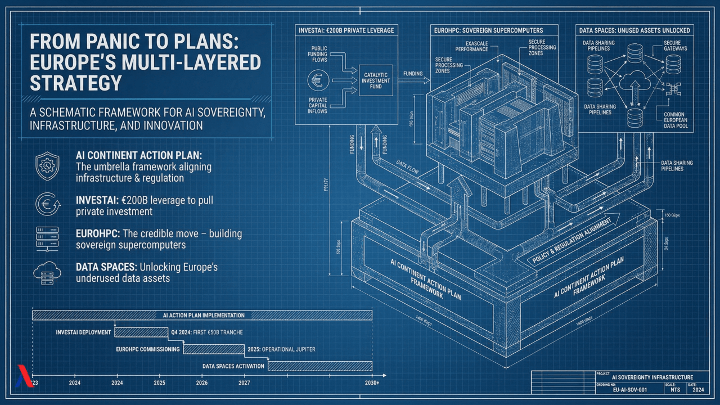
The AI (in)Continent Action Plan
What it pretends to be → A visionary, coordinated strategy to turn Europe into a global AI player
What it actually is → A panic-attack in the form of a Word file that says “We need compute, compute and more compute, and – oh yeah – some models, and um, yeah data, and talent, and let’s not forget industry, yeah, certainly industry, oh, universities – shait, we nearly forgot that one didn’t we – and we need all of it yesterday”.
This is the umbrella framework.
It tries to align infrastructure, regulation, funding, skills, and deployment across 27 member states who don’t even align on lunch.
And this pisses me off. . Europe needs to stop treating AI like a pilot and smother it in legislations, and start treating it like electricity.
And while you’re at it, also upgrade the grid.
InvestAI
What it pretends to be → €200 billion of bold investment to fuel European AI leadership.
What it actually is → A signal flare for the financial markets to please take us seriously now.
It’s not €200B of fresh cash sitting in a vault, with Ursula as the leprechaun guarding it like the dragon she is. Nah, if only. It is, however, a cocktail of EU funds, national commitments mixed with private capital of companies like ASML and a lot of optimistic accounting.
The real point is leverage. Europe is using public money as a lever to pull in private investment, make risky AI infrastructure financially survivable, and stop its best companies from immediately packing their IP and ambition and moving the company’s legal home to the United States so investors feel safer – the so-called “Delaware filing”.
EuroHPC (If you don’t own the FLOPs, you don’t own the future)
What it pretends to be → A research supercomputing initiative.
What it actually is → Europe’s only genuinely credible move in the AI arms race so far.
EuroHPC builds and operates supercomputers because someone finally realized that you cannot have sovereign AI without sovereign compute. These are the machines that train models, simulate physics, optimize grids, and quietly underpin everything serious.
This is the only initiative where Europe finally stopped talking and started bolting GPUs into racks instead.
Data Spaces
What it pretends to be → A federated, ethical, interoperable data-sharing utopia.
What it actually is → A painfully slow attempt to unlock Europe’s most underused asset (regulated, high-quality data).
Data Spaces are sector-specific pools. Health, mobility, energy, manufacturing, public services. The idea is to make data usable for AI without centralizing it or violating GDPR.
It’s elegant in theory, but in practice it means lot’s of GDPR lawyers, and intricate schemas, pallets full of governance boards, and five-hundred-year timelines. Still, if it ever works, it’s a structural advantage the US doesn’t have.
National foundation models
What they pretend to be → Patriotic AI engines reflecting local language, culture, and values.
What they actually are → Tactical hedges against total dependency on US and Chinese models.
Germany, France, Italy, Spain, Poland, Switzerland.
Everyone wants their own model now.
And soon all the provinces will want to have one as well, and before you know it every city and every village needs their own model. Not because it’s necessary, but because relying on a foreign LLM for government, defense, law, and industry is… insane.
And the sad truth behind most of these models is that they’re not even trying to win the benchmarks. They’re trying to be good enough, controllable, auditable, and locally deployable.
But hey, at least they try. And a participation trophy counts for something, right?
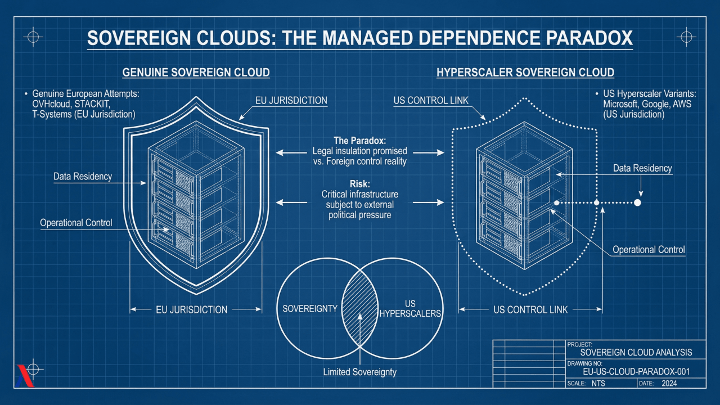
Sovereign clouds
What they pretend to be → Cloud infrastructure with European guarantees.
What they actually are → Damage control. And they’re also fake a.f.
Sovereign clouds promise data residency and legal insulation, and (some degree of) operational control for governments and critical sectors. That is, in theory they keep European data under European law, but in practice, they come in two flavors.
First, the genuinely European attempts
- OVHcloud (France)
- STACKIT (Schwarz Group, Germany)
- T-Systems Sovereign Cloud (Germany)
- Atos / Eviden sovereign offerings
These are built and operated in Europe, under European jurisdiction, with no foreign parent company quietly holding the master key.
Then there’s the second category
- Microsoft Cloud for “Sovereignty”
- Google “Sovereign” Cloud
- AWS European “Sovereign” Cloud (announced, perpetually “coming soon”)
These are US hyperscalers that pretend to be sovereign, and they’re always promising that this time, really, pinky swear, this time the lawyers have sorted it out and no one in Seattle or Mountain View can flip a switch during one of Trump’s mental breakdowns.
But even though they’re not really sovereign, they still matter. Because the alternative is that our courts, ministries, healthcare systems, and defense infrastructure runs on platforms governed by foreign law and are subject to the tantrums of El Presidente Naranja.
Open-source initiatives with “strategic” funding
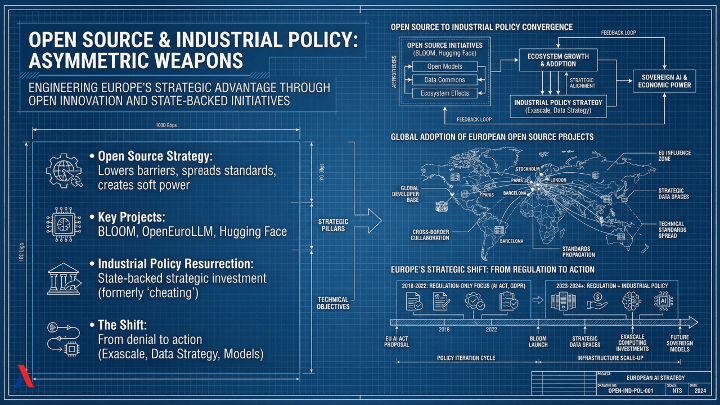
What they pretend to be → Pure, altruistic open science.
What they actually are → State-backed leverage disguised as community goodwill.
Projects like BLOOM, OpenEuroLLM, OpenGPT-X, TildeOpen, Hugging Face collaborations.
Open source is Europe’s asymmetric weapon for it lowers entry barriers, spreads standards, and prevents total platform capture, and it also creates soft power. If the world builds on your open models and tools, you influence the ecosystem without owning it.
The sudden love for “industrial policy”
What it pretends to be → A carefully considered economic shift.
What it actually is → Europe admitting the US and China were right all along.
Industrial policy in this context, means that the governments are deliberately steering the economy by choosing strategic sectors and actively supporting them with subsidies, regulation, and public investment, instead of pretending the market will magically take care of everything on its own.
Europe used to call this cheating, until chips, AI, and energy proved that not doing it was worse, and now, things like semiconductors (ASML), AI, and energy security happened. Suddenly, subsidies, strategic investment, and state coordination are back, as long as you don’t call it that too loudly. Brussels dialect helps.
“Strategic autonomy” they’re calling it. Or building “resilience”, “ecosystem enablement”.
In any case, Europe has moved from denial to action, and that alone is significant. Exascale compute is live. Data strategy exists. Foundation models are real. Startups are scaling. The stack is finally being treated as a stack, yet sovereignty is not achieved.
We are far from it.
The next five years will decide whether Europe becomes a serious AI power with its own gravity, or a well-regulated dependency zone (but with excellent documentation).
Good luck, Europe.
You’re late, but at least you’ve finally shown up to the party.
Signing off,
Marco
I build AI by day and warn about it by night. I call it job security. Big Tech keeps inflating its promises, and I just bring the pins and clean up the mess.
👉 Think a friend would enjoy this too? Share the newsletter and let them join the conversation. LinkedIn, Google and the AI engines appreciates your likes by making my articles available to more readers.
To keep you doomscrolling 👇
- I may have found a solution to Vibe Coding’s technical debt problem | LinkedIn
- Shadow AI isn’t rebellion it’s office survival | LinkedIn
- Macrohard is Musk’s middle finger to Microsoft | LinkedIn
- We are in the midst of an incremental apocalypse and only the 1% are prepared | LinkedIn
- Did ChatGPT actually steal your job? (Including job risk-assessment tool) | LinkedIn
- Living in the post-human economy | LinkedIn
- Vibe Coding is gonna spawn the most braindead software generation ever | LinkedIn
- Workslop is the new office plague | LinkedIn
- The funniest comments ever left in source code | LinkedIn
- The Sloppiverse is here, and what are the consequences for writing and speaking? | LinkedIn
- OpenAI finally confesses their bots are chronic liars | LinkedIn
- Money, the final frontier. . . | LinkedIn
- Kickstarter exposed. The ultimate honeytrap for investors | LinkedIn
- China’s AI+ plan and the Manus middle finger | LinkedIn
- Autopsy of an algorithm – Is building an audience still worth it these days? | LinkedIn
- AI is screwing with your résumé and you’re letting it happen | LinkedIn
- Oops! I did it again. . . | LinkedIn
- Palantir turns your life into a spreadsheet | LinkedIn
- Another nail in the coffin – AI’s not ‘reasoning’ at all | LinkedIn
- How AI went from miracle to bubble. An interactive timeline | LinkedIn
- The day vibe coding jobs got real and half the dev world cried into their keyboards | LinkedIn
- The Buy Now – Cry Later company learns about karma | LinkedIn

 Portfolio Marco van Hurne
Leave a comment