You prolly noticed the Cloudflare outage last week, and if you didn’t, you wouldn’t be reading my schtuff anyway. And that little glitch in the matrix got us all thinking.
Thinking about the dependencies our lil’ AI darlings have on things that support it.
Here’s a drawing some guy made on the internet, which I ran through Nano Banana for 1) IP purposes and 2) to make it nicer†
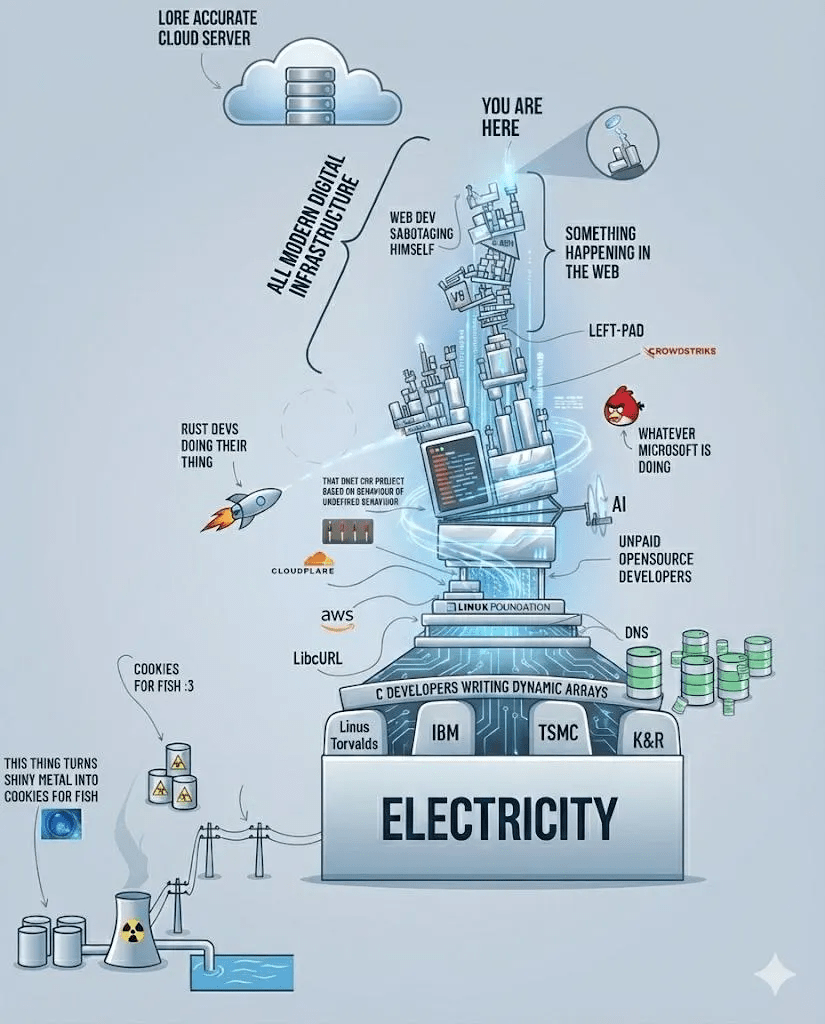
I call it the “leaning tower of PisAI” (cringe I know).
And as you can see, everything and their mothers are running on . . . electricity.
Electricity starts with a conjugated form of the word electron, that comes from the Greek ēlektron – meaning amber – which is hilarious because our entire civilization runs on a phenomenon first discovered by rubbing prehistoric tree sap like a bored caveman with ADHD.
And from that ancient static fidgeting came the universe’s favorite attitude problem of electrons forever shoving each other away, sprinting through wires like “fine, I’ll do it myself” every time you demand light, heat, TikTok, or an AI based OF model that hallucinates your name into a baked potato. Those tiny Greek-named gremlins keep the whole machine upright. No electrons, no power. No power, no AI. No AI… and you’d be back to Googling things manually like a medieval peasant, but with Wi-Fi. And it’s the closest thing we have to magic, except it’s rude, invisible, and occasionally tries to kill you. But somehow it ended up being the entire backbone of human civilization.
You flip a switch, electrons throw their hands in the air, do a little stadium wave, and boom, reality continues. Without it, everything collapses faster than OpenAI burn rate.
And since electricity has become such a powerful driver of our world, there is talk of turning it into . . . . currency.
Yes, money.
Plata (in narco-lingo).
Geld (pronounce like you’re clearing your throat, unless your German).
Argent (the fancy version).
Raha (Finnish, sounds like something you have to scrape off the floor afterwards).
Pecunia (though it does smell)
† The original image is from this linkedin post. (See, I’m not such a bad prick after all).
More rants after the messages:
- Connect with me on Linkedin 🙏
- Subscribe to TechTonic Shifts to get your daily dose of tech 📰
- Please comment, like or clap the article. Whatever you fancy.
Civilization’s universal currency
In the past, and even in todays (fast-pacing 🤣) world, currency is a polite word for stuff we sweated over. Before fiat money or our shenanigans with crypto coins, value was stored in things that required real work. People converted their energy into grain, livestock, gold, horses, and, sometimes other human beings (like, slaves). The ancient economy was actually a sort of a “LinkedIn”, but with chains.
These were the OG productive assets. It was a straight pipeline between human misery and stored value.
But when you walk around a city, especially cities in the far east, you see power everywhere. Charging stations on every corner, including deranged 1 MW monsters. There are electric cars and trucks buzzing around. Trucks hauling batteries to scooter shops, scooter shops selling electric scooter to the Uber eats people and those guys are multiplying like fungi after rain. The whole place hums like someone plugged the city into a cocaine drip.
Everything moves on electricity. Duh.
Heavy industry slurps down electricity. All my gadgets are powered by it. Heck, if the power was suddenly cut, 90% of the stuff in my house would be worthless. And now, with AI sucking megawatts like a hungry bear at a picnic serving brie sandwiches with walnuts and honey (hmm, maybe I should’ve eaten first before writing), nearly everything gets processed by LLMs that ultimately translate human thought into. . . heat.
And since electricity maps so brutally directly to everything we build, break, or pretend to innovate, it more or less turns into civilization’s universal currency.
Simple. Brutally logical.
Physics doesn’t lie, politicians do.
Electricity is measurable, it is divisible, storable, and above all, it is universal. It’s actuall all things a currency should be, except this one actually ties directly to productive output instead of psychology and campaign promises.
Now that we’ve vaulted into an all-electric, all-digital era, that old relationship between work and value is creeping back, but this time it has a new metric, the kilowatt-hour. The robots, Teslas, AI models, and server farms all dine on one thing , and it’s not innovation or hope, it is pure electricity.
And lot’s of it.
And without it lot’s of people die. Read: Icarus bought Wi-Fi and now we won’t have to worry about AI anymore So yes, the kWh is the new base layer.
The petro-dollar can sit down. The electro-dollar just walked in, ate its lunch, and asked if anyone had dessert. Yes, with two s’es.
He who controls electricity
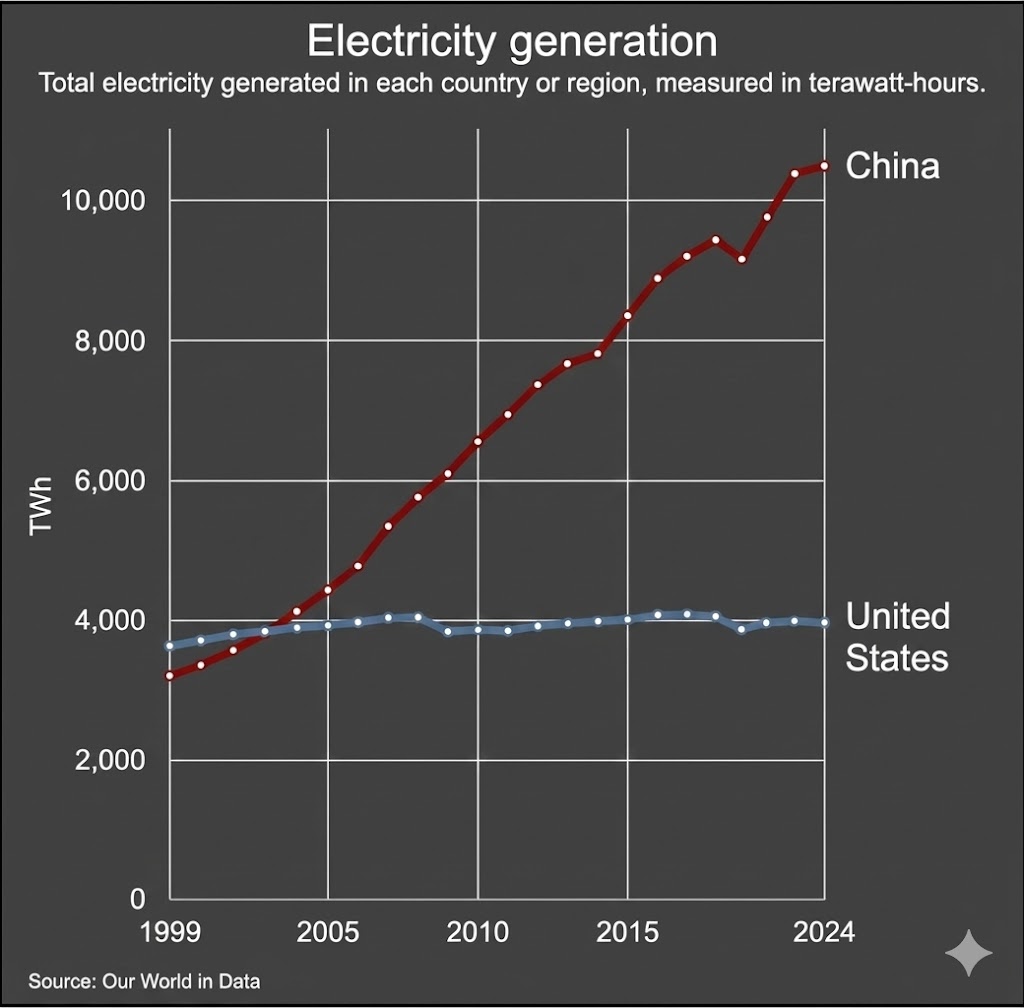
This post-o-mine, isn’t an academic thought experiment if that’s what you were thinking. Because it looks suspiciously like the operating manual of China’s entire strategy.
See, us in the West are all busy arguing over whether crypto is liberation or gambling, if the CDBC is going to screw our personal liberties, but them lil’ peeps in China are speed-running the “electricity is everything” playbook, but with utterly ruthless efficiency.
Now, what China is doing is actually very basic, almost embarrassingly so. They looked at the modern world and though everything runs on electricity. Cars, factories, phones, AI models, hospitals, trains, mines, all of it.
So they made a decision “If everything runs on electricity, then whoever controls electricity… controls everything”.
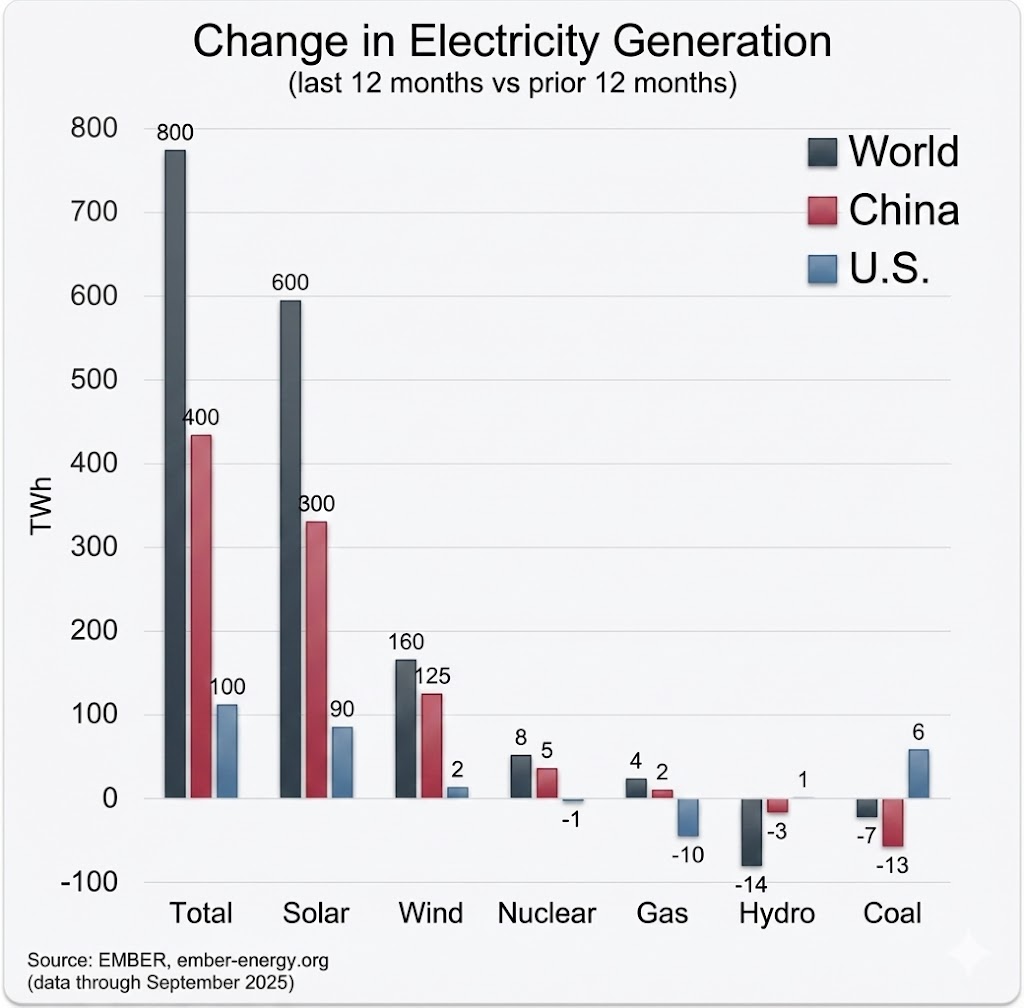
So here’s the child-proof explanation. China is treating electricity the same way old empires treated gold. They’re building gigantic amounts of power, like insane levels, way more than they need right now. Solar, wind, nuclear, hydro – if it generates electrons, China is installing it by the square kilometer.
They control the grid.
Not “regulate”.
Not “influence”.
I mean “control”.
Fully.
Like a parent holding the Wi-Fi password while you beg to finish Fortnite.
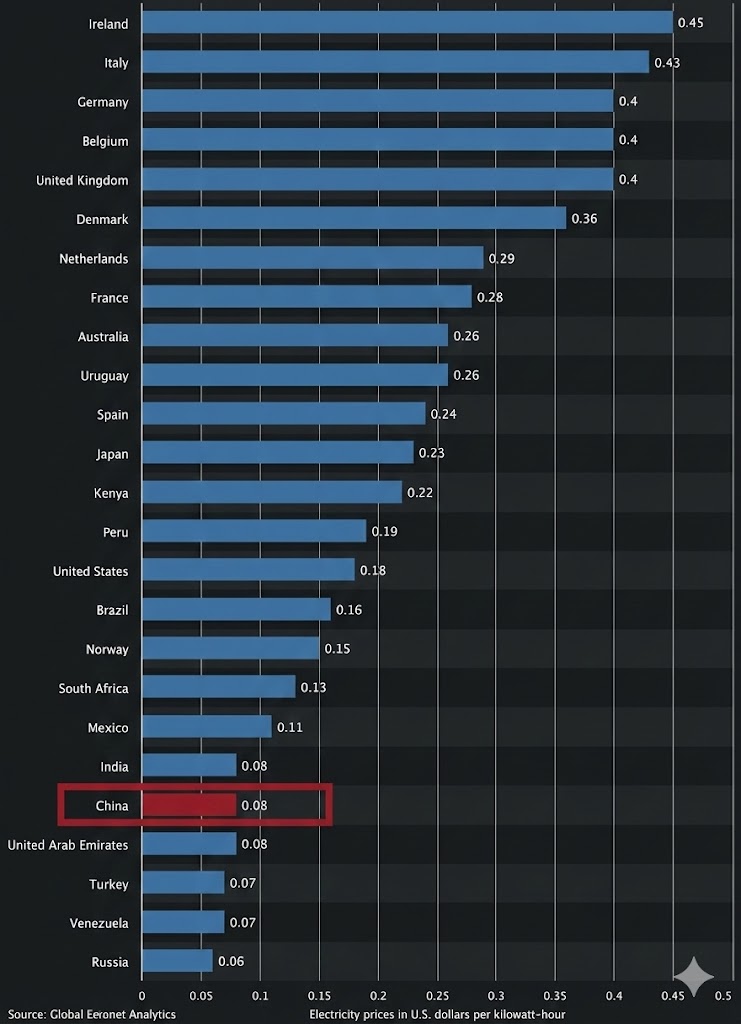
Then they decide who gets cheap electricity and who doesn’t.
- High-tech industries. Cheap power.
- AI companies. Dirt-cheap power.
- Chip manufacturers. Practically free.
- Wasteful industries and peeps they don’t like. Price goes up, hasta la vista baby.
They turn electricity into a reward system. A steering wheel. A national joystick if you may.
But then comes the fun part, crypto mining burned too much electricity. So they banned it. Because in their eyes, crypto was literally wasting their new “currency” – electricity – to create imaginary coins that compete with their own digital yuan.
That’s like someone raiding your fridge to make ice cubes shaped like cartoon ducks.
Annoying, and utterly pointless, and it is using your power bill.
So China shut it down and redirected that electricity into things that actually build national power, like AI, chips, batteries, manufacturing, export dominance.
So, China is printing money, but the press runs on gigawatts. And since they own the press, the plugs, the wires, and the factories that make the wires, and the people who run the factories, they get to decide who gets rich doing what in the 21st century.
Meanwhile, us doofuses in the West are out here yelling about crypto scams, CBDC conspiracies, and whether Donald’s latest tweet is market manipulation.
China is building an empire-by-Voltage
China is very quietly, wiring half the planet into a gigantic, humming web of dependency that only flows in one direction. And the thing is, they’re doing it with such calm, and surgical precision that most countries don’t even notice the leash being wrapped around their necks until the clasp clicks. And to understand it, you have to picture how the West used to run the world, with oil pipelines, military alliances, corporate deals scribbled in smoke-filled rooms, and a lot of “stability” that somehow always looked suspiciously unstable.
Now, China looked at that entire fossil-soaked mess and decided to skip the bloodshed and go straight for the power supply.
Literally.
They have decided to not export ideology, tanks, or cinematic drone footage of freedom, but China exports entire electricity systems. Not panels. Not turbines. Not random gear dumped on a dock. No, bro, they export complete, fully integrated, can’t-live-without-it electricity ecosystems that burrow into a country’s infrastructure like polite cybernetic vines.
Yes. They export electricity grids.
Say, you’re on a sun-scorched African plateau, and after driving a few miles, you suddenly come across a solar farm that’s so big they make airports look tiny. Every square meter of it is assembled by Chinese engineers, financed by Chinese banks, maintained with Chinese hardware, and monitored through Chinese software. Now you’re in a humid Southeast Asian valley and it gets carved open for a new hydro project, with the dam’s concrete stamped by a state-owned enterprise and every bolt, cable, and sensor is reporting its health straight to someone in Beijing who definitely doesn’t believe in democracy as an operating system.
Now scale that everywhere.
Next you have an “empire-by-voltage”.
When China builds your energy infrastructure, it gives you the ability to turn the lights on, on their terms. They design the grid, the cables, and they train the technicians, they supply the spare parts, issue the software patches, provide the financing. They know where every substation is, which transformers groan under stress, which lines are near collapse, and which political crisis might push you to ask for another “emergency loan”. And because electrons don’t care about ideology but do care about hardware compatibility, once you pick a supplier, you’re locked in.
And this is the genius of it.
China doesn’t have to invade anything.
It just has to show up with a smile and a grid-level IKEA kit the size of a small country, and once the system is installed, the dependency is permanent. It’s an umbilical cord disguised as economic development. Ok, you get clean energy, modern infrastructure, national pride, and a slight background hum that reminds you your sovereignty now comes with terms and conditions written in technical Mandarin.
And we in the West – and specifically in the EU – write laws about AI and ethical “values”, but we’re completely missing that China’s real export is electrical continuity.
They give countries the one thing every modern society needs more than anything, a stable, and cheap flow of electricity. And any nation that accepts that gift finds itself physically, economically, and politically wired into Beijing’s sphere.
The dawn of the electro-states
China is not creating partners, it that’s what you were thinking. . .
It is creating what I call Electrostates. These are nations whose beating heart runs on Chinese circuits, whose industry depends on Chinese maintenance schedules, and whose energy sovereignty is only as sovereign as the next loan repayment.
They don’t need bases. They don’t need coups either. And they certainly do not need diplomats threatening everybody with sanctions like the ol’ guard in the West. They just need you to keep the power on. And if the day ever comes when Beijing wants something, well, let’s just say that flipping a switch is a cleaner negotiation tactic than sending an aircraft carrier.
That’s the part nobody in the West seems to grasp.
We argue about crypto, culture wars, and who controls the central bank, but China is very quietly installing the century’s most powerful geopolitical mechanism, a world that literally cannot function without Chinese electrons.
And the lights stay on – until Beijing says otherwise.
Signing off,
Marco
I build AI by day and warn about it by night. I call it job security. Big Tech keeps inflating its promises, and I just bring the pins and clean up the mess.
👉 Think a friend would enjoy this too? Share the newsletter and let them join the conversation. LinkedIn, Google and the AI engines appreciates your likes by making my articles available to more readers.
To keep you doomscrolling 👇
- I may have found a solution to Vibe Coding’s technical debt problem | LinkedIn
- Shadow AI isn’t rebellion it’s office survival | LinkedIn
- Macrohard is Musk’s middle finger to Microsoft | LinkedIn
- We are in the midst of an incremental apocalypse and only the 1% are prepared | LinkedIn
- Did ChatGPT actually steal your job? (Including job risk-assessment tool) | LinkedIn
- Living in the post-human economy | LinkedIn
- Vibe Coding is gonna spawn the most braindead software generation ever | LinkedIn
- Workslop is the new office plague | LinkedIn
- The funniest comments ever left in source code | LinkedIn
- The Sloppiverse is here, and what are the consequences for writing and speaking? | LinkedIn
- OpenAI finally confesses their bots are chronic liars | LinkedIn
- Money, the final frontier. . . | LinkedIn
- Kickstarter exposed. The ultimate honeytrap for investors | LinkedIn
- China’s AI+ plan and the Manus middle finger | LinkedIn
- Autopsy of an algorithm – Is building an audience still worth it these days? | LinkedIn
- AI is screwing with your résumé and you’re letting it happen | LinkedIn
- Oops! I did it again. . . | LinkedIn
- Palantir turns your life into a spreadsheet | LinkedIn
- Another nail in the coffin – AI’s not ‘reasoning’ at all | LinkedIn
- How AI went from miracle to bubble. An interactive timeline | LinkedIn
- The day vibe coding jobs got real and half the dev world cried into their keyboards | LinkedIn
- The Buy Now – Cry Later company learns about karma | LinkedIn


 Portfolio Marco van Hurne
Leave a comment