You know I spend my days implementing AI in organizations, with like real teams, real people, real processes to transform, and often times real political minefields as well, and when you’re ten feet deep in the mud, there’s one thing you learn very quickly. . .
Everyone is at a different stage of the adoption journey.
Some people jump straight in like they’ve been waiting for this moment their whole lives. Others treat AI like a suspicious free sample you get at the supermarket. And a few… well, let’s just say they’re still looking for the “Any Key” on the keyboard.
Because AI adoption takes time.
It is messy. It is also emotional. And it definitely doesn’t happen in one straight line. But after working with a ridiculous number of people across different industries, patterns start to appear. Clear steps. Predictable stages. And also these moments when someone suddenly “gets it”, and moments where someone announces, with full confidence, that “AI can’t do that”, right before the AI does exactly that.
So in this piece, I wanted to map out those stages, the real progression I see in the wild.
Not theory. Not wishful thinking. And certainly not the usual corporate yada yada, just the actual journey people go through as they go from “What the hell is this?” to “I can’t work without this anymore”, like myself.
And after watching so many different people move through these stages, a clear pattern started to emerge, and I shaped that pattern into four major leaps, and each leap contains a few – let’s call them levels for lack of a better word – and in total, there are ten levels you can grow through as a practitioner.
Those 10 levels I describe below are my attempt to capture that whole spectrum, from the AI-unaware, to the skeptics, to the dabblers, and all the way to the people building workflows that make the rest of the team question their career choices. And if you find yourself somewhere low on the ladder, well, don’t worry, everyone starts somewhere.
Some just take… let’s say… the scenic route.

More rants after the messages:
- Connect with me on Linkedin 🙏
- Subscribe to TechTonic Shifts to get your daily dose of tech 📰
- Please comment, like or clap the article. Whatever you fancy.
THE AWAKENING (Levels 0–1)
This is how it starts. This is where people slowly wake up to the idea that AI exists, even though it has been running half their apps for years, like their spam filter, their robot vacuum at home, the autocomplete they’ve come to hate, and their Netflix account they’ve come to love. You can already see the separation starting when some people lean in, curious and willing, while others cling to the familiar like a little kid holding onto mommy in a big mall. And in this early phase, your job is mostly explaining that yes, AI is real, and no, it’s not just “that thing from the movies”.
As a practitioner, expect confusion. Expect denial. Expect that thousand-yard stare people get when they realize their phone has been smarter than them for years.
Level 0 – The unaware
The unaware are the people who live in a world full of AI and manage to miss every single sign of it. They are usually somewhat older, late in their career. I have worked with large groups of them when I was teaching an AI literacy course to a large group of volunteers, and the pattern was always the same. They were kind, dedicated, hard-working people, but completely disconnected from how much automation had already seeped into their daily life, and their tools at work. They would talk about AI as if it lived far away, somewhere in tech companies and laboratories, while using software that was already predicting, correcting, filtering, translating, and classifying every click they made.
The transition starts by making the invisible visible through concrete demonstrations of AI already embedded in familiar tools such as email autocomplete, document summarization, navigation apps, and on their telephones.
They aren’t resisting change though, and they certainly aren’t hostile. They were simply the unaware, who are floating comfortably in their familiar routines, and not realizing how much the ground had shifted underneath them. And once that realization hit them – sometimes by their kids, grandkids or by me – you could almost see the internal rewiring start.
Some adjust quickly, while others need more time. But the starting point is always a calm, innocent unawareness in a world that had already moved several steps ahead. I personally like the “unaware” because when you’re wielding them in, slowly, you can feel their gratitude.
And this ‘persona’ is the total opposite of the next.

Level 1 – The skeptical observer
The skeptical observer knows that AI exists. They have heard the buzzwords and read the headlines about jobs disappearing and tools evolving, but their default posture remains arms crossed and emotionally detached. They talk about AI as if it is a temporary fad that will fade once the hype settles – it’s a comforting belief that keeps their worldview intact – but comfort has never stopped a technological shift, and while the world moves forward, they remain rooted in place.
They also tend to avoid changing the way they work.
They stick to the tools they know and the routines they trust, even if those routines take much longer. Their skepticism isn’t dramatic, but more quiet and practical. They just don’t see a reason to switch to something new when the old way still feels safe. But while they stay in their comfort zone, everyone around them slowly moves ahead, and the gap becomes bigger without them noticing.
What I do to wheel them in is that I keep everything very small and practical and avoid big stories about the future, but instead I show them something they already use and explain how AI quietly supports it, after that I give them one tiny action they can try on their own so they can feel a small success, and once that moment lands their fear fades and their awareness starts to grow.
To help them get into prompting I tell them to talk to the AI the same way they talk to their kids when they want something done because the tone the clarity and the simple instructions are almost identical which makes the whole thing feel natural instead of strange. Another trick, that I teach them later on, is to simply ask ChatGPT to be creative, to interpret your idea and create a prompt for you.
You can also build their motivation by talking openly about people’s worries about for instance job losses, and the fear of privacy, so explain in plain language how privacy and oversight are handled, show them that you use AI yourself so they know it is okay to try, and create a space where mistakes are normal and part of learning. I always have them start with small, low-risk tasks that let them experience one easy win so their skepticism can slowly turn into interest.

EXPERIMENTATION (Levels 2–3)
When you have dealt with the obstacles from the first phase, you’re now entering the stage where curiosity wins. People finally gather the courage to click the little chat icon. No pressure, no expectations, just “let’s see what happens”. You’ll see the first sparks of excitement like “holy shit this works”, and the first accidental masterpieces that start to fuel their enthusiasm.
I call this the playground stage, and it is messy, chaotic, full of surprises, and above all it’s joyfull. And the nice thing is that you can bring almost anyone along at this stage if you keep it light.
Treat them the way you would treat kids who are trying a new game. You know, you show one small thing and let them copy it and play with it a bit. No pressure. Just a few small, safe steps.
And when they see that something works with their own hands, you see the fear drops instantly. And even though their skills are still basic, the mindset shift has begun. They’ve crossed the psychological threshold.
The fear is fading.
Now, the fun is starting.
Level 2 – The curious dabbler
At this stage people have moved past their initial skepticism and finally decide to try AI for themselves. They click the chat box, test a few simple prompts, and are often surprised when it actually works. Their understanding is still shallow, and they don’t yet know what the tool can or cannot do, but they feel a first spark of interest. Their confidence is low, their results are inconsistent, and they are unsure when to trust the tool. But all in all, their curiosity is stronger than their fear, which makes them open to small steps forward.
You can help them grow by giving them clear and simple examples they can copy before they try anything new.
Keep the tasks small and connected to their real work so they immediately see value, show them basic prompt patterns they can reuse, and stay close enough to remove friction quickly when they get stuck. Let them practice in short, low-pressure bursts instead of long sessions, and create an environment that feels relaxed, safe, and supportive so they are not afraid of making mistakes or looking inexperienced.
A very effective support method at this stage is peer pairing, especially pairing an older employee or an executive with a younger digital-native colleague. Both sides benefit: the senior person brings experience, domain knowledge, and real-world context, while the younger person brings confidence, tool familiarity, and a natural comfort with experimentation. Together they learn faster, stay motivated, and reinforce each other’s progress.
Personally I like this stage because people start to loosen up a little and you can see their mindset opening in real time, and once they feel one small win their curiosity takes over and the whole learning process becomes lighter, more natural, and much easier to guide.

Level 3 – The occasional user
We’re still working with beginners here, just a bit further along. The ‘occasional users’ as I have started to call them, are people who have tried AI, liked some of what they saw, but haven’t really turned it into a habit . . yet. They use it only when they remember or when a task becomes annoying enough to push them toward the tool. Their prompts are still inconsistent and their results are inconsistent too, which makes it easy for them to slip back into their old ways of working.
Though they now see that AI has value, it hasn’t reached the point where it feels natural or automatic, so the tool stays on the side instead of becoming part of their daily workflow.
To help them move forward, try giving them a few simple use cases that fit directly into the work they already do, and keep these use cases small, clear, and predictable.
Give them one basic prompt structure they can use again and again so they don’t have to guess their way through each request. Yes, I still have them build lists of example prompts. But this is just a temporary measure to build confidence.
You get them to choose two or three weekly tasks where AI should always be used, and you get them to follow up on it, and you reinforce this rhythm with reminders or prompt-help.
In one case, I set up a small help point so people could get quick support the moment they hit friction, which kept them from getting discouraged, and I made sure to show them the time or effort they saved so the benefits felt real and personal.

INTEGRATION (Levels 4–5)
I call this phase the “integration” phase because this is where AI becomes part of someone’s normal way of working instead of something separate or occasional.
AI now fits into their daily tasks, routines, and thought process, and it blends naturally with the tools they already use. They’re trying it in their private lives, and they’re also actually using it as a regular part of getting work done. And here you can see their confidence grow because the tool finally delivers consistent value, and the goal in this phase is to help them strengthen those early habits, expand their skills, and make AI a stable, dependable part of their daily workflow.
You can spot people in this phase by one simple sign, that they actually get things done.
Level 4 – The regular practitioner
At this level, people use AI several times a week and it becomes part of their normal work routine. They know which tasks AI is good at and they feel more confident asking it for help. You can tell they are a ‘regular practitioner’ because heir results are more consistent since they know how to give clear instructions. AI saves them time, reduces effort, and helps them think more clearly.
They are not advanced yet, but they have reached a solid, reliable level where AI is no longer new or strange. It is simply a useful tool they trust.
People at this stage are easy to support because they already see the value and only need guidance to deepen their habits.
You can help them grow by giving them a few stable prompt patterns they can rely on for writing, planning, and summarizing. What I sometimes do, is offer intermediate prompt clinics where they learn how to break a task into small steps so the AI can support them more effectively.
Again, you provide them with workflow templates they can reuse so they don’t have to reinvent their process every time, and make AI easy to access by integrating it directly into the tools they already use.
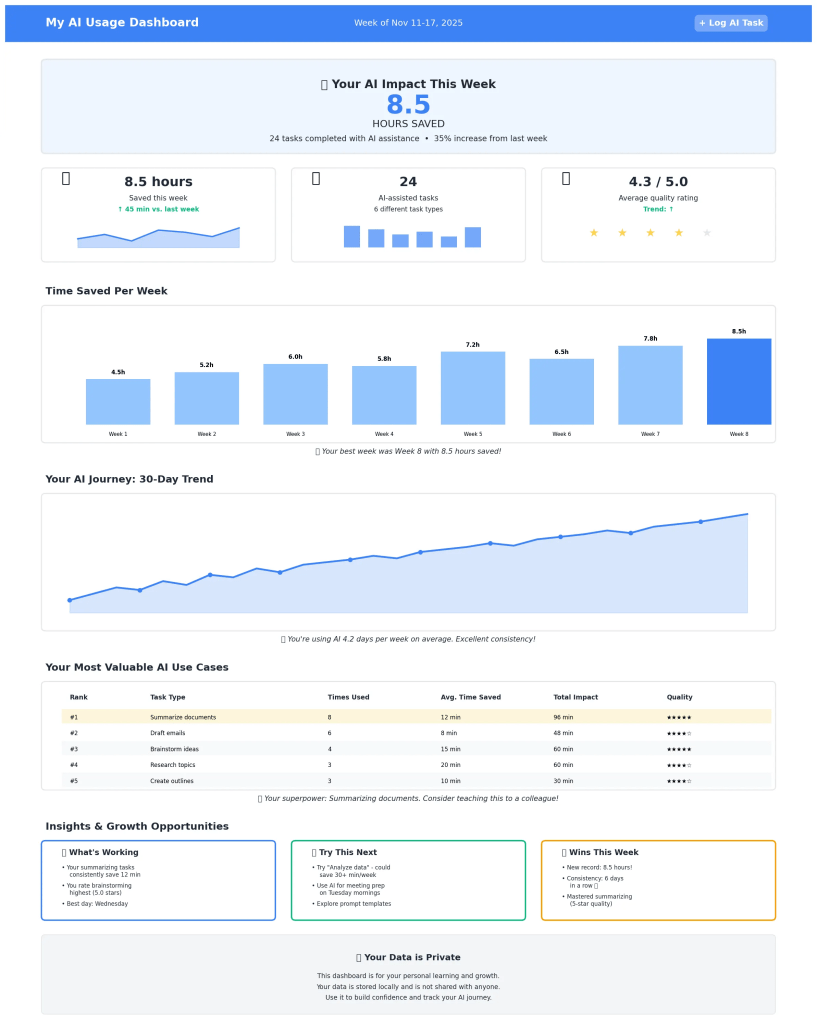
And to keep them motivated, show them simple numbers like time saved or improved clarity using a basic usage dashboard. But hold your horses, keep it extremely simple. You don’t need fancy analytics. The goal is to give people a quick, motivating snapshot of the value they’re getting from AI.
This is a clean example of a dashboard that I use. I built them in Manus, but you can use any vibe coding tool out there, you’re comfortable with. It’s easy:
[if you want to receive the ‘prompt’ for this dashboard, just send me a DM]
This dashboard ultimately makes the benefits feel real and personal.
And there’s one other thing to do, which is to strengthen their routine by pairing them with someone at the same level so they can trade examples, share tips, and reinforce each other’s habits. Together, these techniques help them move from casual use to confident, stable, and consistent practice.
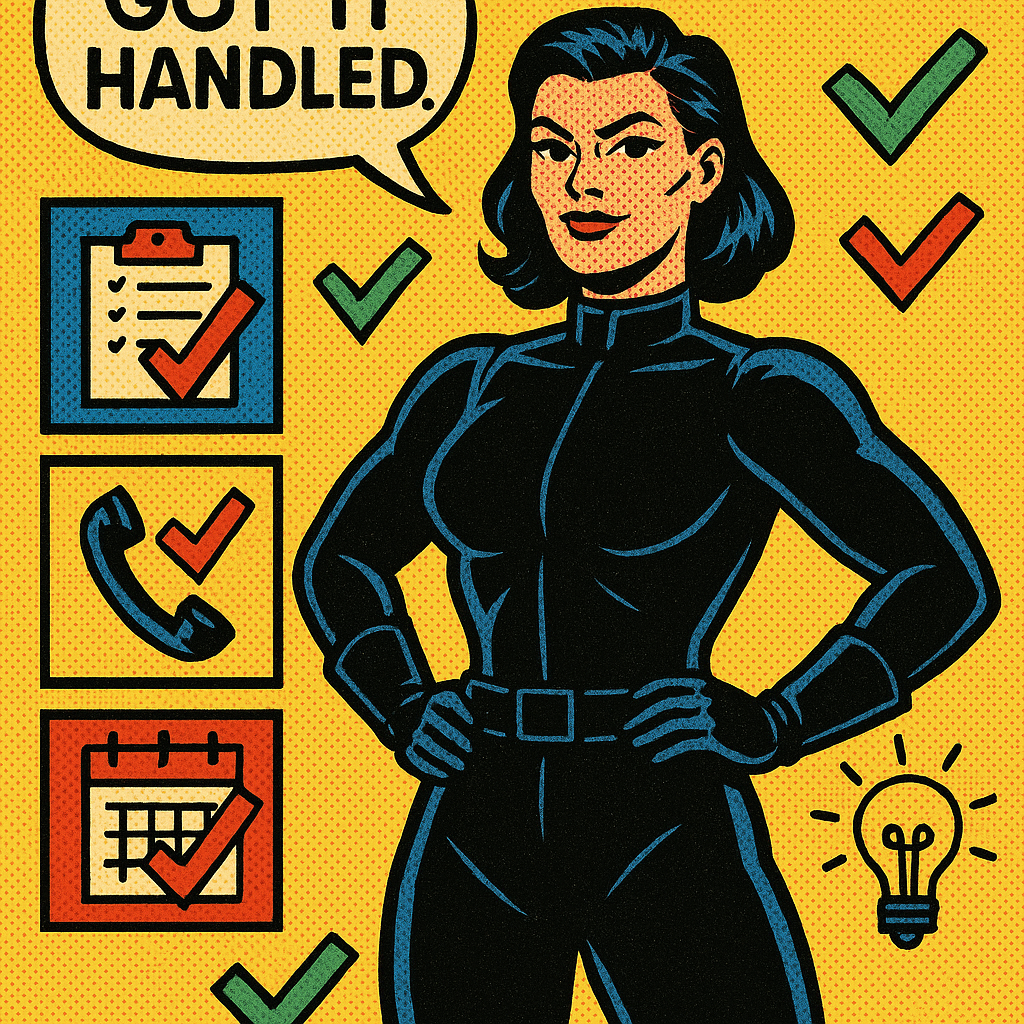
Level 5 – The AI-First professional
The people at this level begin their work with AI instead of adding it at the end.
They naturally think, “How can AI help me with this”, before they start writing, planning, analyzing, or preparing anything.
AI is part of their thinking process, and not a tool they grab when they are stuck. They work faster, create clearer output, and feel more confident because they understand how to give good instructions and how to correct the model when needed. They also recognize limits and know when a task requires their own judgment instead. AI is normal and reliable to them, and this shift gives them a strong daily advantage in both speed and quality.
There’s not a lot you have to do, they’re the ones that grab a coffee and finish your tasks before they drank it. But if you want to support people at this level, you help them expand their toolset and strengthen their habits. You can introduce them to new AI tools so they learn that different tools fit different jobs, and show them simple ways to break larger tasks into smaller steps so AI can support each part more effectively.
At this stage I also slow people down a little. Yup.
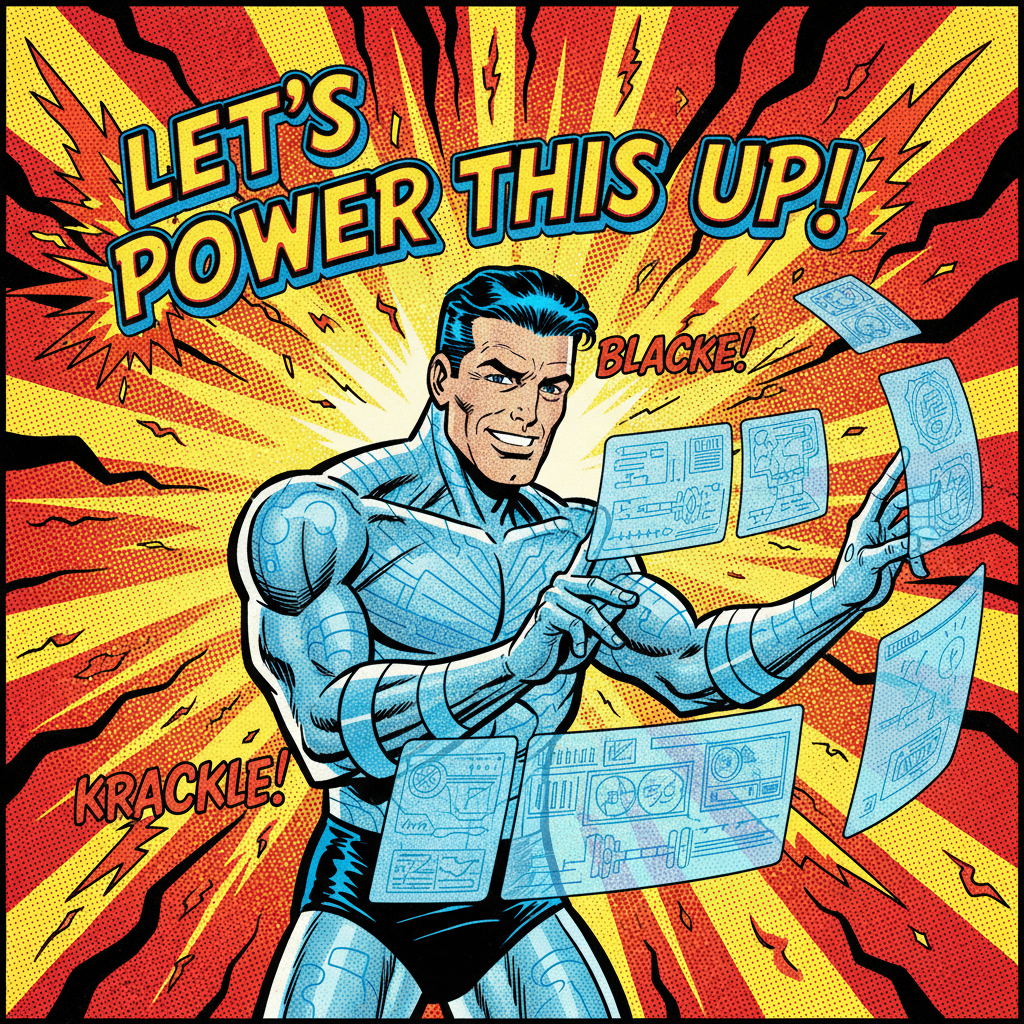
And that’s because once they discover how powerful AI can be they sometimes swing too far in the other direction and rely on it for everything without checking the output. I know this behavior well from my own experience, when people stop reviewing what the AI produces, the content becomes something they don’t fully understand, the quality drops, and errors slip in unnoticed. This problem is small when we talk about short emails or internal messages, but it becomes serious when they use tools that generate full slide decks, complete documents, or even entire websites. At that point they must stay critical and stay in control.
So I teach them to bring their own thinking back into the loop. I show them how to apply simple review cycles, where they read the output once for structure, once for accuracy, and once for clarity. You get them to check their sources, asking the AI to list where information comes from, and verifying the key points independently. I also teach them to use “reverse prompts”, where they ask the AI to explain the content back to them in simple terms, so they can see quickly whether it makes sense.
Another useful technique is spot-checking, where they check only the most important paragraphs, numbers, or claims instead of reviewing everything line by line.
This keeps the workload small while still maintaining quality. And for tools that create entire PowerPoints or websites, I give them a simple rule, always edit the outline manually before accepting the final version. This forces them to stay engaged and make sure the story, structure, and message remain theirs.
All in all, the goal is to help them combine the speed of AI with their own judgment. They stay fast, but they stay responsible. They use AI confidently, but not blindly. They create more, but they keep ownership of the result.
OPTIMIZATION (Levels 6–7)
In this phase people move beyond basic use and begin reshaping the way they work with AI at the center. They build new workflows, websites that help them perform tasks and turn slow processes into fast, streamlined systems.
Tasks that once took hours or days become quick, repeatable steps. Creativity and efficiency come together, and the impact becomes visible in the quality and speed of their work. Instead of thinking about what AI can do for them, they focus on how to redesign their entire workflow so everything runs smoother, smarter, and with far less effort.
These guys might just surprise you with their latest inventions.
And here’s how to work with them.
Level 6 – The strategic integrator
This person is someone who no longer thinks in single tasks but in whole systems. They step back and look at the full picture of how work flows through their team or department, and they immediately spot the pieces that can be improved with AI. They redesign processes so that AI handles the repetitive steps, tools talk to each other, and information moves automatically instead of getting stuck in inboxes or spreadsheets.
They connect systems through MCP, build small automations in n8n, set up research crawlers, and create internal websites or mini-tools that support daily work.
These are the early adapters, and they’re curious, practical, and fast thinkers who test ideas quickly and pick the ones that work. They enjoy solving bottlenecks and removing friction for themselves and others. When something is slow, they redesign it. When something is manual, they automate it. When something is unclear, they build a simple interface on top. Their work often delivers immediate value, which makes them highly visible inside an organization.
If (at all) you feel the need to support them at this level, you give them the freedom to experiment and the resources to test ideas without crashing the whole company.
Offer sessions where they can learn basic workflow mapping and where they explore how different tools can be chained together. Let them join small groups with others at the same level so they can exchange patterns and shortcuts, and provide a sandbox environment where they can build without breaking anything live. I encourage short demo moments where they show what they created, because sharing their solutions helps them refine their thinking and inspires the rest of the organization.
All in all, the Strategic Integrator is someone who transforms AI from a personal helper into a system-wide engine. They are the bridge between everyday users and the builders who come after them.

Level 7 – The AI architect
The AI Architect goes a step beyond redesigning workflows. They start creating tools themselves, AI-assistants, and small internal systems that other people in the organization can use.
They’re the vibe-coders, and they think like builders. When they see a repeating task, they not only automate it, but they create a reusable scalable solution as well.
When they see colleagues struggling with the same problem, they design a simple interface, a custom GPT, or an internal agent that solves it for everyone. They work with no-code and low-code builders, MCP-based setups, and platforms like the GPT Builder, Gemini Gems, or lightweight agent frameworks. Their focus shifts from “How do I work faster” to “How do we work better as a group”.
An AI Architect understands patterns. They know how to turn messy workflows into clear steps, how to design logic that others can follow, and how to combine different tools into a unified experience. They care about ease of use, predictability, and stability. They refine their prototypes, test them with colleagues, collect feedback, and adjust until the solution is simple enough for anyone to use. The things they build often become the foundation for team-wide productivity gains.
These people do need support, but on a totally different level. You give them access to builder tools and a safe environment to test without risking production systems. You offer sessions on user-friendly design so they learn how to make their solutions easy and intuitive.
Important here is to encourage them to document what they build in a clean, simple way so other teams can adopt it.
Pair them with small groups of real users to test their prototypes, because this feedback loop turns them from clever tinkerers into true solution designers. And give them space to show their tools to the organization, since sharing their work not only improves their designs but inspires the next wave of builders. All in all, the AI Architect turns personal creativity into shared value. They build the tools that lift the entire organization, not just themselves.
INNOVATION (Levels 8–9)
This is the summit where people stop reacting to AI trends and start shaping them. They lead adoption. They guide strategy. They build new capabilities that didn’t exist before. These are the catalysts of change. They influence executives, their teams, their organization, and sometimes whole industries. And while not everyone needs to reach this level, every company needs a few people who do.
Level 8 – The AI strategist
The AI Strategist looks far beyond tools, prompts, or workflows. They think in terms of the culture, the skills, the processes, the risks, and the long-term direction. They see where teams struggle, where adoption slows down, where the biggest value sits, and where friction blocks progress. They turn scattered AI activity into a coordinated plan.
An AI Strategist connects people, teams, and systems.
They map out how AI fits into the business, define which skills the workforce needs, and identify the changes required to make AI part of everyday work. They translate high-level ideas into practical roadmaps, showing what to build, what to buy, what to train, and what to stop doing. They think about governance, sovereignty, security, privacy, data readiness, and long-term impact. They are also good at communicating, because they must explain AI in a way that makes sense to executives as well as frontline workers. Their goal is to make AI adoption sustainable and meaningful, not chaotic and accidental.
To support someone at this level, give them access to leadership discussions, real business data, and the space to analyze how work flows across departments. Offer them training in change management, communication, and organizational design, because their role depends on influencing people who do not report to them. Pair them with senior leaders so they learn how strategic decisions are made, and let them shadow cross-functional AI initiatives to see how different parts of the business connect. Encourage them to run small pilot programs where they test their ideas in the real world and refine them based on what actually happens, not just what looks good on paper.

Level 9 – The AI engineer / builder
The AI Engineer is the person who goes deep into the technical side of AI. They understand how models work, how data flows through systems, and how to shape AI to fit the needs of the organization. These people work with real model behavior, fine-tuning, evaluation, reliability, and integration with backend systems.
An AI Engineer builds new AI-based systems. They can build custom agents, connect APIs, design data pipelines, and improve model quality through prompt optimization, fine-tuning, or retrieval. Their mindset is focused on building new capability, not just using what exists.
Usually you won’t get them in your AI adoption classes, but when your goal is to offer company wide support, and you wish to support someone at this level, give them structured learning time to deepen their technical skills in new technologies, machine learning, model evaluation, etc.
I always give them a day in the week to work on their own ideas how they think their knowledge can benefit the organization. And I provide them with a sandbox where they can test, break, and rebuild stuff without risk to production systems. Let them work on meaningful problems that require real engineering solutions, not just isolated experiments. Encourage them to document their setup, share their methods, and teach others how to maintain what they build, because good engineering depends on clarity and continuity.
Wrapping it all up
By the time you’ve walked through all ten levels, you start to see the real story behind AI adoption. It’s not about intelligence, age, background, talent, or job title. It’s about readiness, curiosity, safety, practice, and the willingness to adapt. People all move at their own pace, sometimes fast, sometimes slow, sometimes in little jumps, sometimes in big leaps. But when you look closely, every person follows the same underlying arc from unaware, to cautious, to curious, to confident, to creative, and finally to strategic and technical mastery.
I enjoy working with people and helping them build these skills, and I’m pretty sure you will too. And if you recognize yourself in one of these levels, let me know in the comments, I’m curious where you are on the journey.
Signing off,
Marco
I build AI by day and warn about it by night. I call it job security. Big Tech keeps inflating its promises, and I just bring the pins and clean up the mess.
👉 Think a friend would enjoy this too? Share the newsletter and let them join the conversation. LinkedIn, Google and the AI engines appreciates your likes by making my articles available to more readers.
To keep you doomscrolling 👇
- I may have found a solution to Vibe Coding’s technical debt problem | LinkedIn
- Shadow AI isn’t rebellion it’s office survival | LinkedIn
- Macrohard is Musk’s middle finger to Microsoft | LinkedIn
- We are in the midst of an incremental apocalypse and only the 1% are prepared | LinkedIn
- Did ChatGPT actually steal your job? (Including job risk-assessment tool) | LinkedIn
- Living in the post-human economy | LinkedIn
- Vibe Coding is gonna spawn the most braindead software generation ever | LinkedIn
- Workslop is the new office plague | LinkedIn
- The funniest comments ever left in source code | LinkedIn
- The Sloppiverse is here, and what are the consequences for writing and speaking? | LinkedIn
- OpenAI finally confesses their bots are chronic liars | LinkedIn
- Money, the final frontier. . . | LinkedIn
- Kickstarter exposed. The ultimate honeytrap for investors | LinkedIn
- China’s AI+ plan and the Manus middle finger | LinkedIn
- Autopsy of an algorithm – Is building an audience still worth it these days? | LinkedIn
- AI is screwing with your résumé and you’re letting it happen | LinkedIn
- Oops! I did it again. . . | LinkedIn
- Palantir turns your life into a spreadsheet | LinkedIn
- Another nail in the coffin – AI’s not ‘reasoning’ at all | LinkedIn
- How AI went from miracle to bubble. An interactive timeline | LinkedIn
- The day vibe coding jobs got real and half the dev world cried into their keyboards | LinkedIn
- The Buy Now – Cry Later company learns about karma | LinkedIn

 Portfolio Marco van Hurne
Leave a comment