About a month ago I received a very friendly email from a person with the very common name of Susan Lee. She addressed me as Professor van Hurne – which is wrong, but it got worse – and she told me she liked my previous post, which was a simple literature review, and because she was part of the newly formed HSPI, the Journal of (lemme look it up), the Journal of Artificial Intelligence Research and Innovation, and she offered me a spot in their upcoming journal.

You gotta know that, In the U.S., “Susan” was one of the top 10 female baby names from the 1940s through the 1960s, and “Lee” is among the 25 most frequent surnames, and based on census data I checked, there are over 15,000 people named Susan Lee in the U.S. alone, which is roughly one for every medium-sized town. So if you ever try to Google “Susan Lee,” you’ll get everything from dermatologists to senators to TikTok coaches. This is a crowd so large it’s practically a statistical fog, and finding my “Susan Lee” in this mist is a mathematical impossibility.
I was completely caught off guard, I’d never even heard of something called predatory publishing before. So when they reached out, I got curious and sent them my manuscript. You have to understand, getting published in a respected journal is a pretty big deal, and I didn’t want to let the chance slip by. Normally, the peer-review process drags on for months, with endless rounds of revisions and polite rejections disguised as “constructive feedback”, so naturally, I expected more of the same, until their “peer-review report” landed in my inbox.
It was glowing. Suspiciously glowing.
But it is the kind of praise that feels more like a trap than a compliment.
And then – click – my internal light bulb flickered on, and Jiminy Cricket started chirping in my ear, warning me that maybe this “amazing opportunity” wasn’t quite the golden ticket it seemed to be.
More rants after the messages:
- Connect with me on Linkedin 🙏
- Subscribe to TechTonic Shifts to get your daily dose of tech 📰
- Please comment, like or clap the article. Whatever you fancy.
So, I did what any mildly suspicious researcher would do, I Googled them, and within seconds, I stumbled upon a database of predatory publishers, with more than 1,200 shady outfits pretending to be respectable academic presses. They prey on desperate academics who need publications to survive, charging hefty “processing fees” for papers that never see a real peer reviewer.
Once I realized what I’d walked into, my first thought was basically, well, that’s a bummer. But curiosity won out. I decided to play along, just to see how far the rabbit hole went. So, I polished up my manuscript, renamed it “RevisionXYZ_FINAL_FINAL,” and sent it back to “Susan”.
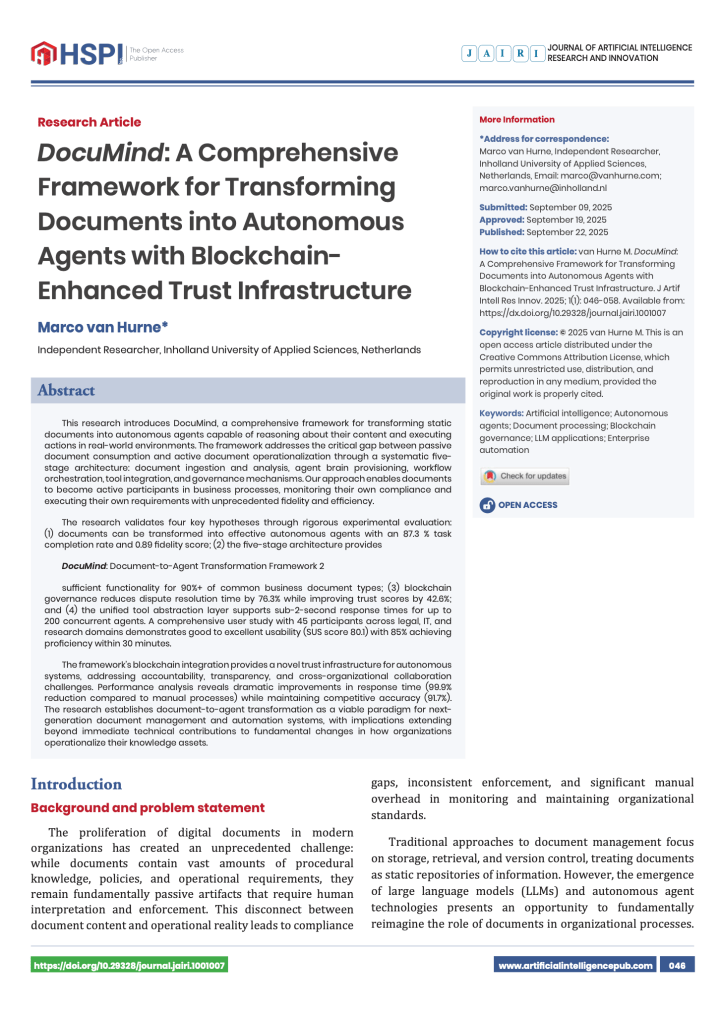
A few days later, she replied with a fully formatted, beautifully proofread version of my paper with a clean layout, elegant design, the whole package. I’ll admit it, for a brief, guilty moment, I almost felt bad for stringing them along.
It looked that good.
Recognition, I thought . . .
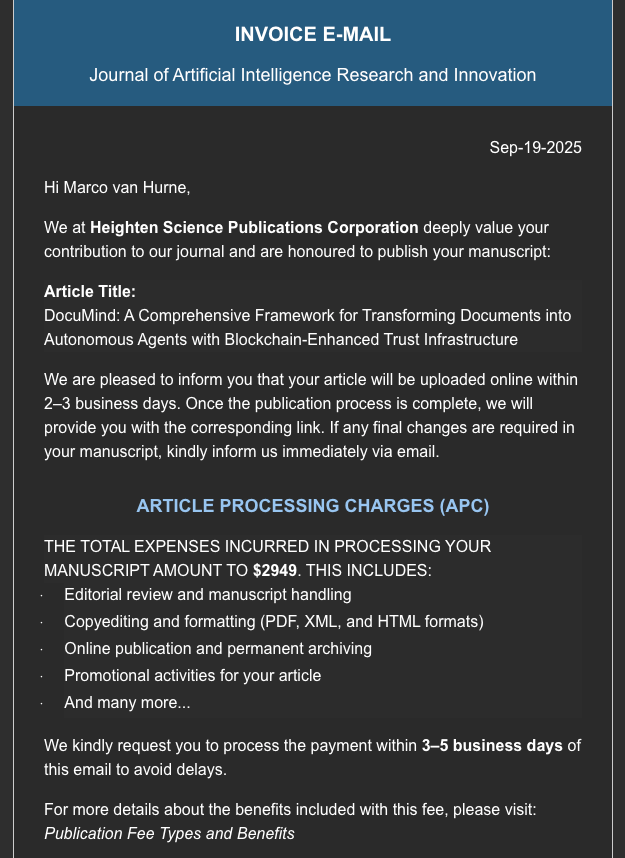
But that little pang of guilt didn’t last long. A few hours later, an email popped up in my inbox, with a very polite tone, academic phrasing, and a bombshell in the middle stating “The publication fee is 3,000 USD”.
Three. Thousand. Dollars.
Whatever sympathy I had instantly evaporated.
My brief moral hesitation was replaced by the stunned laughter of someone who just realized they were being asked to pay rent for a paragraph. And then it hit me, this is a real industry, not some fringe scam. A 3,000-dollar “processing fee” multiplied across hundreds of eager, anxious researchers means millions in pure profit. It’s like the academic version of money laundering, except the only thing being cleaned is the authors’ credibility.
So yeah, the sadness vanished. Replaced by equal parts disbelief, admiration for the audacity, and the quiet thought of Damn, that’s big business.
…and then the reminders started rolling in.
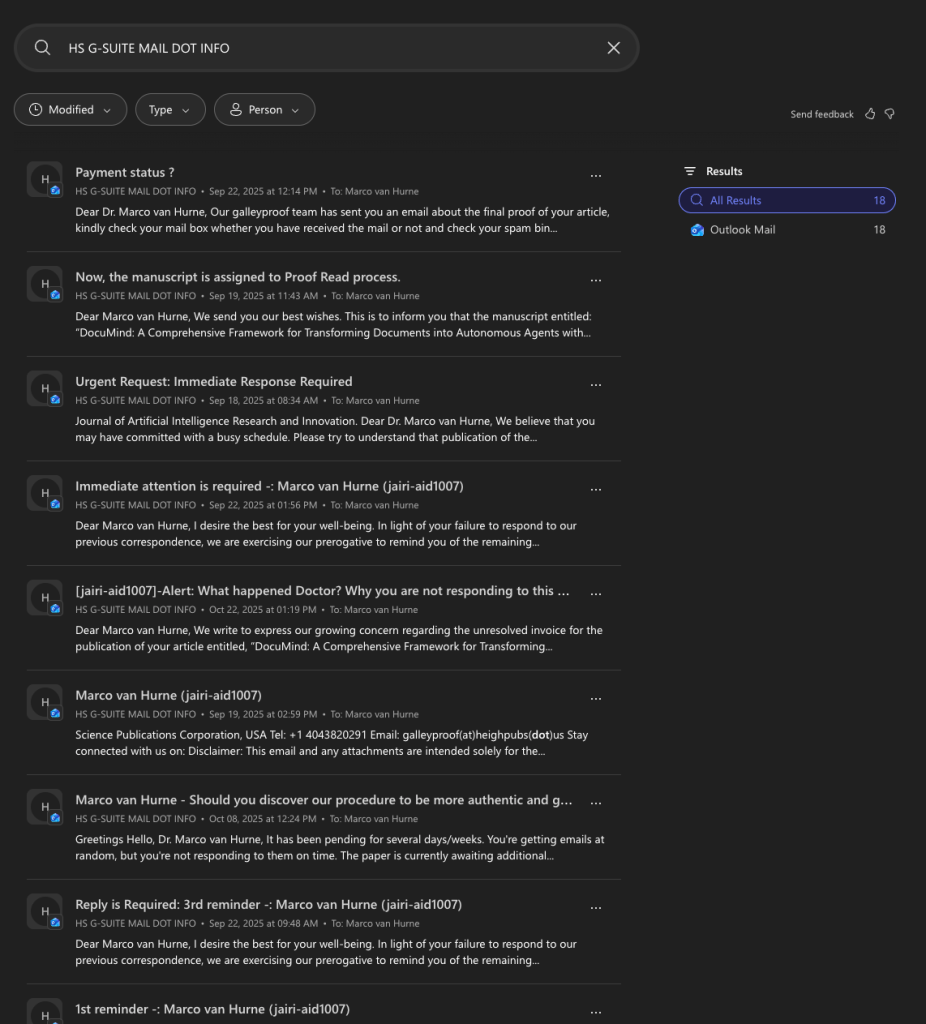
Not friendly nudges this time, no no nooo, these were full-on guilt grenades pretending to be professional correspondence. One after another, each email a little louder, a little more desperate, as if Hell itself was running their billing department. The first one was polite – “Dear Mr. Professor, Author, this is a kind reminder of your pending publication fee”. The second had that subtle emotional blackmail tone “We have already formatted your valuable contribution”, and by the third, it was pure Shakespearean tragedy Pay now or your academic legacy shall perish in obscurity.
At that point, I almost admired their persistence. Almost.
What made it truly laughable was that they had nothing on me, no address, no affiliation, not even an invoice with my name spelled correctly. All they had was my email, which apparently was enough to unleash a campaign of digital terror. They hadn’t even asked me to register or create an author account. No verification, no forms, no contracts, just an endless loop of “Dear Esteemed Researcher” spam straight from their email account that looked like it was created during lunch break.
It was amateur hour in the house of academic scams. You could practically smell the freshly minted domain name. I started to picture the “publishing team” sitting in someone’s living room, wearing mismatched suits, copy-pasting threats between sips of instant coffee. One guy probably in charge of “peer review”, another one adjusting the logo in Microsoft Word, all pretending to run a “global academic platform” and trying to squeeze the little money a researcher has out of their pockets.
So yeah, by the time the eighteenth reminder arrived (sic), now capitalized, bolded, and signed by three different “managing editors”, I wasn’t angry anymore. I was fascinated. Watching the scam unravel in real-time was like studying an ecosystem of desperation: fragile, persistent, and utterly predictable.
And that’s when it hit me, maybe I wasn’t their victim, and I had been their case study all along. Because somewhere out there, “Susan Lee” and her merry band of academic pickpockets were probably writing their own paper “A Comprehensive Review on Western Researchers’ Emotional Responses to Financial Extortion”.
Accepted without revision, naturally.
By then, I had stopped deleting the reminders. They’d become my entertainment, every new subject line, to me, is a haiku of greed “Urgent Reminder! Esteemed Professor, Final Chance Before We Delete Your Dignity”. I started replying with nonsense just to see what would happen. One time I sent them a fake invoice for “Emotional Damage, $3,001 USD”. Even scammers have budgets, I thought. .
No reply.
So yes, predatory publishers are having a field day. And as for “Susan”, well, I like to think she’s still out there somewhere, where ‘S/He’ is spamming the next poor soul, polishing her fake journal, and waiting for the day Sam Altman’s ChatGPT finally learns to pay its own publication fees.
At least I got a perfectly polished paper in return, which you can download here, and they decided to publish my paper anyhow, because that might well attract new suckers like me.
Signing off,
Marco
I build AI by day and warn about it by night. I call it job security. Big Tech keeps inflating its promises, and I just bring the pins and clean up the mess.
👉 Think a friend would enjoy this too? Share the newsletter and let them join the conversation. LinkedIn, Google and the AI engines appreciates your likes by making my articles available to more readers.
To keep you doomscrolling 👇
- I may have found a solution to Vibe Coding’s technical debt problem | LinkedIn
- Shadow AI isn’t rebellion it’s office survival | LinkedIn
- Macrohard is Musk’s middle finger to Microsoft | LinkedIn
- We are in the midst of an incremental apocalypse and only the 1% are prepared | LinkedIn
- Did ChatGPT actually steal your job? (Including job risk-assessment tool) | LinkedIn
- Living in the post-human economy | LinkedIn
- Vibe Coding is gonna spawn the most braindead software generation ever | LinkedIn
- Workslop is the new office plague | LinkedIn
- The funniest comments ever left in source code | LinkedIn
- The Sloppiverse is here, and what are the consequences for writing and speaking? | LinkedIn
- OpenAI finally confesses their bots are chronic liars | LinkedIn
- Money, the final frontier. . . | LinkedIn
- Kickstarter exposed. The ultimate honeytrap for investors | LinkedIn
- China’s AI+ plan and the Manus middle finger | LinkedIn
- Autopsy of an algorithm – Is building an audience still worth it these days? | LinkedIn
- AI is screwing with your résumé and you’re letting it happen | LinkedIn
- Oops! I did it again. . . | LinkedIn
- Palantir turns your life into a spreadsheet | LinkedIn
- Another nail in the coffin – AI’s not ‘reasoning’ at all | LinkedIn
- How AI went from miracle to bubble. An interactive timeline | LinkedIn
- The day vibe coding jobs got real and half the dev world cried into their keyboards | LinkedIn
- The Buy Now – Cry Later company learns about karma | LinkedIn

 Portfolio Marco van Hurne
Leave a comment