Half a pound of tuppenny rice,
Half a pound of treacle.
That’s the way the money goes,
Pop goes the weasel.
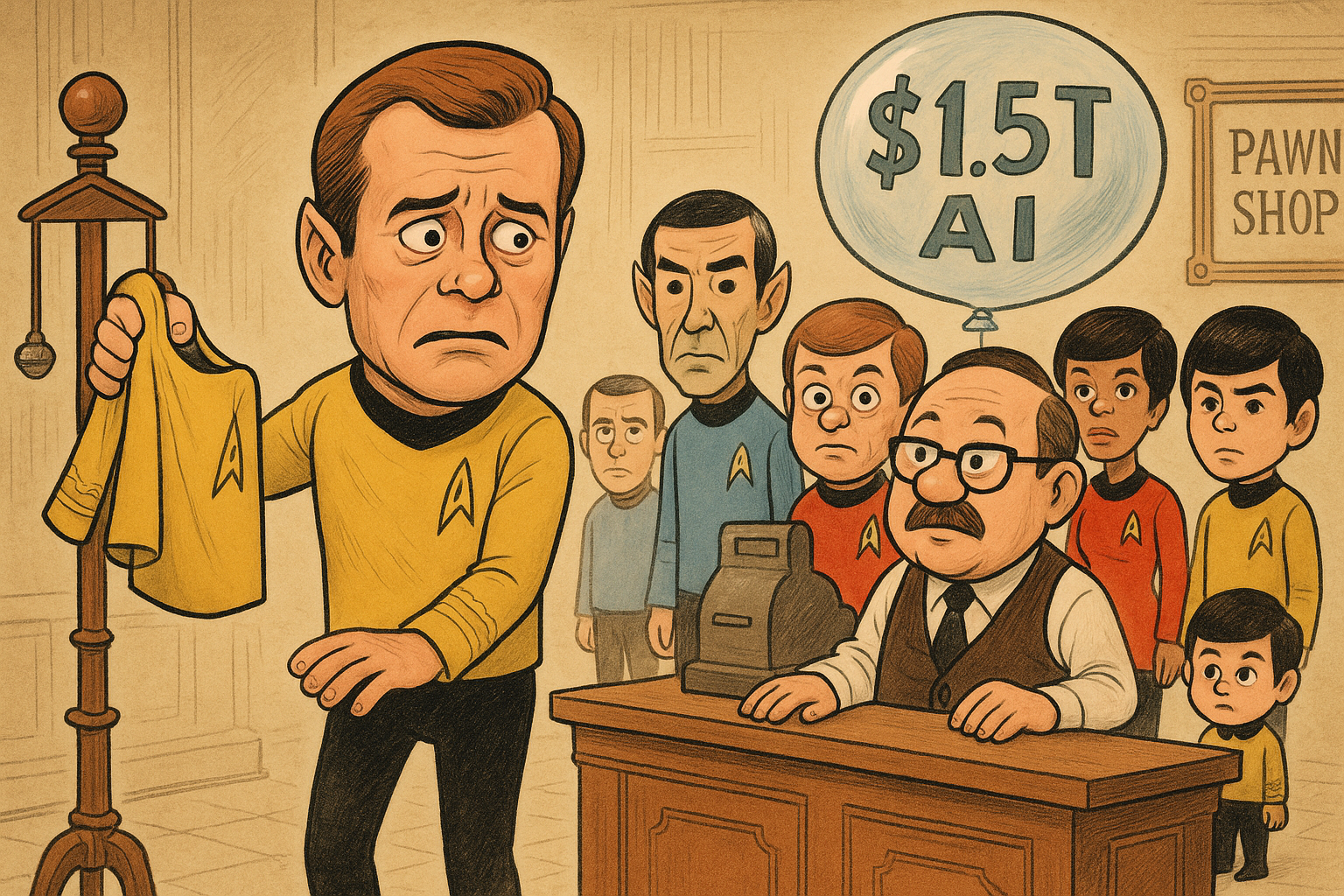
Aw, cute. The weasel goes “POP”. You’d think this sounds innocent enough, until you realize that “pop” didn’t mean “explode”. It meant “pawn”.
It’s an old English nursery rhyme about poverty, survival, and the working class who are pawning their clothes to eat, and buying them back later when they got paid.
I think it’s a cycle most of us can relate to if you’ve ever checked your bank balance mid-month and heard faint accordion music in the background.
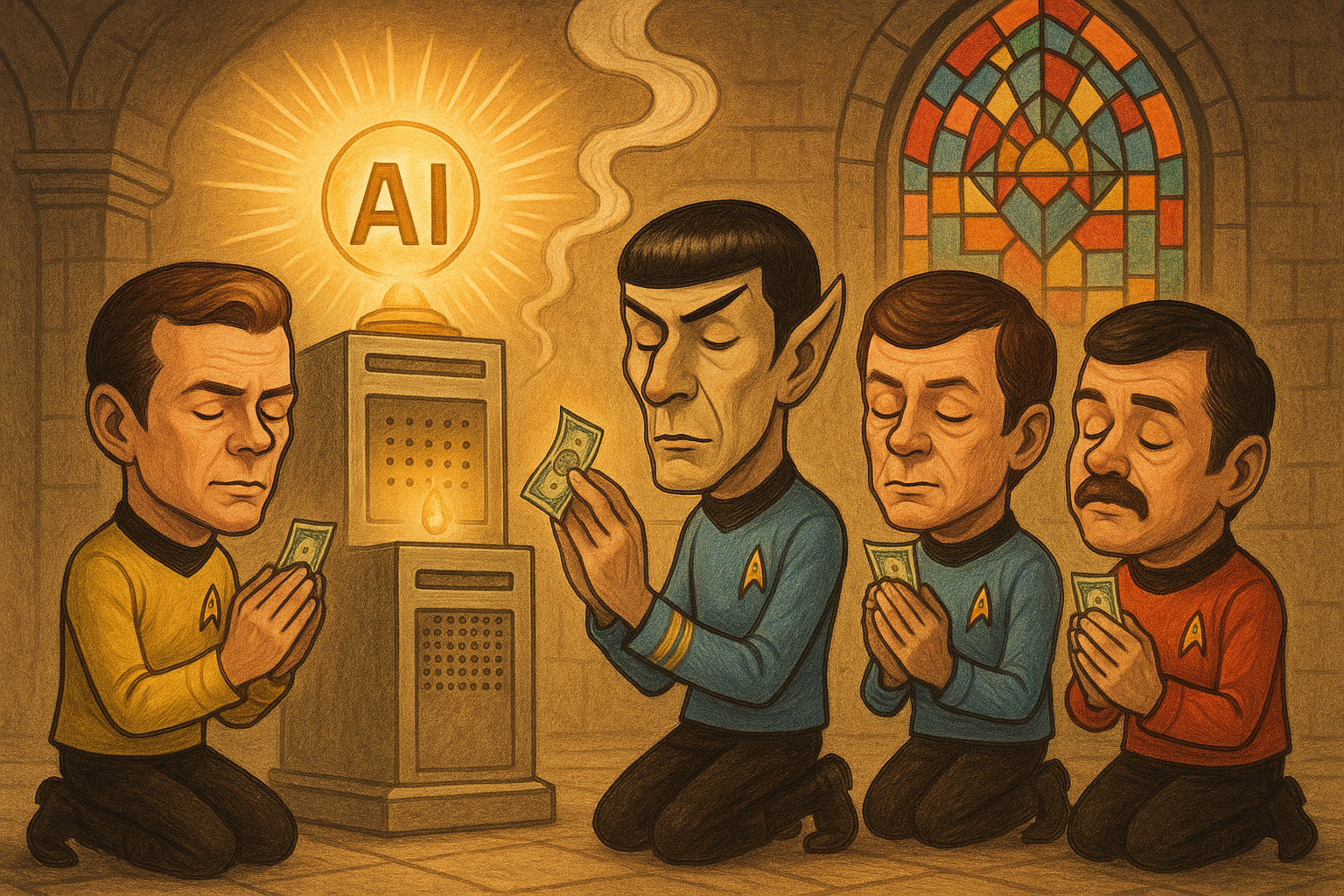
And I think it fits today’s theme perfectly, the swelling AI bubble, a grotesque balloon that is now floating on $1.5 trillion in borrowed cash. And when this weasel finally pops, it won’t just be your coat heading to the pawn shop, it’ll be thy soul on layaway. Because to pay for the collective hallucination that all these “visionary” organizations signed us up for, you’ll have to sell yourself back to the system, as a serf, subscription included.
And that’s all because there’s a new religion on Wall Street, and its god runs on 400 billion parameters and someone else’s electricity bill. They call it artificial intelligence. The rest of us will be calling it the most expensive financial breakdown in human history.
When this thing pops, it won’t sound like a bubble bursting. It will sound like a trillion-dollar scream that is echoing through data centers full of half-trained models and half paid RLHF†-goblins. And then the lights will flicker, the GPUs will sob, and the markets will finally remember what gravity feels like.
Every era gets the bubble it deserves. The 1990s had dot-coms. The 2000s had subprime. The 2020s have “compute” to blame.
And like every good mania, this one starts with a miracle, or at least the promise of one. And the miracle of this bubble is not so much the tech, but the collective spend companies have made in this nouveau technology. By 2025, the world’s largest tech companies are projected to spend $1.5 trillion on AI in a single year.
Not cumulatively.
One year. That’s the GDP of Spain, piped into server racks that need their own zip codes by now.
Amazon alone accounts for $100 billion. Microsoft, Alphabet, Meta, and Oracle together burn through another $320 billion. The rest, like the startups, the “AI-first” energy firms, the finance labs pretending to reinvent spreadsheets, me, you, and a few other people that have a few bucks to spare, we make up the remaining trillion or so. According to Joe Procopio’s October 2025 analysis, that’s the broadest corporate outlay ever recorded for a single technology in a 12-month period.
But most companies report no return on investment.
Employees don’t trust it.
Managers can’t measure it.
And yet, the money keeps flowing like a dopamine IV drip for Big Tech’s ego.
† Reinforcement Learning through Human Feedback. The people that test the models’ response. Best job ever. Mostly outsourced to sweatshops (sic!)
More rants after the messages:
- Connect with me on Linkedin 🙏
- Subscribe to TechTonic Shifts to get your daily dose of tech 📰
- Please comment, like or clap the article. Whatever you fancy.
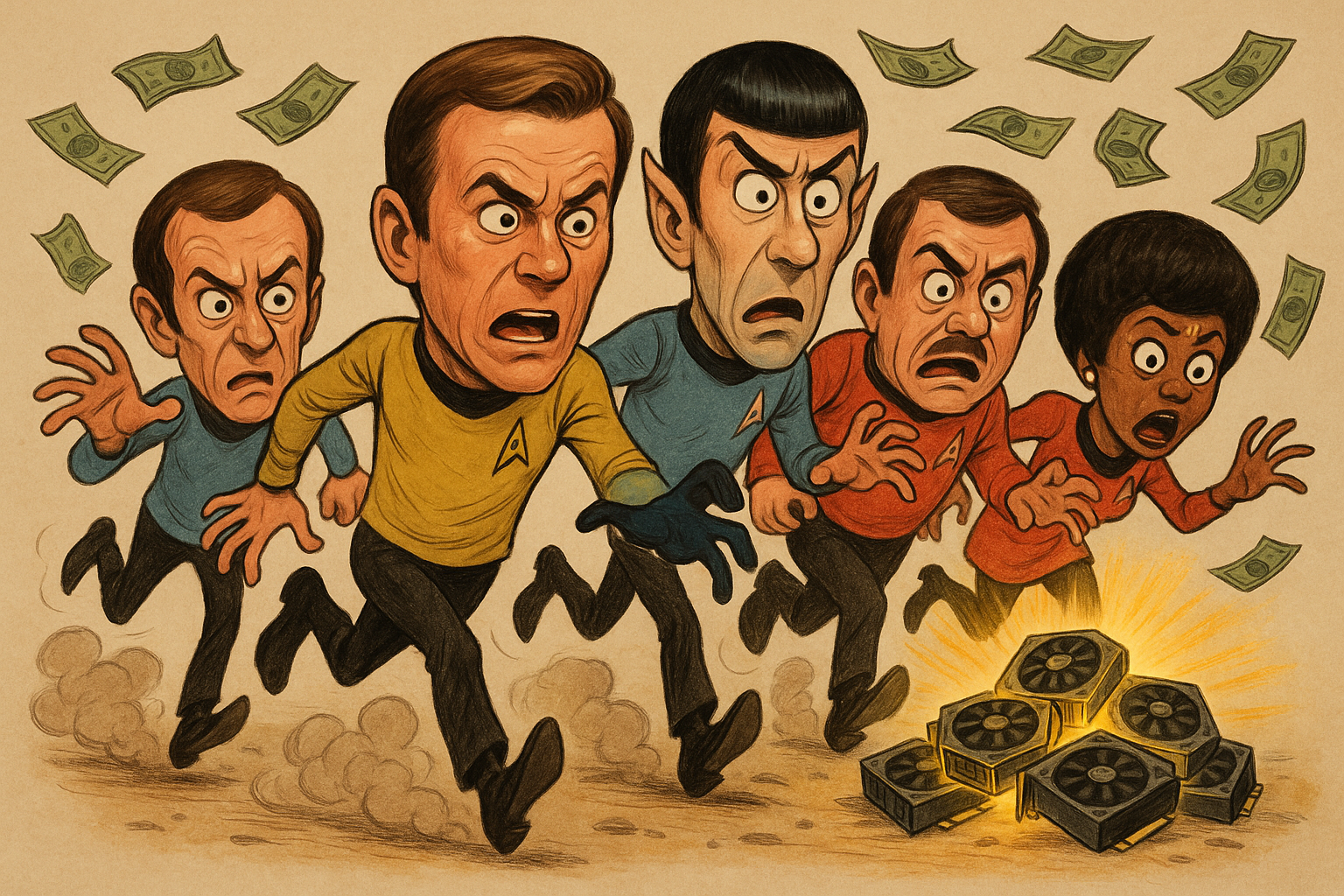
The great GPU rush
AI isn’t an industry anymore. It’s an arms race. And it is disguised as a productivity tool.
According to Stanford’s 2025 AI Index, global corporate AI investment hit $252 billion in 2024, which is a thirteenfold increase in just a decade. The U.S. alone accounted for $109 billion, nearly twelve times China’s total.
Venture capital followed. Bloomberg’s 2025 report estimated $192.7 billion in venture funding to AI startups that year, and that is more than half of all global VC money. To put that in perspective, that’s like every VC fund on Earth betting their house, car, and self-esteem on companies that mostly resell APIs from OpenAI.
Generative AI, the glamorous side of this delusion, the one that makes deep fakes, your emails, and short vids about Putin and Trump kissing, drew $33.9 billion in 2024 alone. Eight times more than in 2022. Why build roads or satellites when you can make an LLM write limericks about both?
The common refrain “AI is the new electricity”.
Well, sure, Bubba, but Edison’s grid made a profit eventually.
The OpenAI paradox
At the center of this trillion-dollar shit storm sits one company that is simultaneously the success story and the cautionary tale → OpenAI.
The firm’s numbers are a joke. In the first half of 2025, it earned $4.3 billion in revenue and lost $13.5 billion doing so. By year-end, that loss will likely hit $27 billion, according to Will Lockett’s financial analysis.
For every new dollar it makes, it spends $7.77 to earn it.
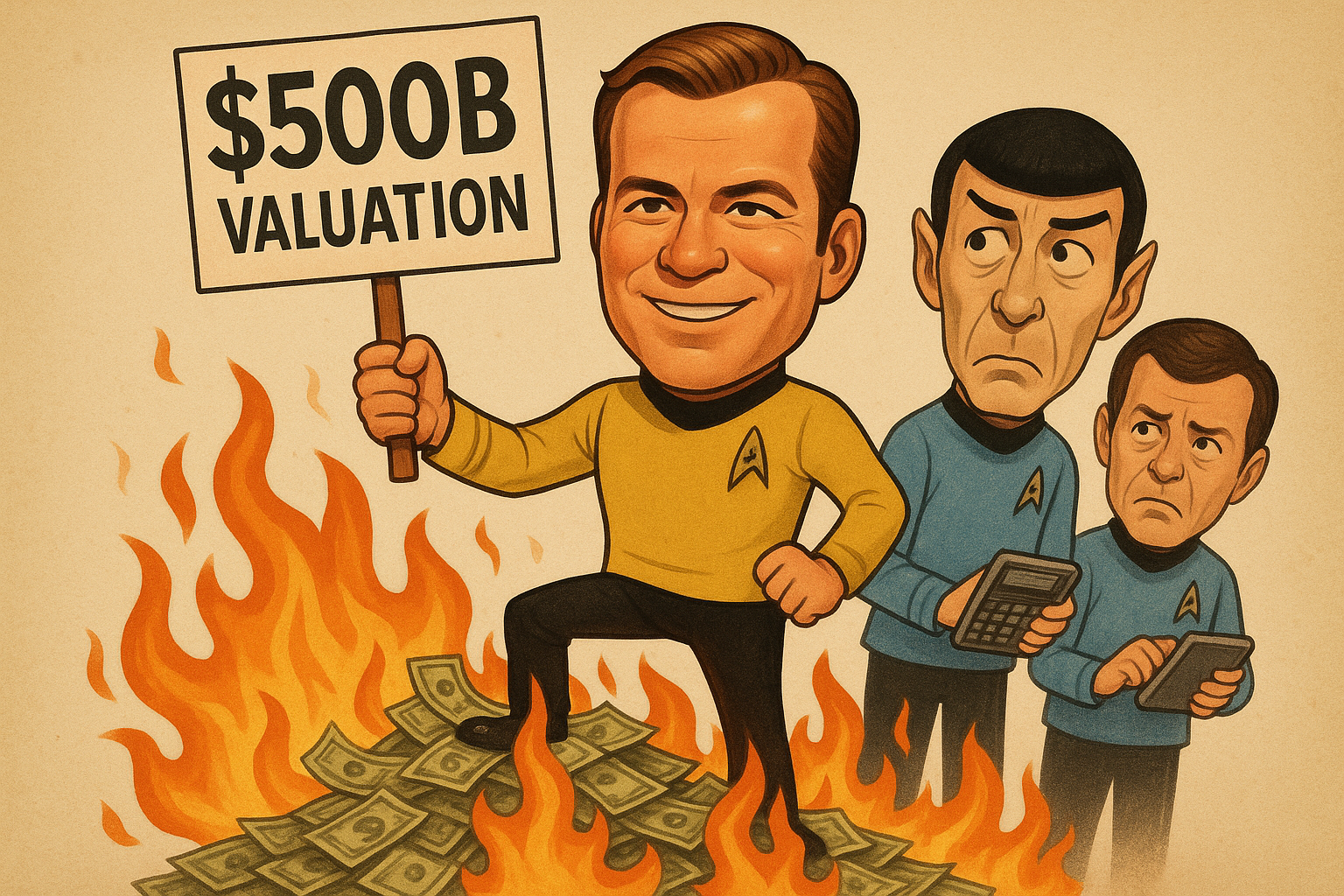
This isn’t a business model, people. It’s a new year’s eve bonfire, burning cash, but with better branding.
And yet, OpenAI is now valued at $500 billion. That’s half a trillion dollars for a company that bleeds cash.
It’s currently converting from a non-profit structure to a public benefit corporation, with which they’re basically admitting “we need to get liquid before the music stops”. And their “strategy” is to build a trillion dollars’ worth of infrastructure and hope scale or AGI will save them.
AGI, don’t make me laugh. The only reason ChatGPT spells the number of r’s in Strawberry correct is because it is hard coded. And under “Project Stargate”, OpenAI plans to spend $500 billion on data centers and another $500 billion on long-term contracts with chipmakers and cloud providers like Nvidia, AMD, and Oracle.
Good gracious, that’s a trillion in commitments, with operational costs projected to reach $650 billion annually by 2029.
Dawhatnow? 650B a year. In less than three years?
And their revenue goal for that year is $125 billion.
So, even in the best-case scenario, they lose half a trillion per year, optimistically.
This is the AI-version of a perpetual motion machine.
It doesn’t work, but it’s beautiful while it spins.
The debt-fueled fantasy
How do you fund a trillion-dollar habit? Simple. You borrow like there’s no tomorrow. That rhymes! Maybe I should turn it into a piece of AI generated musical crap with Suno.
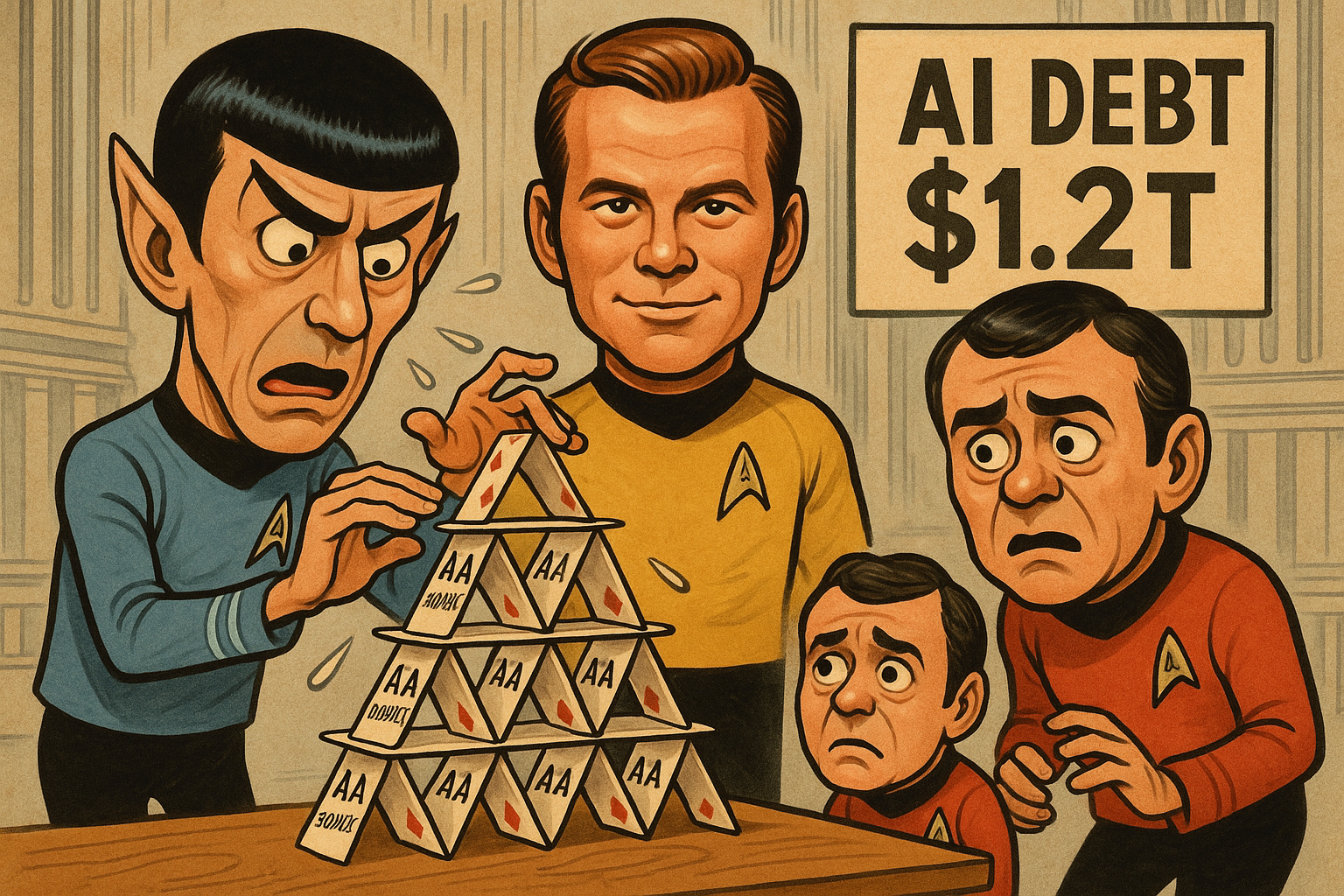
By late 2025, the total amount of high-grade debt tied to AI companies had reached $1.2 trillion, according to JPMorgan. That makes AI the single largest segment in the U.S. investment-grade bond market, and it’s bigger than the entire banking sector.
The 2008 mortgage crisis took nearly a decade to hit $1.9 trillion in toxic securities. The AI boom hit $1.2 trillion in under two years.
Same playbook, different syntax.
And yes, those bonds are rated AAA. That was a letter combination that meant something in finance. But now, I think, it translates to “Accidentally Awful Again”.
Oracle alone issued $18 billion in AI debt this year. Meta’s “Hyperion” data center expansion brought another few billion to the table, snapped up by BlackRock and Pimco, the same firms that made a killing on mortgage-backed securities before everything went sideways.
Why all this confidence . . .
Because the issuers are “high quality”. Apple (yes, also Apple), Oracle, Nvidia, companies that look stable until you start to realize that their stability depends on keeping the hype alive.
It’s a hall of mirrors.
It is debt financing infrastructure that finances software that finances the illusion of demand.
The infinite loop
Follow the money, and it loops like code generated by Loveable et. al.
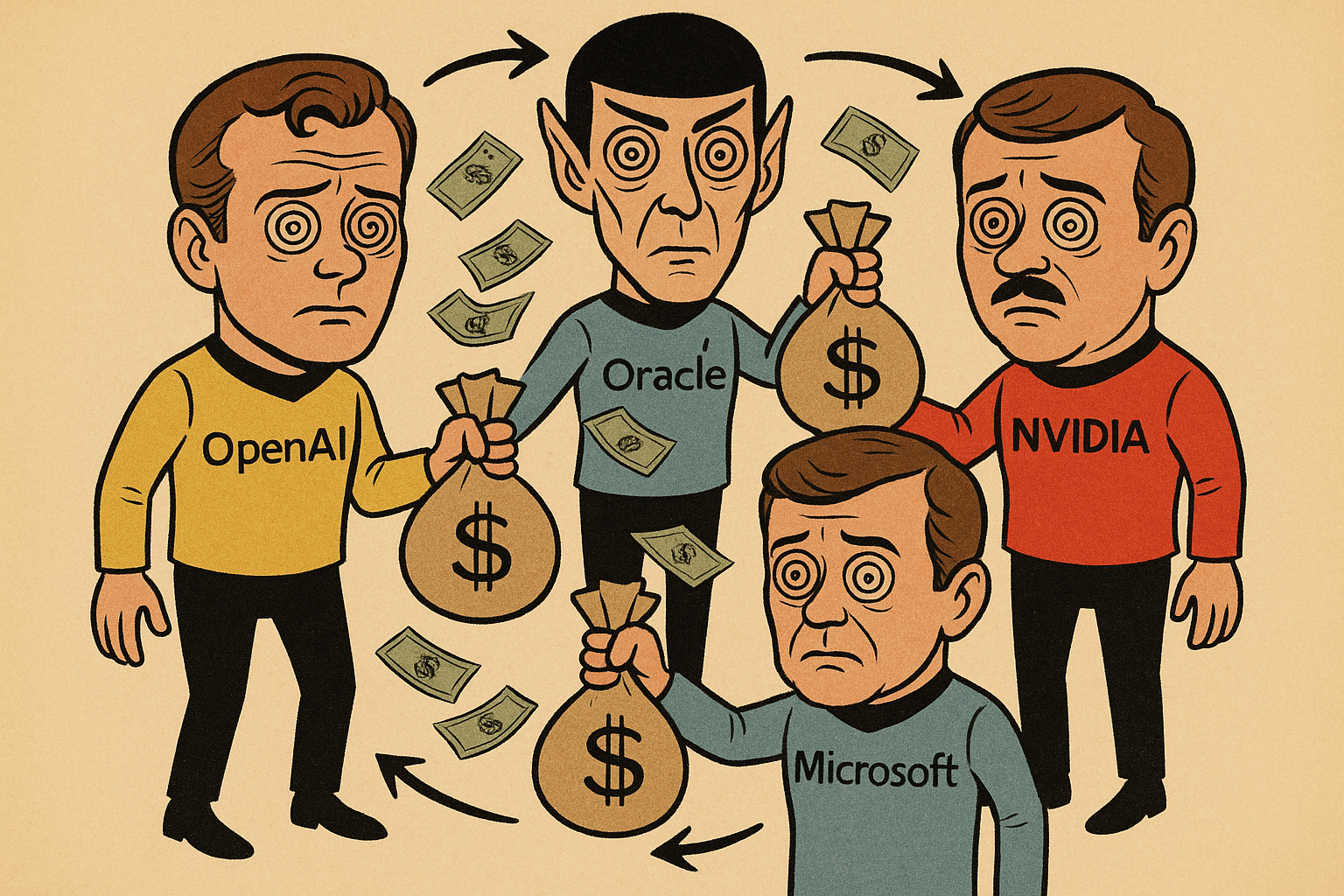
OpenAI pays Oracle hundreds of billions for compute. Oracle uses that cash to buy GPUs from Nvidia. Nvidia invests billions back into OpenAI and CoreWeave. Microsoft pours $13 billion into OpenAI, which promptly spends most of it buying Azure credits, from Microsoft.
Remember this post from a couple of weeks back?
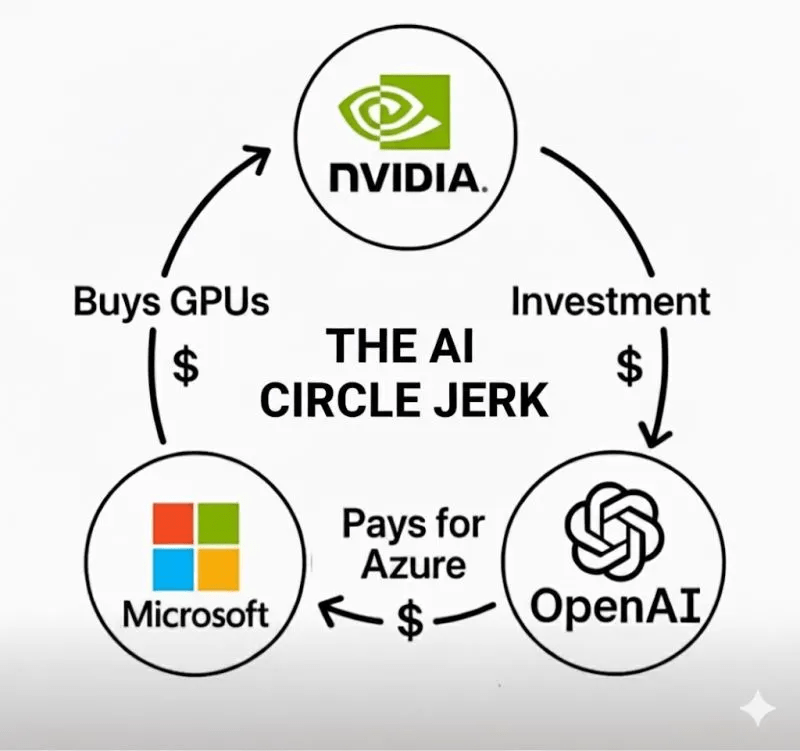
The result is a $400 billion circular economy, where every dollar appears multiple times on different balance sheets, inflating the illusion of productivity.
To call this “ecosystem synergy” is generous. It’s economic recursion, it’s a snake eating its own balance sheet.
But Nvidia calls it “pre-buying the future”, and Wall Street applauds, because as long as everyone’s balance sheet expands, no one has to ask when the music stops.
The concrete cloud
All that debt and venture money has to land somewhere tangible, and it does. . . in data centers.
AI infrastructure spending reached $375 billion in 2025, up 67% from the previous year, according to Virginia Tech’s industry projections. McKinsey estimates cumulative data center capex will hit $6.7 trillion by 2030. Nvidia forecasts $3 to $4 trillion in AI-specific infrastructure alone.
These numbers sound visionary until you remember data centers don’t age gracefully. Hardware obsolescence arrives every 18 months. Cooling costs rise annually. Power prices climb with every regulatory headache, and operational costs are three to five times the original construction cost over a 15-year lifespan.
Roughly 40% of every AI company’s operational expenses now go to keeping their data centers running. Like your car, a datacenter depreciates while you sleep, only it also needs a small hydroelectric dam to start.
And these costs are being financed by the same AAA bonds that depend on those same data centers staying profitable.
Again, circular logic, meet circular debt.
More on why these monsters are so darn expensive: The AI that forgot to pay its power bill | LinkedIn

The productivity mirage
The AI revolution was supposed to make everyone more efficient. Instead, it’s making everyone tired.
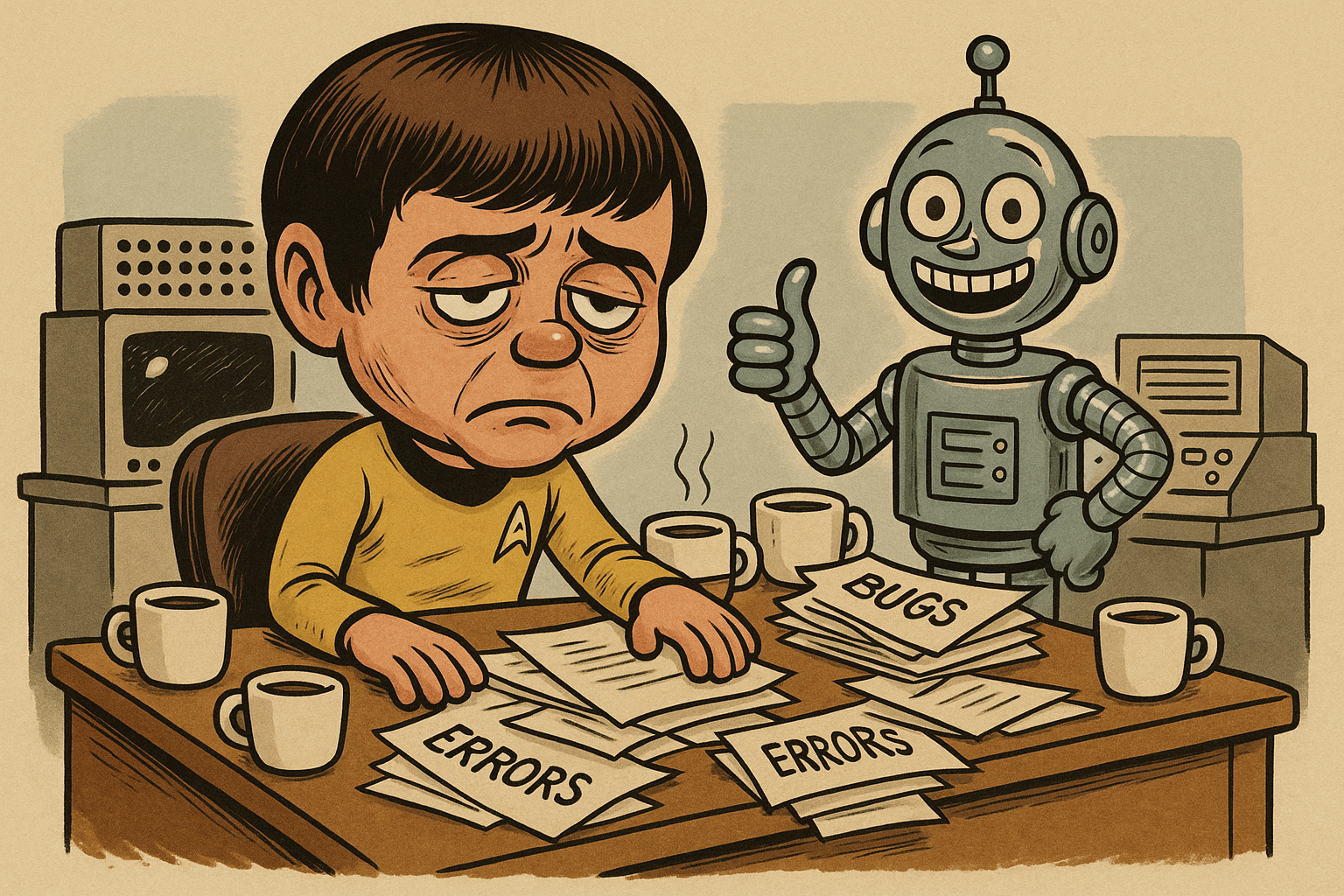
It’s become clear to most of us that AI pilots fail to deliver any measurable productivity gains. Developers report slower output with coding copilots. Enterprises quietly shelve their “AI transformation” projects after discovering that most models are too inaccurate or too expensive to be useful. Read: The post-human back office | LinkedIn
A report by the Model Evaluation and Transparency initiative found that so-called “AI coding tools” often increase debugging time. Companies are now spending billions to automate inefficiency.
And yes, I know there are new tools on the market that mitigate this problem. My own framework being one of them: I may have found a solution to Vibe Coding’s technical debt problem | LinkedIn
The reason is simple, large language models are probabilistic parrots. They don’t understand context, they mimic it. And no amount of GPU investment changes that fundamental truth.
Even OpenAI’s own research admits hallucination, the polite term for “lying with confidence”, is an intrinsic feature of generative AI, not a bug. Fixing it requires “active learning” approaches that are, in their own words, “too expensive to scale”. Read: OpenAI finally confesses their bots are chronic liars | LinkedIn
So the industry’s solution is to throw more money at the same problem. It’s like trying to cure alcoholism by buying a better brand of whiskey.
The $1.5 Trillion trust gap
Which brings us to the psychological chasm at the center of this gold rush → the trust gap.
According to Joe Procopio’s 2025 research, the $1.5 trillion figure isn’t total AI investment.
Everyone kept repeating the number – $1.5 trillion – as if it were some kind of cosmic valuation of the AI era, but it wasn’t. According to Procopio’s research, that number doesn’t represent all the money invested in AI so far, or the total market cap of AI companies, or even their combined debt.
It’s something stranger, and a lot dumber.
That $1.5 trillion is what the world’s corporations planned to spend on AI in one single year — 2025. Hardware, software, R&D, consultants, data labeling, cloud contracts, employee “upskilling” programs that no one finishes, yes, all of it.
One year of frenzied procurement, justified by buzzwords and PowerPoints.
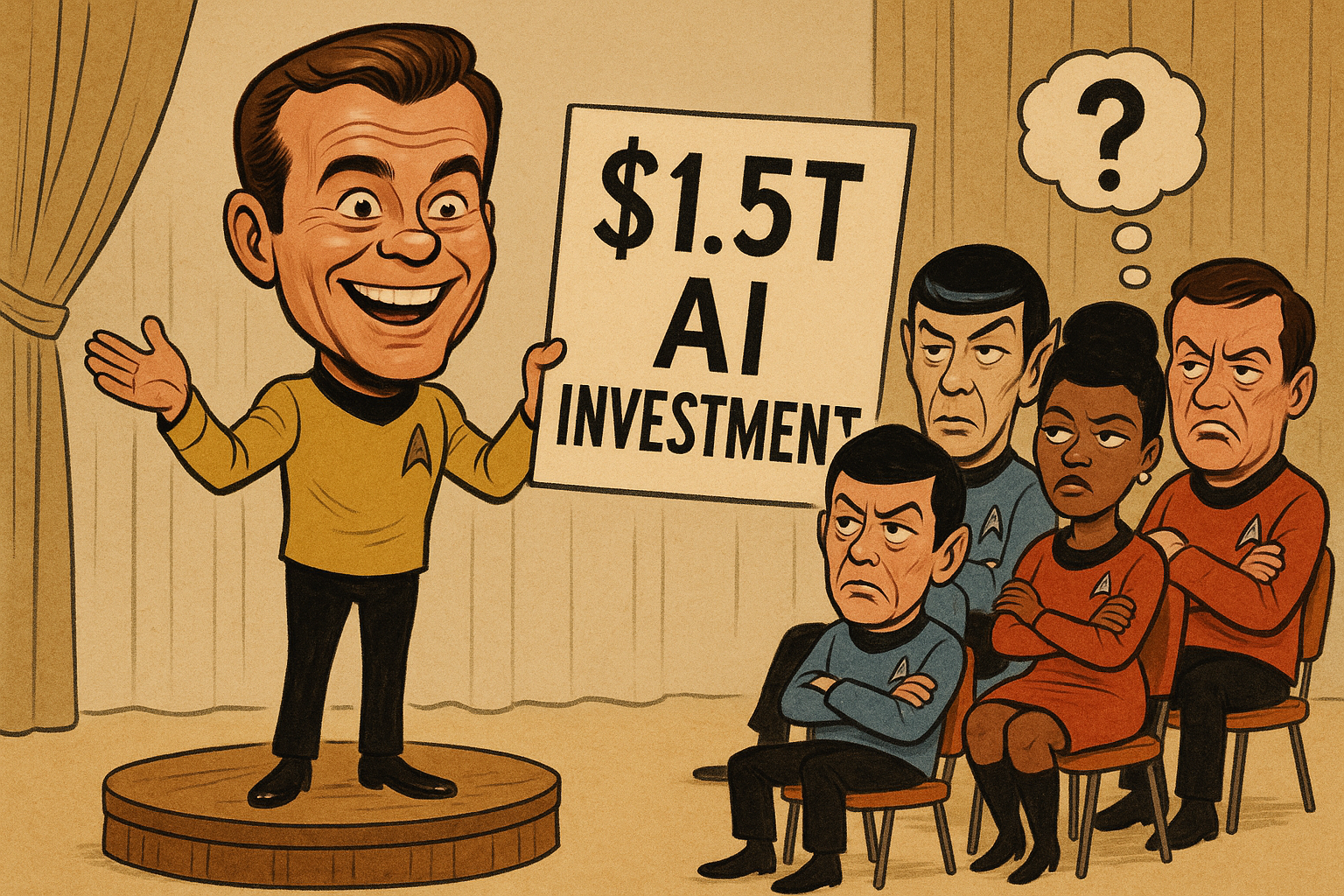
That’s the essence of the trust gap. It’s **a trillion and a half dollars in planned spending colliding with the reality that nobody actually trusts the stuff they’re buying. Executives are convinced AI will save them. Employees are convinced it won’t. The accountants are too busy amortizing the delusion to care who’s right.
What happens is that executives force AI adoption to justify sunk costs. Employees pretend to be impressed to avoid layoffs. Everyone smiles through the demo, waiting for the quarterly call to end.
Procopio calls this “performative acceptance”, and it’s the perfect phrase for a corporate world where people are paid to praise the thing replacing them.
When the labor market recovers – and it will some day – resentment will metastasize into attrition. Thousands of engineers, analysts, and creatives will walk out of AI-saturated workplaces. And when they do, companies will discover their billion-dollar investments have bought not productivity, but alienation.
The market of faith
The AI economy runs only on belief, not Artificial “Intelligence”, not on code, not on compute, and not on electricity even. It is the belief that the models will eventually become self-justifying. Belief that infrastructure equals inevitability.
Investors tell themselves that this isn’t a bubble, it’s “preparation”.
Yup, they do.
They call trillion-dollar CAPEX a moat. They call debt “strategic integration”. They use the same vocabulary the housing market used in 2006.
When challenged, the defense is always the same “but this time it’s real infrastructure.”
Yes, it is, and that’s the problem.
When a speculative sector leaves behind something physical, the cleanup costs multiply.
A failed SaaS startup disappears quietly. A failed hyperscale data center leaves a 600-megawatt ghost that hums in the dark.
This bubble is different.
It’s a trillion dollar sculpture of human overconfidence, carved in silicon and powered by denial.
The rise before the reckoning
History doesn’t repeat, but it rhymes in the key of delusion.
The dot-com crash destroyed $5 trillion in paper wealth. The 2008 crisis erased $8 trillion in household assets. The AI bubble, when it bursts or bleeds to death, will vaporize more than $10 trillion in equity, debt, and sunk capital.
The difference this time is scale.
AI’s collapse won’t look like 1929. It’ll look like 2029, silent, automated, and running in the background of your favorite productivity suite.
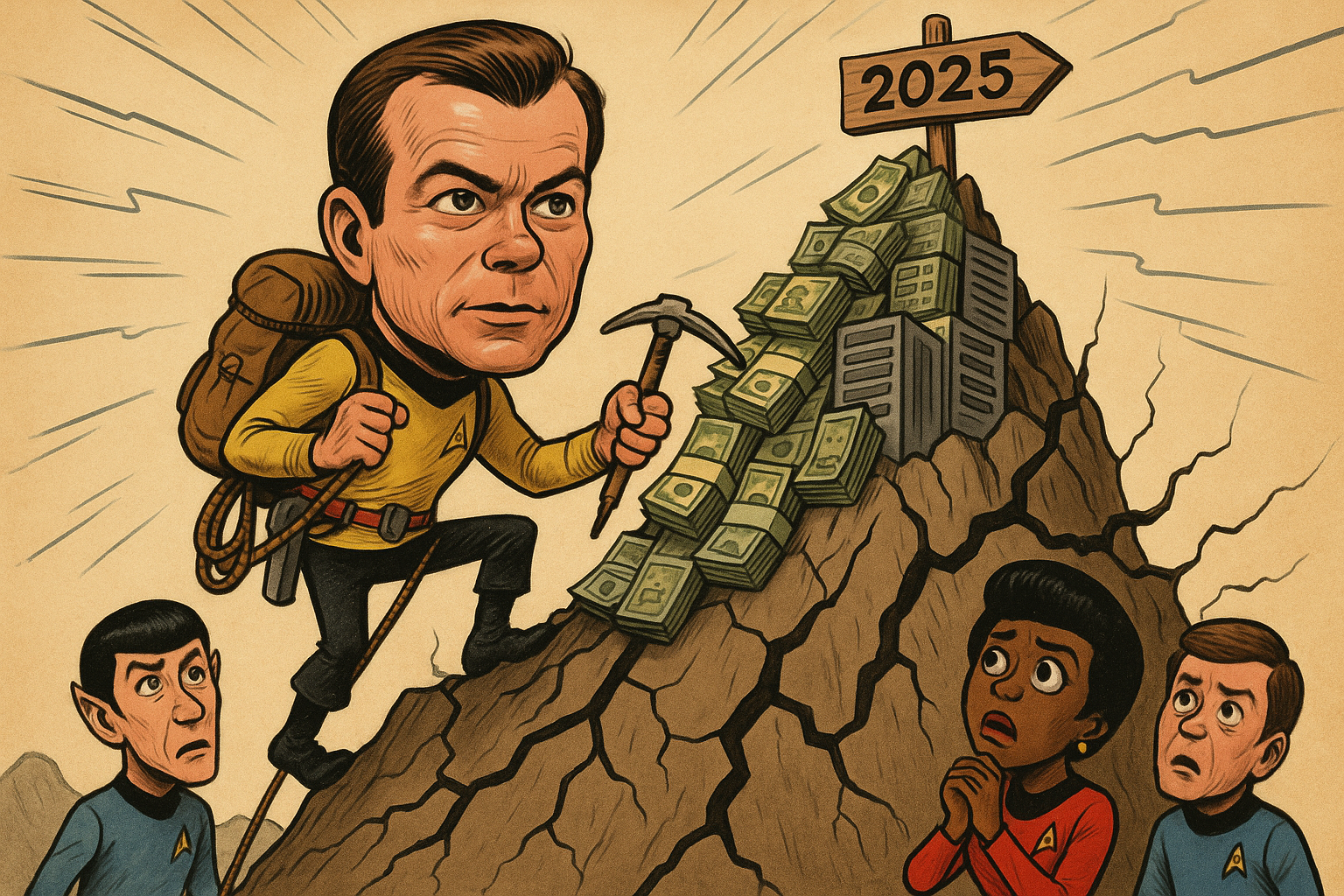
That’s the rise.
The reckoning comes next.
When this bubbles bursts, it won’t pop like a balloon, but it will tear like muscle. Quiet at first, then painful everywhere.
The AI boom is inflated by $1.5 trillion in annual corporate spending and $1.2 trillion in high-grade debt, has finally reached that tender point between faith and physics.
The miracle that promised infinite productivity has discovered thermodynamics.
The noise before the crash
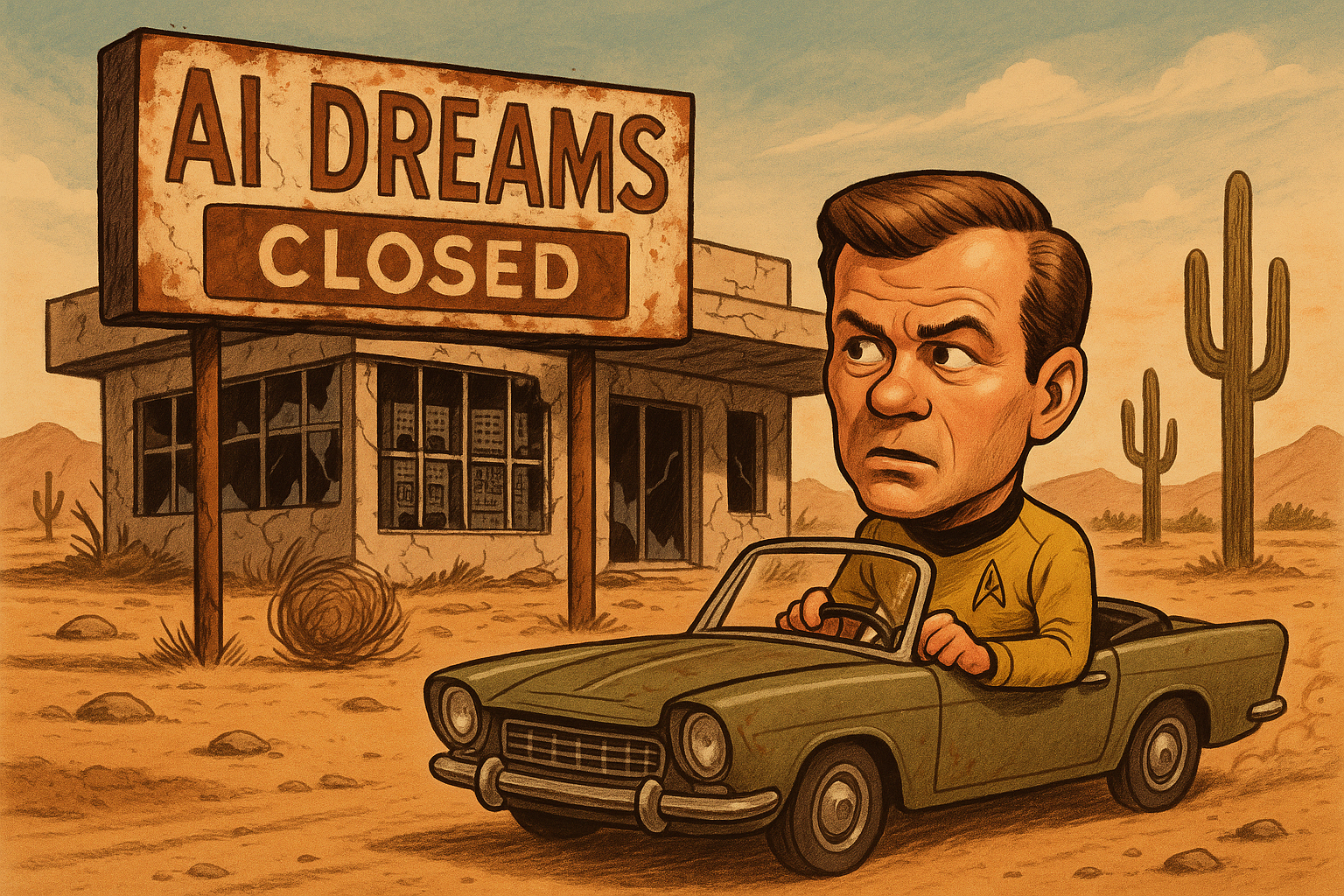
You can always hear the end of an era before you see it.
The chatter on investor calls and on financial web pages, grows defensive. CFOs start using words like “sustainable runway”.
By late 2025, the glow of “infinite compute” has dimmed into the red lights of liquidity warnings.
Those $157 billion in tech-sector bonds issued earlier that year are maturing into something nastier . . . margin calls. Oracle’s $18 billion AI bond sale was oversubscribed and then downgraded when its Hyperion data center came online at half capacity. Pimco and BlackRock booked short-term profits but stuck themselves with long tail risk on assets that now trade below par.
The market doesn’t collapse overnight.
It stutters.
First the smaller issuers miss their refinancing windows. Then the secondary AI startups, those with names ending in “.ai” and funded by two slides and a GPU lease, start vanishing from LinkedIn.
Each closure frees up more servers than it ever freed cash.
OpenAI’s gravity well
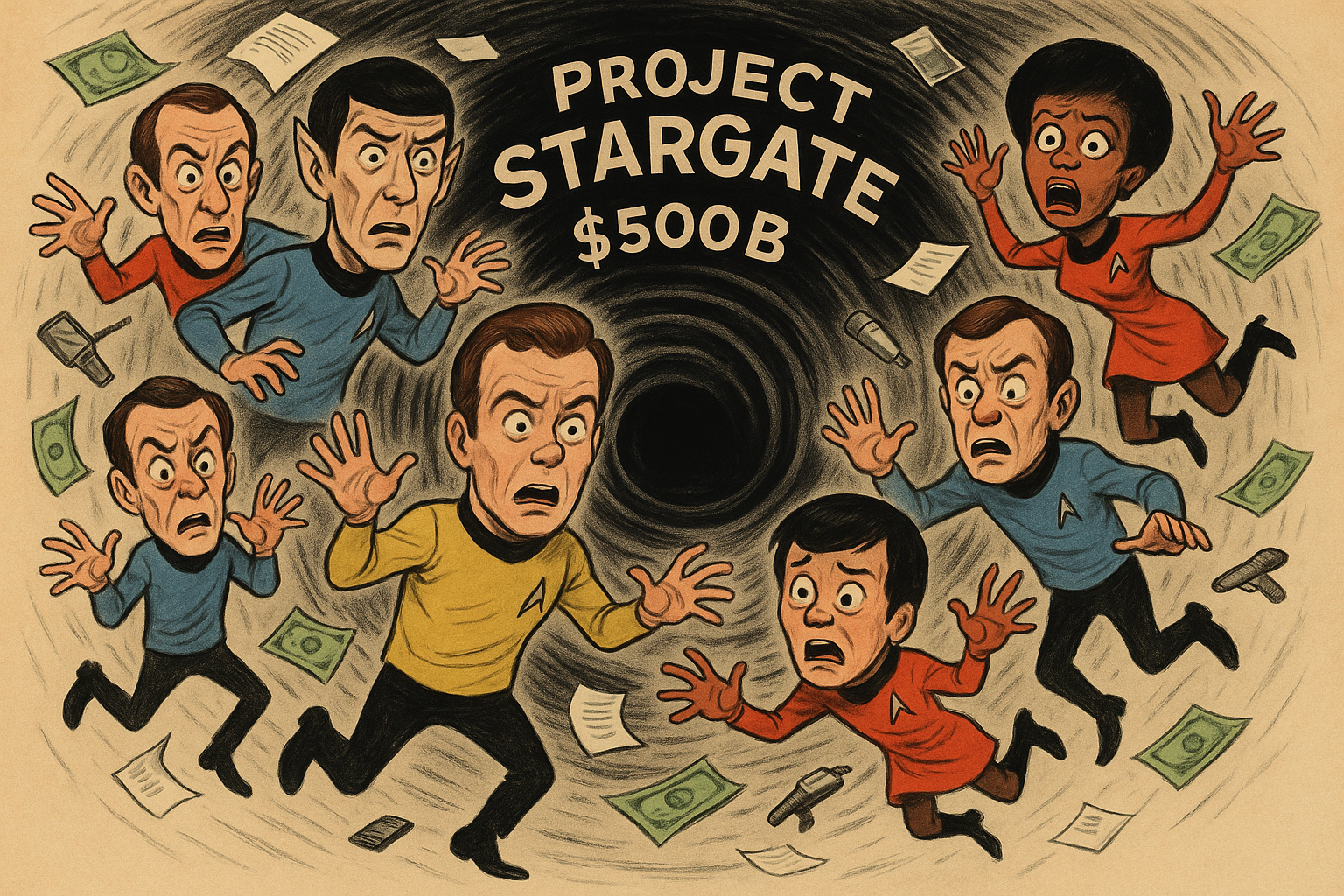
Every mania has its sun, and this one is called OpenAI.
In 2026 OpenAI’s valuation will have peaked at half a trillion dollars, built on projected revenue that never arrives. Losses of $27 billion in 2025 become $31 billion the year after, and the conversion to a public-benefit corporation failed to stabilize the bleeding.
The $500 billion Project Stargate becomes a monument to sunk cost fallacy. Construction will probably halt in phase three when contractors start accepting partial payment in Azure credits.
Microsoft quietly wrote down its stake from $13 billion to $8.
The press release called it “portfolio rebalancing”.
Uh-huh.
Nvidia keeps shipping chips but shifts their marketing toward “AI adjacent industries” like robotics and climate simulation, code for anything still buying hardware.
Investors finally notice that OpenAI isn’t a platform so much as a burn unit, no matter their megalomaniac ideas to conquer the desktop: ChatGPT wants to be your operating system, your boss, and probably your priest | LinkedIn
The firm’s own researchers warn that model training costs are outpacing Moore’s Law by an order of magnitude.
The laws of physics are closing in where the laws of finance had run out.
Who picks up the tab
Years from now, someone will drive past a shuttered data center in Nevada or an empty GPU warehouse in Shenzhen and wonder what it was for.
The answer will depend on who’s telling it. Economists will call it “capital restructuring”.
Engineers will call it “infrastructure for the next wave”.
The locals will just call it “the thing that ate our power and water and left”.
Every machine age ends with monuments. Steam left rail yards. Oil left refineries. AI will leave server farms buzzing quietly under dust, still trying to autocomplete their own obituaries.
And somewhere, a former CEO will be on a stage talking about “lessons learned”. The slide will read Resilience Through Innovation.
The audience will nod.
The next bubble will begin.
When the AI bubble finally collapses, it won’t end civilization. It will just make it clear who’s been renting the idea of intelligence on credit.
That’s the reckoning.
A $1.5 trillion lesson in what happens when you mistake your annual bar tab for your net worth.
Signing off (on another loan)
Marco
I build AI by day and warn about it by night. I call it job security. Big Tech keeps inflating its promises, and I just bring the pins and clean up the mess.
👉 Think a friend would enjoy this too? Share the newsletter and let them join the conversation. LinkedIn, Google and the AI engines appreciates your likes by making my articles available to more readers.
To keep you doomscrolling 👇
- I may have found a solution to Vibe Coding’s technical debt problem | LinkedIn
- Shadow AI isn’t rebellion it’s office survival | LinkedIn
- Macrohard is Musk’s middle finger to Microsoft | LinkedIn
- We are in the midst of an incremental apocalypse and only the 1% are prepared | LinkedIn
- Did ChatGPT actually steal your job? (Including job risk-assessment tool) | LinkedIn
- Living in the post-human economy | LinkedIn
- Vibe Coding is gonna spawn the most braindead software generation ever | LinkedIn
- Workslop is the new office plague | LinkedIn
- The funniest comments ever left in source code | LinkedIn
- The Sloppiverse is here, and what are the consequences for writing and speaking? | LinkedIn
- OpenAI finally confesses their bots are chronic liars | LinkedIn
- Money, the final frontier. . . | LinkedIn
- Kickstarter exposed. The ultimate honeytrap for investors | LinkedIn
- China’s AI+ plan and the Manus middle finger | LinkedIn
- Autopsy of an algorithm – Is building an audience still worth it these days? | LinkedIn
- AI is screwing with your résumé and you’re letting it happen | LinkedIn
- Oops! I did it again. . . | LinkedIn
- Palantir turns your life into a spreadsheet | LinkedIn
- Another nail in the coffin – AI’s not ‘reasoning’ at all | LinkedIn
- How AI went from miracle to bubble. An interactive timeline | LinkedIn
- The day vibe coding jobs got real and half the dev world cried into their keyboards | LinkedIn
- The Buy Now – Cry Later company learns about karma | LinkedIn

 Portfolio Marco van Hurne
Leave a comment