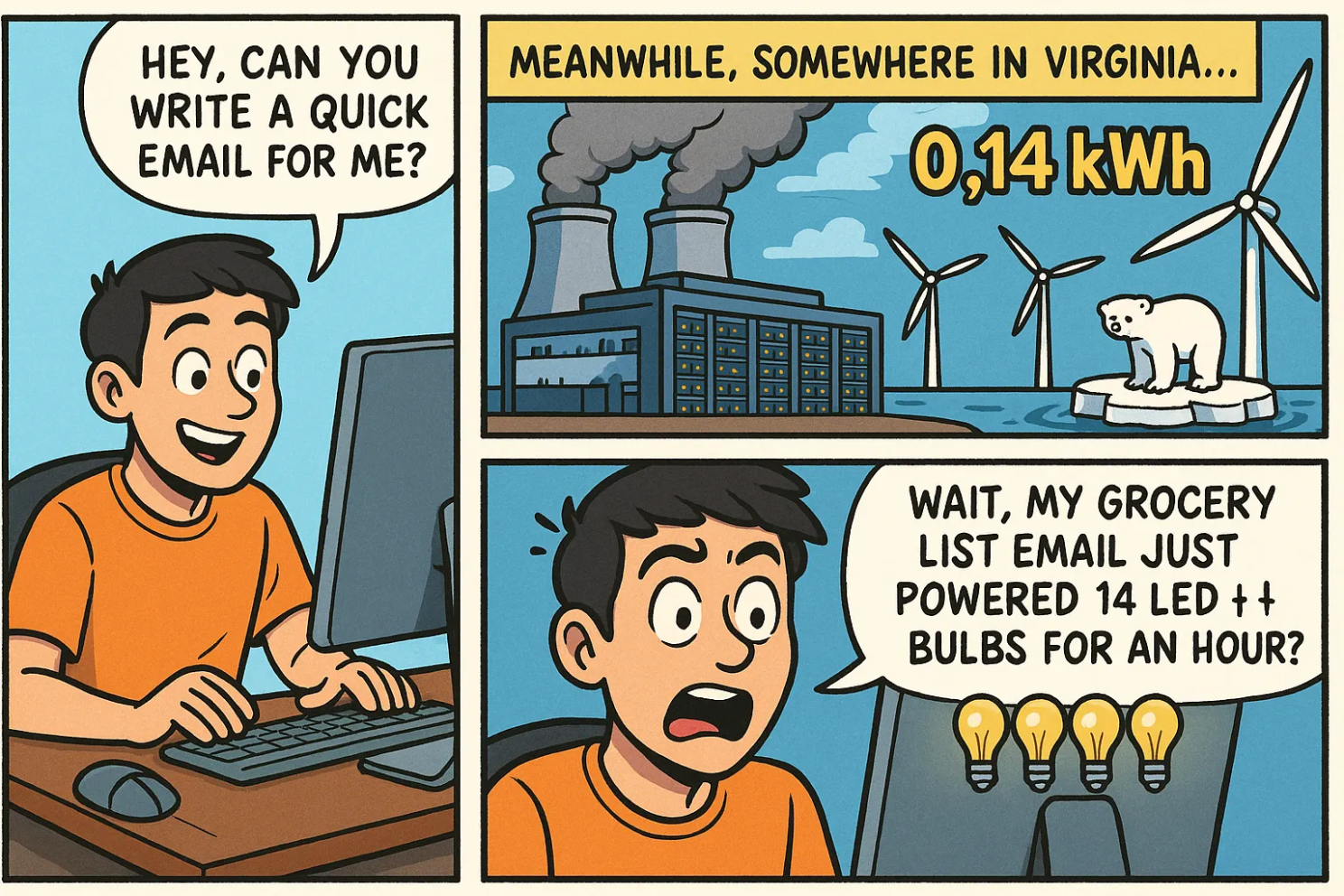
I tried being environmentally conscious last Wednesday when I visited the office in Utrecht, bought an overly expensive reusable plastic coffee cup and felt smugly superior for exactly forty-seven minutes. Then I entered the office, unpacked my laptop and generated a hundred-word email with ChatGPT and discovered that I had consumed enough energy to power fourteen LED bulbs for an hour. Fourteen. For an hour ! But that was before I learned about AI video generation, which makes email writing look like the planet just got a respirator.
Oopsy daisy.
This – my dear friends – is going to be a very polite apocalypse with a user-friendly interface, a subscription model, and now a video editor that consumes electricity like a blood- addicted vampire with a cocaine habit.
The artificial intelligence ‘revolution’. . .
It promised to make us smarter, and of course more efficient†, and it is also making us complicit in the most spectacular environmental ℉ꌈ℃ ₭-up since since Chernobyl had its little glow-up in ’86.
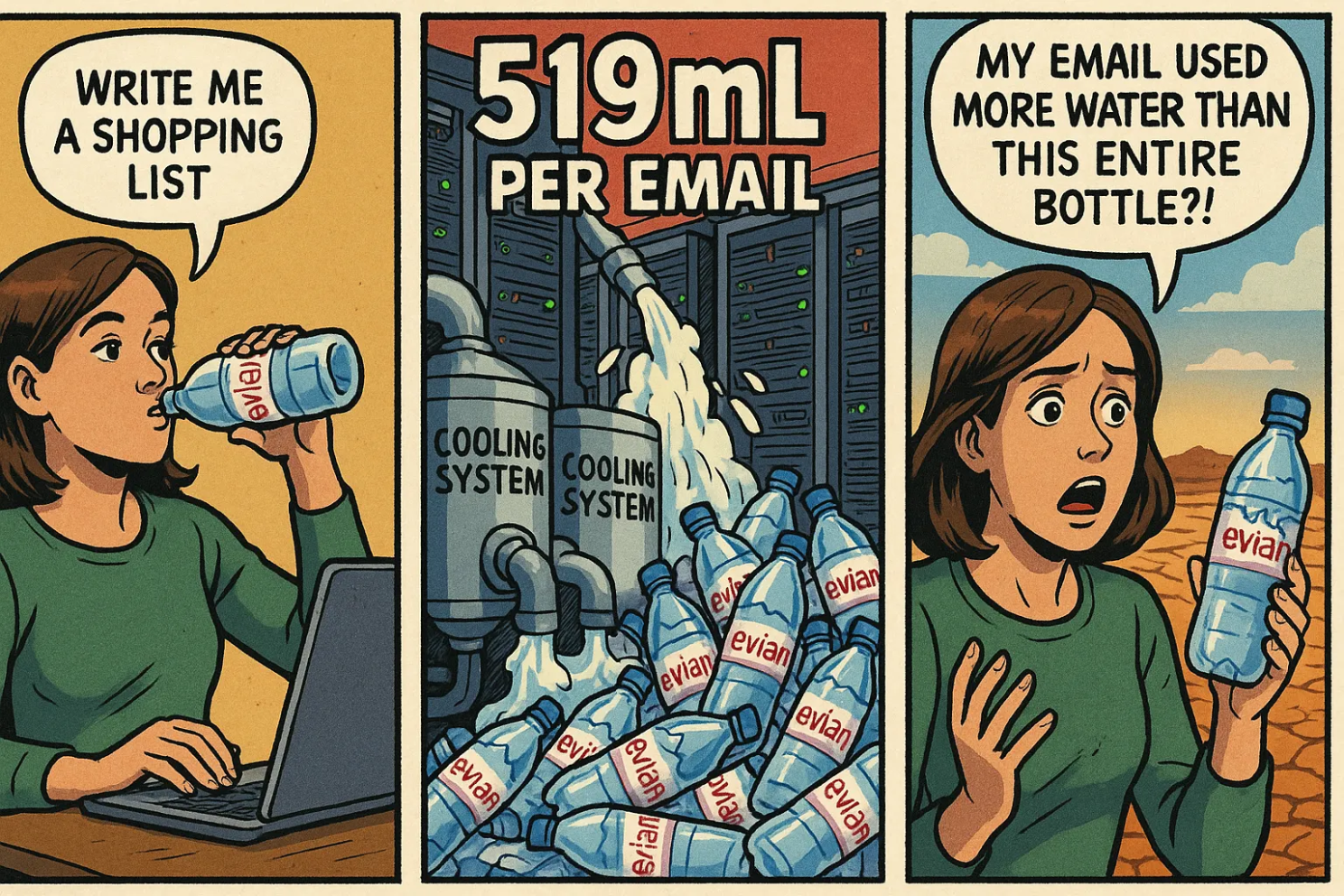
Every time you ask ChatGPT to write your grocery list, or to check your grammar, somewhere a data center chugs 0.14 kilowatt-hours and guzzles 519 milliliters of water. That’s more water than an Evian bottle, just so you can remember to buy milk without using your actual brain.
To give you an idea:
The RAID anti-bug spray contains 519 millililliliters of gnarly fluid. So you can fairly say that with one email, you kill the equivalent of 427 cockroaches (if you line ‘em up firing-squad style).
Now here me out. . .
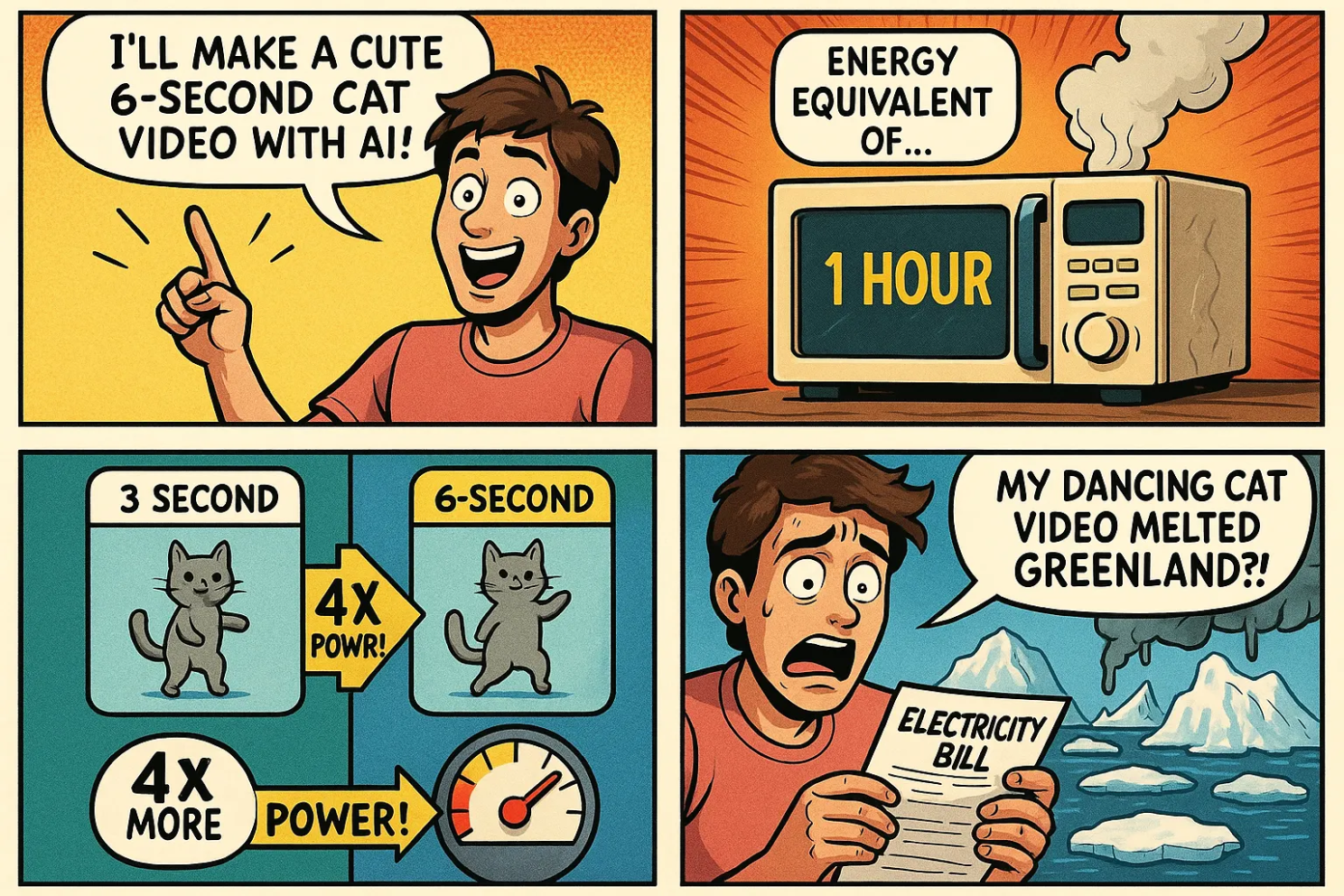
Generating a six-second AI video clip consumes four times as much energy as a three-second clip (that’s not 12, just 4 → redo the math), because the laws of physics decided to get exponentially vindictive. A five-second video requires the equivalent of running a microwave for over an hour and that means your adorable AI-generated video consumed more energy than heating your lunch for the entire month.
Pathetic. But true, alas.

† Not really – Read yesterday’s article about workslop
More rants after the commercial brake:
- Download a copy of the Position Paper about the unmanned economylet me know what your thoughts are. 🧻
- Connect with me on Linkedin 🙏
- Subscribe to TechTonic Shifts to get your daily dose of tech 📰
Projections, projections, more projections!
Researchers from Hugging Face discovered that text-to-video generators quadruple their energy demands when video length doubles and this means that power requirements don’t scale linearly but rather like a mathematical middle finger pointed at the ozone layer. The carbon footprint of generative AI tools that turn text prompts into images and videos is “far worse than we previously thought” said one of the face-huggers.
The math is uglier than your last Tinder date.
The whole of ChatGPT burns through 39.98 million kilowatt-hours daily, which is more electricity than 117 countries use in an entire year.
117 countries < 1 datacenter. Absurd.
Their daily water consumption hits 39.16 million gallons. Now in Europe we don’t know what a gallon is‡, so we can pretend to be ignorant and continue asking the bot for love-advise. But this is truly bonkers!
39 million gallons is equivalent to everyone in Taiwan flushing their toilets at the same time. Image generators use the equivalent of five seconds of microwave warming to create a single 1,024 x 1,024 pixel image, while video generators prove so energy-intensive that longer clips imply rapidly increasing hardware and environmental costs.

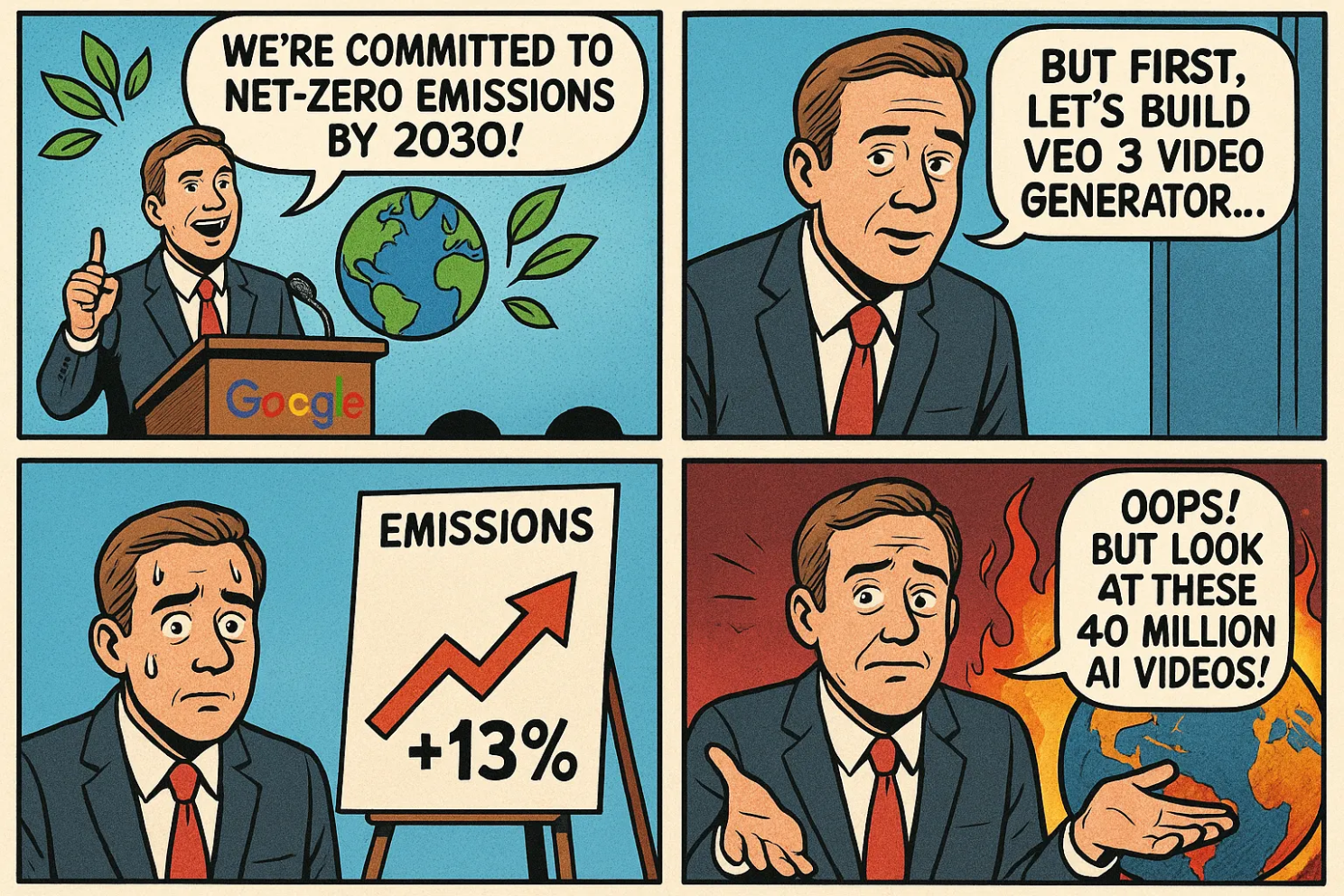
Google released its Veo-3 AI video-generator and users created over 40 million videos in just seven week, but the real environmental impact of this stunt remains unknown since Google isn’t exactly forthcoming when it comes to its sizable contributions to carbon emissions. But yeah, have you ever seen a tobacco company volunteering to study lung cancer rates? Me neither.
Those power-hungry data center beasts are projected to consume 1,050 terawatt-hours by 2026, and that makes them the fifth-largest electricity consumer globally, right between Japan and Russia.
Have you ever seen a pet hamster eat more than a Great Dane? I can imagine you haven’t and neither have I, but that is not the point. It is the same level of absurdity, as those teensy weensy datacenters consuming as much energy as the whole of mother Russia.
Another projection by people who make projections:
These gluttons will devour 21% of global energy demand in 2030 (if the planet still exists by then), and AI-related energy usage is already 20% of the global datacenter power demands.
The global data center water consumption will double from 560 billion liters in 2023 to 1.2 trillion liters by 2030.
I asked my friend ChatGPT to kill a couple of roaches to help me out with the math:
1.2 trillion liters is like 480.000 Olympic swimming pools, or the exact daily water intake of the Estados Unidos, or 7.5 billion barrels of oil a day, and that is equivalent to the entire planet driving for 75 days and that is the length of a corporate quarter. The logic is flawed here, but that’s normal when it comes to saving the planet.
But enough with the comparisons !
Google admitted in its 2024 environmental impact report that it was woefully behind its ambitious plan to reach net-zero carbon emissions by 2030, and that they were seeing a staggering 13% increase in carbon emissions year over year which was largely due to its embrace of generative AI.
There you have it.
These guys are promising to help us quit smoking and opening a cigarette factory at the same time. Piss off with your coal factories you schmucks.
But wait, don’t go away just yet, cause I have more horse manure in store for you.
‡ 1 US Gallon is 3.8 liters. Now you know.
Take me home, country roads
Have you ever seen a periodic table having a nervous breakdown? Me neither – and I’m a chemist. But give it time. The hardware that keeps our universal hobby running, chews through the elements like it’s a free buffet, and it is striking every symbol off the menu until the periodic table looks like it was made by a shitfaced Mendeleev. Lithium, Cobalt, Nickel, rare earth elements, Neodymium – all extracted through mining ops. Congo supplies most of the world’s Cobalt through environmental destruction and mix it with human rights violations.
Why choose just one form of suffering when you can bundle them, aye?
Electronic waste generation was just over 62 million tons in 2022 and keeps climbing higher than my anxiety when I check my bank statement. The rapid obsolescence of AI hardware creates vast waste streams that existing recycling infrastructure cannot handle and toxic materials like Lead, Mercury, and Cadmium leach into soil and water from landfills and is creating environmental damage that will persists longer than my last relationship did.
Virginia has become the global epicenter of data center development and over there, they are hosting nearly 600 facilities and they have 70 more planned.
The power demand from this state is so insane that Dominion Energy contracted to build 40 gigawatts of new capacity. They are adding three nuclear power plants so we can generate memes and six-second videos.
Of course people don’t sit still.
The anti-datacenter movement over there in ze US- La Résistance if you may – has successfully blocked sixteen projects, and the people over there are celebrating council rejections like they just won the lottery, because people don’t enjoy 24/7 cooling system noise and watching their water supplies disappear so we can automate small talk and create AI-generated dance videos.
How selfish.
Two-thirds of new US data centers since 2022 landed in high water-stress areas because someone thought the best place to build water-intensive facilities was in regions already fighting over every drop.
Hold on. This one will make you roll-over-and-freaking-laughing-your-ass-off . . . Arizona limited home construction in Phoenix to preserve groundwater for data centers.
I thought I was reading a chapter from the Game of Thrones, where Daenerys Targaryen’s pet dragons were eating a whole flock of sheep while she was having a boiled egg.
The tech industry’s response to this clusterfuck involves throwing money at nuclear power plants. Google committed over $2 billion to nuclear deals, Microsoft coughed up $1.5 billion including the first-ever commercial fusion energy purchase (if ever), and Amazon invested $1 billion in small change on modular reactors. The total industry nuclear investment will hit $180 billion by 2030, like, man, building nuclear plants to power chatbots and video generators. . . sheesh!
Read: Oracle has commissioned three small nuclear reactors to power its new AI data center
Big Tech is investing hundreds of billions of dollars in infrastructure buildouts and is of course abandoning climate goals in the process.
The scale of investment tells me that they’re either completely delusional about the environmental impact or they’ve decided to beat the aliens at planetary destruction.
Speaking of which.
OpenAI’s Stargate project is the largest private technology investment in history at $500 billion coin, requiring 7 gigawatts of power across multiple sites, with the first phase in Texas which needs 1.2 gigawatts and that is more power than Lithuania consumes. And Lithuania is a power hungry country cause – next to latvia, and estonia – they are the digital hubs of Europe. Now, that either says a lot about the energy consumption of Texas or the fact that the rest of Europe lives in total darkness, though I’m guessing it’s the former.
The project timeline runs through 2030 and they’re hoping that fusion energy becomes available and small modular reactors don’t melt down spectacularly while we are happily generating videos of ourselves kissing that lovely chick’s picture we store in our photo app.
Ahem.
Fusion energy companies raised $9.7 billion in 2025, up from $1.9 billion in 2021. Investors finally realized that unlimited clean energy might be useful for powering unlimited digital stupidity. Commonwealth Fusion Systems plans their SPARC test reactor for 2025 and Sam’s Helion promises that their first plant will open by 2028, and multiple other fusion facilities should be operational by 2030. Yeah, yeah, right-oh! The timeline assumes everything goes perfectly and that my friends, is like assuming your diet will work this time like it did the last – aye?
We all know how that went.
Read: Sam’s glow-in-the-dark ambition
Efficient computing
But my smart ass-friends there are ways to slim down energy demands and that included intelligent caching , reusing existing AI generations , and “pruning” – meaning sifting out inefficient examples from training datasets. But whether those efforts will make a dent in the enormous electricity consumption of current AI tools remains to be seen , like wondering if a band-aid will fix a severed artery.
The manufacturing sector embraced “dark factories” that operate without human presence , lighting, or heating , reducing industrial energy consumption by 15-20% according to the International Energy Agency. China leads deployment with facilities running continuously , while the US takes a more cautious hybrid approach because Americans apparently need coffee breaks even when robots do all the work and generate all the videos.
AI-native companies consume 2-7% of global greenhouse gas emissions through their technology infrastructure , but often achieve lower carbon footprints per unit of economic output compared to traditional industries. This efficiency comes from reduced physical infrastructure and algorithmic optimization , which is like saying your gambling addiction is cost-effective because you use a rewards credit card and only bet on environmentally-themed slot machines.
The technology solutions emerging from this environmental nightmare include neuromorphic computing promising 100x efficiency improvements , biological computing offering 10,000x gains , and DNA data storage potentially eliminating energy requirements for data retention entirely. These breakthrough technologies should reach commercial deployment within the next decade , assuming we don’t accidentally trigger the robot apocalypse first or melt the polar ice caps with video generation.
Quantum computing presents both opportunities and challenges , with quantum algorithms potentially reducing energy requirements for certain tasks by orders of magnitude while quantum computers themselves consume up to 25 kilowatts per dilution refrigerator for cryogenic cooling. The energy efficiency gains kick in for large-scale problems , which is like discovering your sports car gets excellent mileage but only at 200 miles per hour while towing a trailer full of video rendering equipment.
The path forward requires coordinated action across multiple dimensions , accelerating deployment of efficiency improvements and clean energy infrastructure while implementing policies to limit environmental damage. In the medium term , we must commercialize breakthrough technologies while building circular economy systems for AI hardware. In the long term , we need an AI ecosystem that enhances human capability while operating within planetary boundaries , assuming we still have a planet by then.
The environmental cost of intelligence isn’t predetermined , but the choices made in the next five years will determine whether AI becomes a force for environmental sustainability or an accelerant of climate change with a video editing feature. The technologies and resources exist to choose the sustainable path , what remains is the collective will to implement necessary changes without accidentally destroying civilization in the process of making it more entertaining.
The AI revolution is inevitable , but its environmental impact doesn’t have to be. By acting decisively now , we can ensure the age of artificial intelligence becomes the age of environmental restoration rather than destruction. The future of both human intelligence and planetary health depends on choices made today , assuming we’re smart enough to make them correctly and resist the urge to generate one more six-second video of a dancing penguin.
Neat.
I build AI by day and warn about it by night. It’s job security with a side of existential dread and a video portfolio that’s slowly melting Greenland.
Signing off,
Marco
I build AI by day and warn about it by night. I call it job security. Big Tech keeps inflating its promises, and I just bring the pins and clean up the mess.
Think a friend would enjoy this too? Share the newsletter and let them join the conversation. LinkedIn, Google and the AI engines appreciates your likes by making my articles available to more readers.
To keep you doomscrolling
- The chicken that refused to die | LinkedIn
- Vibe Coding is gonna spawn the most braindead software generation ever | LinkedIn
- The funniest comments ever left in source code | LinkedIn
- Today’s tech circus is a 1920s Wall Street reboot | LinkedIn
- The Sloppiverse is here, and what are the consequences for writing and speaking? | LinkedIn
- Why we’re all writing like shit on purpose now | LinkedIn
- Creating a hero’s journey for your AI-strategy | LinkedIn
- How corporations fell in love with AI, woke up with ashes, and called It ‘innovation’ | LinkedIn
- The corporate body snatchers | LinkedIn
- Screw your AI witch hunt, you illiterate gits | LinkedIn
- AI perverts make millions undressing your daughters for fun and profit | LinkedIn
- The state of tech-jobs 2025 | LinkedIn
- Meet the sloppers who can’t function without asking AI everything | LinkedIn

 Portfolio Marco van Hurne
Leave a comment