Friday, 2:55 p.m. I told myself this Friday was going to be different. No heroics, not a lot of writing. Just clear my inbox, knock out one last analysis, and slide into the weekend before the traffic turned into a parking lot.
Then the email landed. A PDF from a guy I work with.
It was a cost analysis from a colleague who swore he had it handled.
So I open the PDF. Three pages, beautiful charts, corporate fonts, sexy headings. For ten seconds I believed I might escape early and avoid the Friday traffic jam of minivans. Then I actually read the damn thing.
Something felt off.
The words were all there, but they said nothing. It was beautifully wrapped into something that looked legit, but it contained only air and I felt a sense of disappointment. So I read it again. And a third time. Then it hit me, the form was perfect but the content was . . . a ghost.
I had been workslopped.
More rants after the messages:
- Connect with me on Linkedin 🙏
- Subscribe to TechTonic Shifts to get your daily dose of tech 📰
- Download a new paper about the rise of dark factories 🏭
Trust is for suckers and other office truths
Slop looks right but means nothing. You can’t even ignore it, it is that good – on the outside, so you have to decode it, repair it, or nuke it from orbit. And like bad sushi, it ruins you trust quicker than it ruins your bowels.
Some researchers at Stanford and a place called BetterUp Labs-who I’m sure are very important, published a little study in the Harvard Business Review, and it made me laugh, but also reevaluate every document I had received the last week. The researchers spent months watching people use AI at work, and their big discovery was quite the shocker.
Companies that allow AI tools at the workplace are prone to workslop and they are forcing everyone to read this junk, and meanwhile nobody is getting anything useful done.
Miracle.
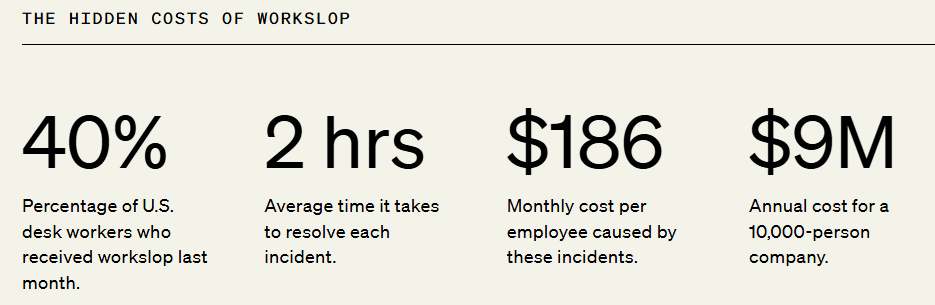
The researchers say that 40% of people got hit with workslop last month. Not a typo.
And it’s not only the rework you know, this one is about respect evaporating. If you send me a pile of AI compost, I stop thinking of you as a colleague and start filing you next to the office printer – there, but dumb.
And the numbers they show, they do not lie. 53% of the respondents report being annoyed by it, 38% confused, 22% offended, and a chunky 42% stop trusting you altogether.
So using AI to craft deep-shit-appearing-legit at work doesn’t only waste their time, it also eats up relationships.
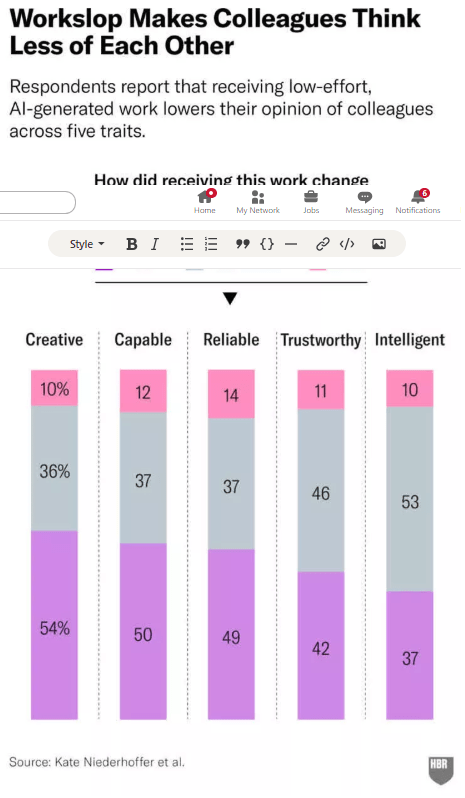
One finance drone put it quite blunt “AI content made me choose between rewriting, humiliating the sender, or signing off on garbage”. His conclusion was like every other good controller would say “This is making everyone mentally lazy. We are creating a population of slow thinkers wired to the vending machine”.
He nailed it.
Powering a small country or generating more slop
What the fancy HBR article doesn’t really get into is the insane amount of energy this nonsense even burns. MIT Technology Review did a deep dive on it back in May 2025.
The numbers are grotesque.
They say that training GPT-4 alone ate about 50 gigawatt-hours of electricity. That’s enough to power San Francisco for three days. And that’s just the training. The day-to-day use is where it gets really stupid. In 2024 , U.S. data centers used around 200 terawatt-hours of electricity. AI servers were responsible for up to 76 of those.
Lemme mansplain this. 76 terawatt-hours is enough juice to power more than 7 million homes for a year. All, so your coworker can send you a report that means nothing. They figure AI will need between 200 and 300 terawatt-hours a year in ‘28.
That’s enough for 18 to 27 million homes.
And – hold on to your hats – these data centers use electricity that’s 48% more carbon-intensive than the average cause-it’s-coming-straight-from-da-coal-mine. So every kilowatt-hour of slop produces way more carbon dioxide than your regular energy consumption.
We are boiling the planet because we want to create useless documents.
Bizarf†
† Not a spelling error – it’s a contamination, literally and figuratively.
From wow to worthless in ten minutes
Here’s the truth, buried somewhere deep in this article. I discovered workslop myself by inflicting it on others, of course. A few colleagues kept telling me to try Google’s NotebookLM. They knew I do a lot of research and writing.
So I gave it a shot.
I uploaded seven documents. About 400 pages of my life’s work from the last six months-research†, writing, spreadsheets, the whole shebang for a paper I’m working on. NotebookLM offered to turn it all into a video presentation.
So I clicked the button. Why not. Ten minutes later, I had a seven-minute video.
I hit play.
My first reaction was pure wonder. Wow. It was like my entire brain got turned into a TED talk. The video seemed to capture my vision better than I ever could. I played it again, transcribed the whole thing, and pasted it into a Word doc.
Wow man, I was already planning the investor pitch. But that’s when the high wore off.
I started really looking into the narrative it created. It missed key details about my business. Fine, I can add those back in. But then I noticed the big ‘ah-ha’ moment around the four-minute mark wasn’t an ah-ha moment at all. It was a made-up connection that had nothing to do with my actual research.
The thing just fabricates claims out of thin air!
After two hours of trying to salvage it, I realized the entire scaffolding was worthless. I had workslopped myself.
The researchers said it takes an average of one hour and 56 minutes to fix workslop, and my experience was so spectacularly stupid THAT it fit their curve perfectly.
And as a retaliation, I made my colleagues watch the entire video as well.
† Not really, my Oompa Loompas bear the load of the grunt.
The artists saw it coming
But who could have predicted any of this?
Artists. That’s who.
Artists saw this coming a mile away. Back in March 2024, I wrote a piece of slop about an AI music generator called Suno. The findings were clear then. The AI made stuff that sounded like music, but when you listened closely, it was just incoherent noise.
Slop. Slop slopperdieslop.
It’s fascinating though. In a weird kind of way.
In a world that treats artists like second-class citizens, it was the artists and the musicians who screamed the loudest about AI’s false promises. It seems that people who actually work with their hands and hearts have a better nose for horseshit than all the geniuses in the C-suite.
The Harvard Business Review which is a magazine for those very C-suite dwellers without the actual guts to deep-dive into something, offers some brilliant advice for how ‘leaders’ can stop the ensloppification of their companies.
They calculated that those 1 hour and 56 minutes spent fixing each others’ workslop costs about $186 per worker per month. For a company of 10,000 people that has just invested 400 pop a head in AI, that’s over $9 million a year in lost productivity.
Tjakkaaaa!
Their solution is to not push AI on everyone uncritically. Tough word, I know.
So, lemme dumb this Harvard-scented horseshit down for the simpletons.
What the researchers basically said was that we should caps-lock—on STOP SHOVING AI DOWN EVERYONE’S THROAT caps-lock—off.
Not everyone should be trusted with these things cause they simple can’t handle tech. Some folks (they call em the “pilots”) use it to brainstorm, test ideas and maybe even spark something useful, but the others (they called ‘em “passengers”, I have a different word for ‘em) they just mash the big button, puke out a fake report, and call it work.
Groundbreaking insights HBR-show!
And their number one insight from all this is that companies need to “recommit to collaboration” with humans and with AI.
Sigh.
This is a truly unfortunate conclusion. It just assumes AI is our inevitable future and we just have to get used to it. The real poverty here is a total lack of imagination on the side of the HBR peeps.
As Susanne Langer wrote way back in 1958, art education is the education of feeling.
Who is she?
Dunno, some philosopher, but I saw the sentence hang in someone’s toilet, it kinda stuck and I think it is fitting in this context.
You know why?
When a society throws art education in the trash, it ends up swimming in raw, shapeless emotion with no structure and no discipline†. And once feelings get that sloppy, bad art shows up. The kind that twists emotion instead of refining it. That corruption of feeling is dangerous, because it feeds the kind of irrational frenzy dictators and demagogues know exactly how to exploit.
Energy-guzzling workslop can only exist in a society that has decided art doesn’t matter.
AI is bad art actually.
AI strips nuance the second it “summarizes” anything. Instead of giving you messy, contradictory human texture, it compresses the world into neat corporate-sounding sentences.
That is the modern propaganda machine. It teaches you how to feel productive on command.
Our response to it is a monument to the tyranny of corrupted feeling. The solution isn’t to collaborate with AI. It’s to put art back into the fabric of our lives.
Strange coming from a guy that builds AI by day?
I agree. I like to use the stuff myself – a lot – cause I get enthusiastic about its potential. But in the hands of the mob it gets . . . deformed. And now I’m starting to sound like a Nazi.
Now, am I a hypocrite? Of course.
I build this stuff by day, then light candles for its funeral at night. But at least I admit it. I love the tools, they thrill me, they make me feel like I can bend time. Then I watch what happens when the mob gets ahold of them and suddenly we’ve got slop factories, fake TED Talks, and a workforce hallucinating its own importance.
Deformed doesn’t even cover it.
Signing off,
Marco
† Entartete Kunst. “Degenerate art” that got replaced by their own kitsch of herioic farmer statues and Wagner blasting on the loudspeakers.
I build AI by day and warn about it by night. I call it job security. Big Tech keeps inflating its promises, and I just bring the pins and clean up the mess.
Think a friend would enjoy this too? Share the newsletter and let them join the conversation. LinkedIn, Google and the AI engines appreciates your likes by making my articles available to more readers.
To keep you doomscrolling
- The chicken that refused to die | LinkedIn
- Vibe Coding is gonna spawn the most braindead software generation ever | LinkedIn
- The funniest comments ever left in source code | LinkedIn
- Today’s tech circus is a 1920s Wall Street reboot | LinkedIn
- The Sloppiverse is here, and what are the consequences for writing and speaking? | LinkedIn
- Why we’re all writing like shit on purpose now | LinkedIn
- Creating a hero’s journey for your AI-strategy | LinkedIn
- How corporations fell in love with AI, woke up with ashes, and called It ‘innovation’ | LinkedIn
- The corporate body snatchers | LinkedIn
- Screw your AI witch hunt, you illiterate gits | LinkedIn
- AI perverts make millions undressing your daughters for fun and profit | LinkedIn
- The state of tech-jobs 2025 | LinkedIn
- Meet the sloppers who can’t function without asking AI everything | LinkedIn

 Portfolio Marco van Hurne
Leave a comment