Somewhere in 2024 I painstakingly produced four pieces about the Future of AI, banging on about the rise of AI-native companies. Now, a year later, I’m digging in to see if that prophecy actually landed or if I was just talking out of my keyboard. So I set out and spent a number of weeks researching companies that run without humans, and then realized my own job might be next on the chopping block.
The irony tastes bitter, like cold coffee, mixed with a bit of panic.
The thing is that nobody wants to admit that we are already living in the post-human economy. Folks like me love to debate about when the AI will someday steal our jobs, and we’re cranking out endless think-pieces that prove the point (ahem†) and as this happens, thousands of companies have already downsized to skeleton crews or ditched humans entirely.
And the thing is that most people either don’t know that it’s possible at all, or they are so stunned that no one dares say it out loud.
Dark factories and AI-native companies already hum through the night without a single human eye to look at their mechanical ballet. Those zero-employee companies are already raking in thousands of millions‡ of dollars while their “founders” sip margaritas in Dubai.
Have a look at this video:
So, like a good writing drone, I set out to cover this story and wandered deep into unknown territory where I expected to find some edge cases somewhere in Shenzhen and a few in Silicon Valley. But instead I found an entire economic ecosystem. A system that makes our traditional hooman based business models look like they are quaint artisanal workshops.
This, my smart ass-friends, is not an overstatement. For me, this truly was a jaw-dropping moment.
† Read: Did ChatGPT actually steal your job? (Including job risk-assessment tool) | LinkedIn
‡ = Billions
More rants after the messages:
- Download a copy of the Position Paper about the unmanned economy and let me know what your thoughts are. 🧻
- Connect with me on Linkedin 🙏
- Subscribe to TechTonic Shifts to get your daily dose of tech 📰
The great deception of “automation”
Every manager I’ve met talks about automation like it’s binary – you are either automated or you’re not. That’s like saying you’re either pregnant or you’re not, which works pretty well – truth be told – until you meet someone who is three months along and still fitting into her jeans.
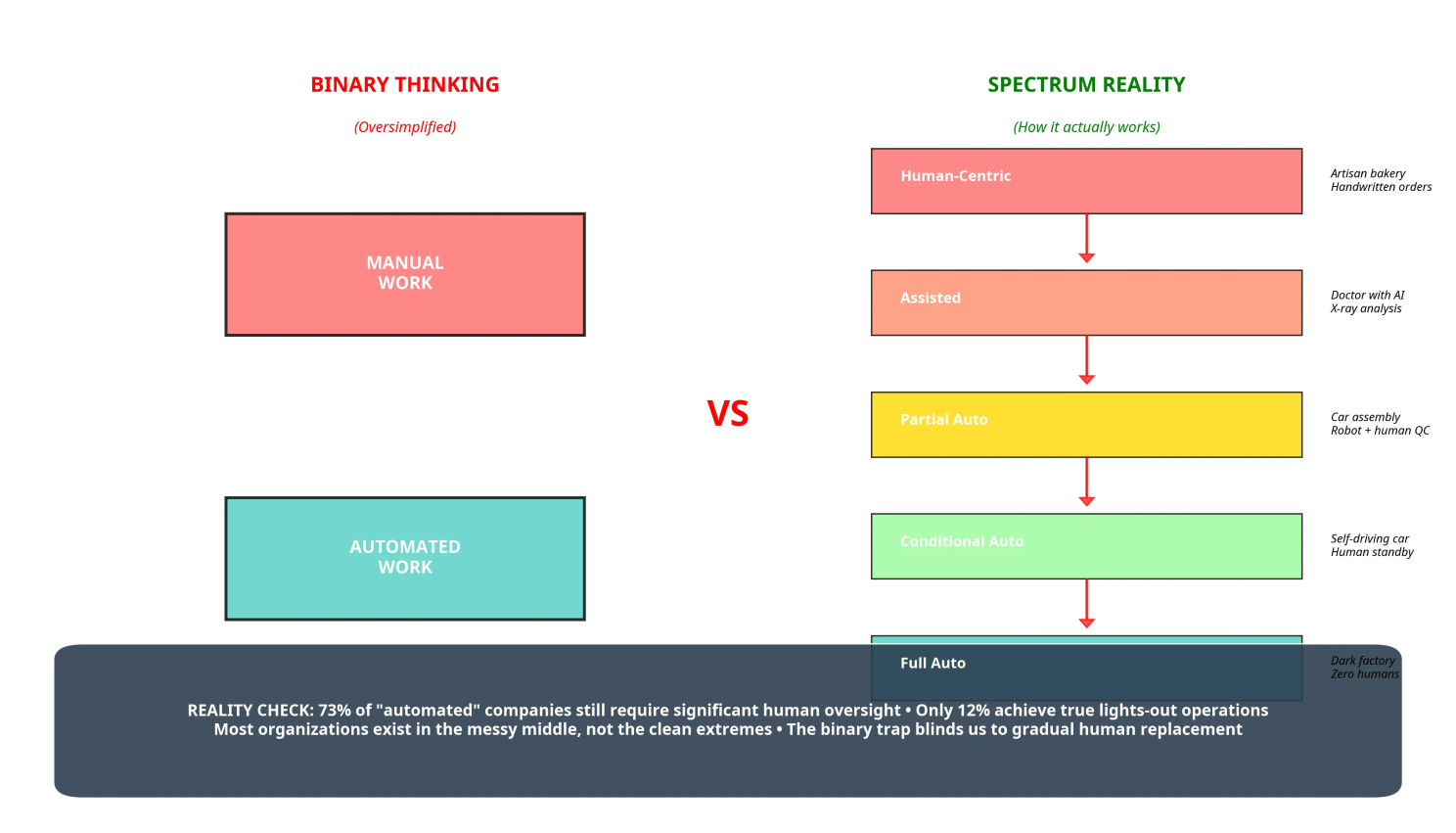
The reality is indeed messier, and a tad more nuanced, but way more terrifying than the binary crowd even wants to admit. I found companies that are operating across a broad spectrum, whereby some are using AI to enhance human workers, and other use humans to babysit AI systems, but there’s a fast-growing number of companies that have eliminated humans from the equation entirely.
To be honest, I had not expected that these developments would go this fast.
I think everyone in the IT industry maybe knows a case or two about a company that operates with ‘no humans’. And with ‘no humans’ I mean, nobody on sales, marketing, operations, finance, customer support or finance – and you certainly don’t need HR.
Recently I came across the initiative called Marcus, the 100% AI-based in-house marketing agency. This platform is built by a renowned marketing agency in my country called Prospex and it’s basically a mashup of an AI-powered marketing agency. They pitch it as a single place that replaces the mess of having to deal with scattered marketing tools, so teams don’t have to jump between platforms, and they sell this as faster and cheaper than a traditional agency, and promising up to half the cost.

Before I started this journey, I knew of just this one example, but after barely scratching the surface, I found dozens of similar outfits who are silently proving that “fully automated companies” aren’t a sci-fi thingy anymore, and that they are already billing clients and shipping work without a single human in sight.
So after I analyzed hundreds of organizations and reading enough academic papers to qualify for a PhD in “Holy Shit We’re All Doomed”, I started developing a simple classification system that actually makes sense of this chaos. It’s a two-dimensional framework that maps companies based on how automated they are and how deeply AI is baked into their business model. Think of it like a periodic table for the post-human economy but in this case I am cataloging the different ways humans become obsolete.
I have written a position paper about this subject for publication. It is much more succinct than this blog, so perhaps you’d be more inclined to read this over my musings.
You can download the paper here. Let me know in the comments what your thoughts are.
The classification framework
I was drowning in spreadsheets and trying to make sense of why some companies covet their workers while others treat them as expensive decorations. Traditional business analysis isn’t quite useful when you’re dealing with organizations that generate millions in revenue with no employees.
You need to build an alternative classification model first:
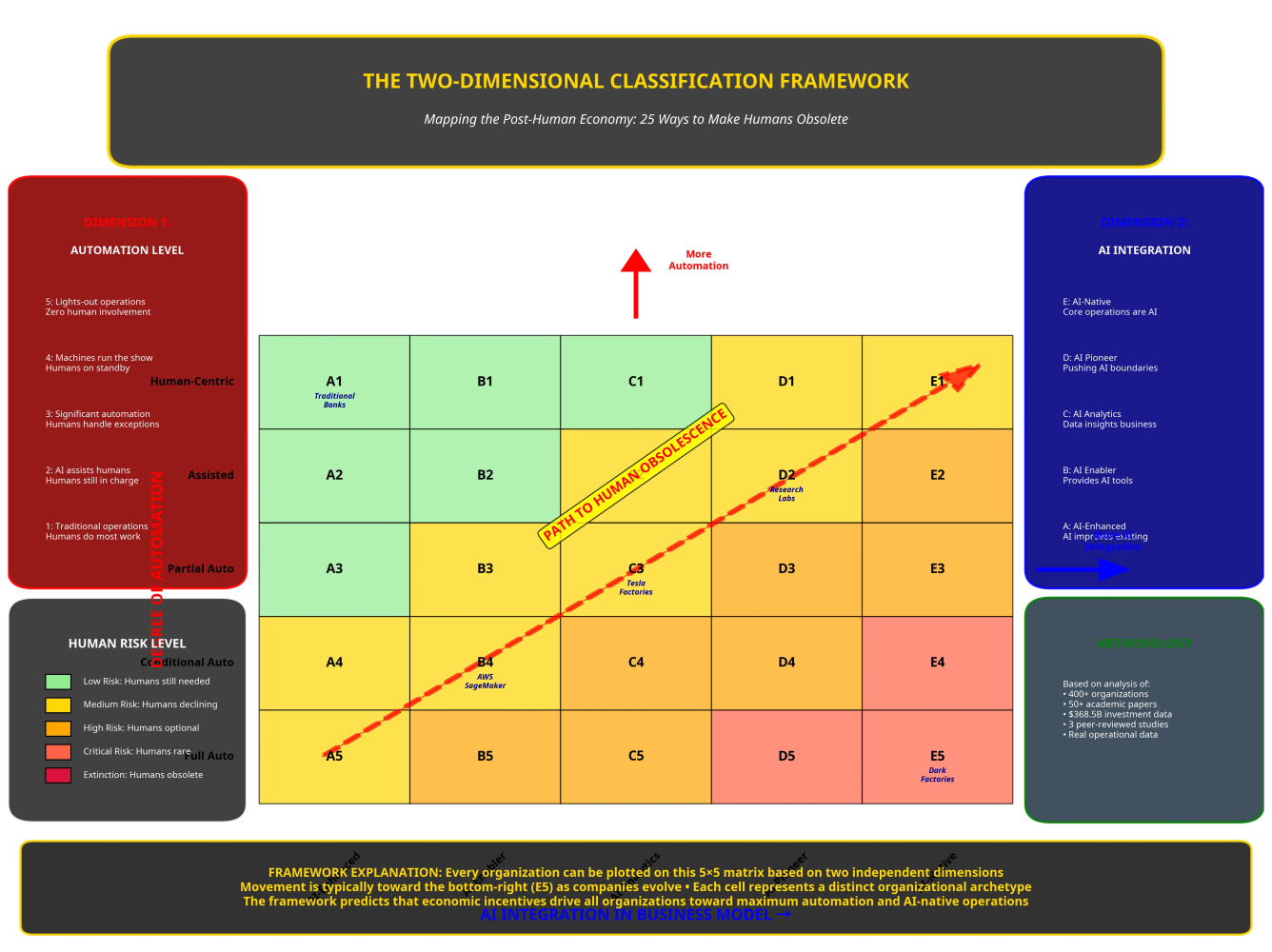
So, I did what any reasonable person would do when faced with chaos, I created a framework that turns the mess into a neat little grid of doom, and the result is a 5×5 matrix that plots every organization based on two simple questions 1. “How automated are you?” and 2. “How much of your business model depends on AI?” The model is based on 400+ organizations, 50+ research papers and $368.5B in investment data and that results in twenty-five cells, twenty-five different ways to make humans irrelevant.
The vertical axis measures automation levels from “humans do everything” to “humans do nothing“. In this ladder, each rung represents another step toward making your workforce obsolete. Level 1 companies still think humans are necessary for most tasks and level 5 companies have achieved the holy grail of capitalism, production without payroll.
The horizontal axis tracks AI integration from “we use AI to make our existing stuff better” to “our entire business IS AI”. This is the +AI and AI+ spiel we learnt from MIT’s ruthless paper. It is the difference between putting a smart doorbell on your house and living inside a computer. Companies in column A are dipping their toes in the AI pool and companies in column E have built their entire business model around artificial intelligence and humans are legacy systems.
Now, every company you come into contact with can be plotted somewhere on this grid, and they all want to move toward the bottom-right corner.
That is cell E5, the promised land of AI-native operations with full automation. It’s where the dark factories live, where zero-employee companies thrive, and where human workers go to wither away and go extinct.
The ‘beauty’ of this framework is that it predicts behavior.
Companies don’t randomly jump around the grid; they follow predictable paths toward maximum efficiency. A traditional bank (A1) might add AI chatbots (A2), then automate loan processing (B3), then eliminate human underwriters (C4), until eventually they’re running algorithmic banking operations (E5) that make lending decisions faster.
The color coding also tells the story behind the scenes. Green cells are where humans still have job security – for now – yellow cells are where the writing is on the wall, but nobody wants to read it, orange cells are where humans become “strategic advisors”, and red cells are where humans exist only to flip the on switch and make sure nothing breaks.
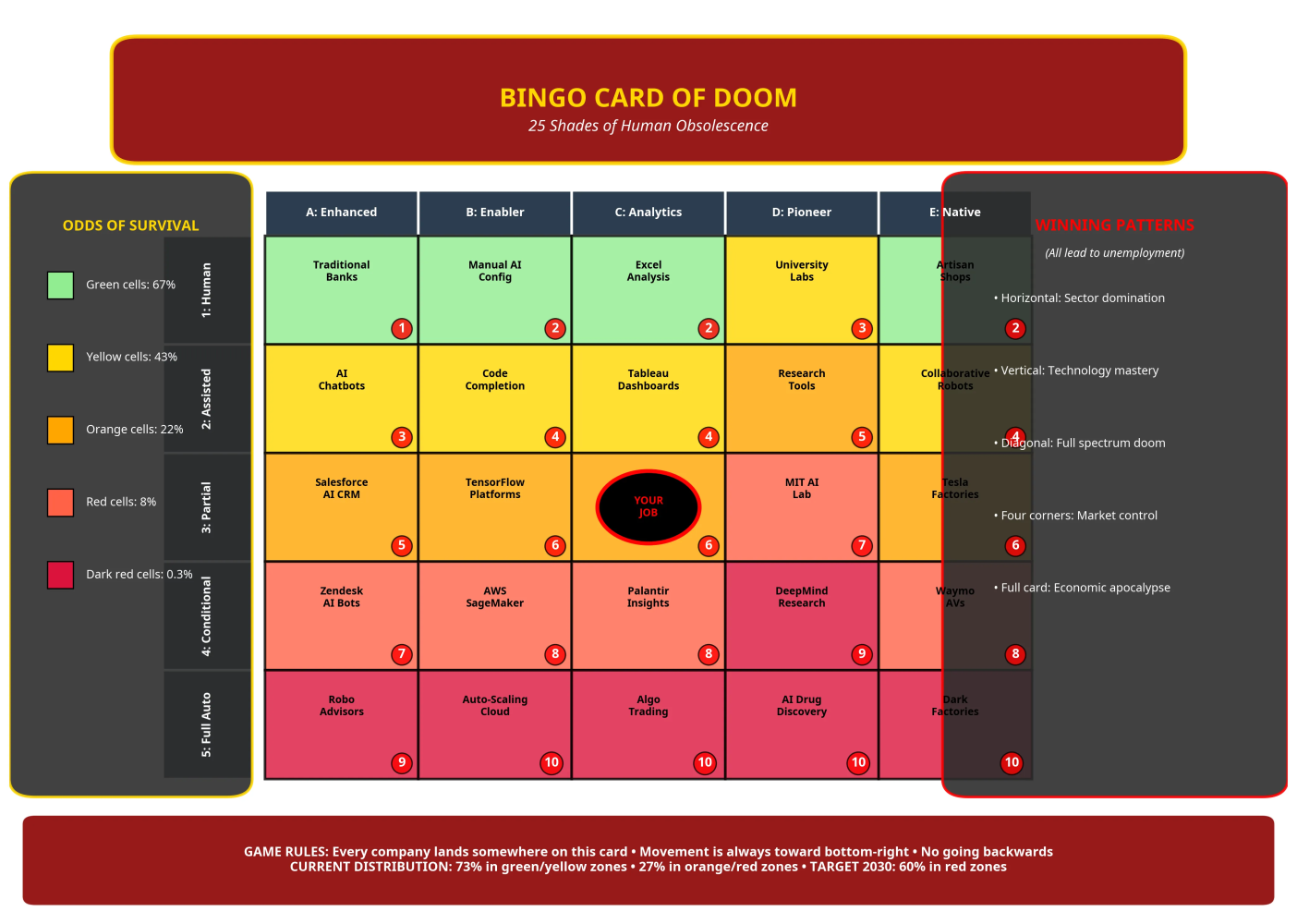
The darkest red cell – E5 – is where our future lives.
It is populated by organizations that have achieved the ultimate fantasy for capitalists, which is infinite scalability without human limitations. No sick days, no vacation requests, no sexual harassment training, no union negotiations, no whining whatsoever. Just pure, lovely, mechanical efficiency generating profits. And the humans are left to figure out what to do with themselves.
What makes this framework particularly twisted is that it’s not theoretical.
I didn’t ‘invent’ these categories, I discovered them by analyzing real companies that are already operating in each cell.
The framework doesn’t predict the future, but it maps the present. And once you see the pattern, you can’t unsee it. Every company announcement about “digital transformation” or “operational efficiency” is really nothing more than a press release about moving southeast on this grid. Every AI implementation is a step toward human irrelevance. Every automation project is another rung up the ladder toward total lights-out operations.
I built this framework to make sense of the chaos, but now I realize the chaos was the point.
While I was debating the ethics of AI and the future of work in my posts, the market was already sorting itself into this neat little matrix of human obsolescence. The classification system reveals that what is happening was always . . . inevitable.
The framework tells you exactly where you are, where you’re going, and how screwed you guys are when you get there. The only question left is whether you’re driving the car or getting run over by it.
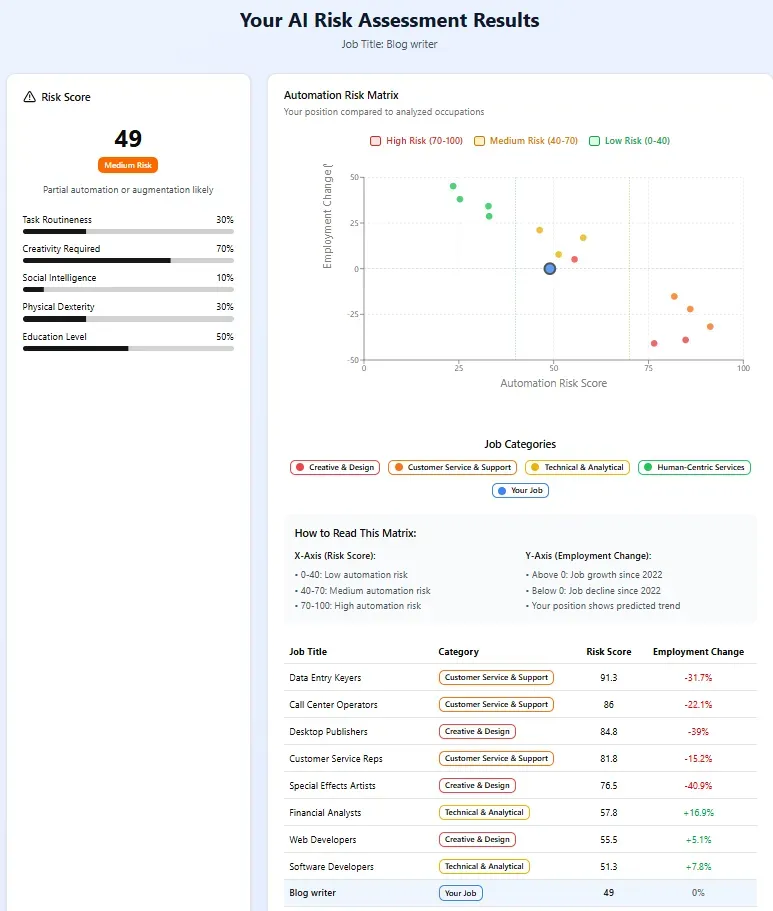
And if you want to calculate the chance of your job being “automated” by AI – checkout this AI-automation risk-assessment tool: AI Automation Risk Assessment – Will AI Replace Your Job?
Just fill in your job title, answer a few questions and voila:
The automation spectrum
The first dimension of the model measures how much of a company’s operations run without human intervention. I found there are five distinct levels of human obsolescence, each one is more depressing than the last:
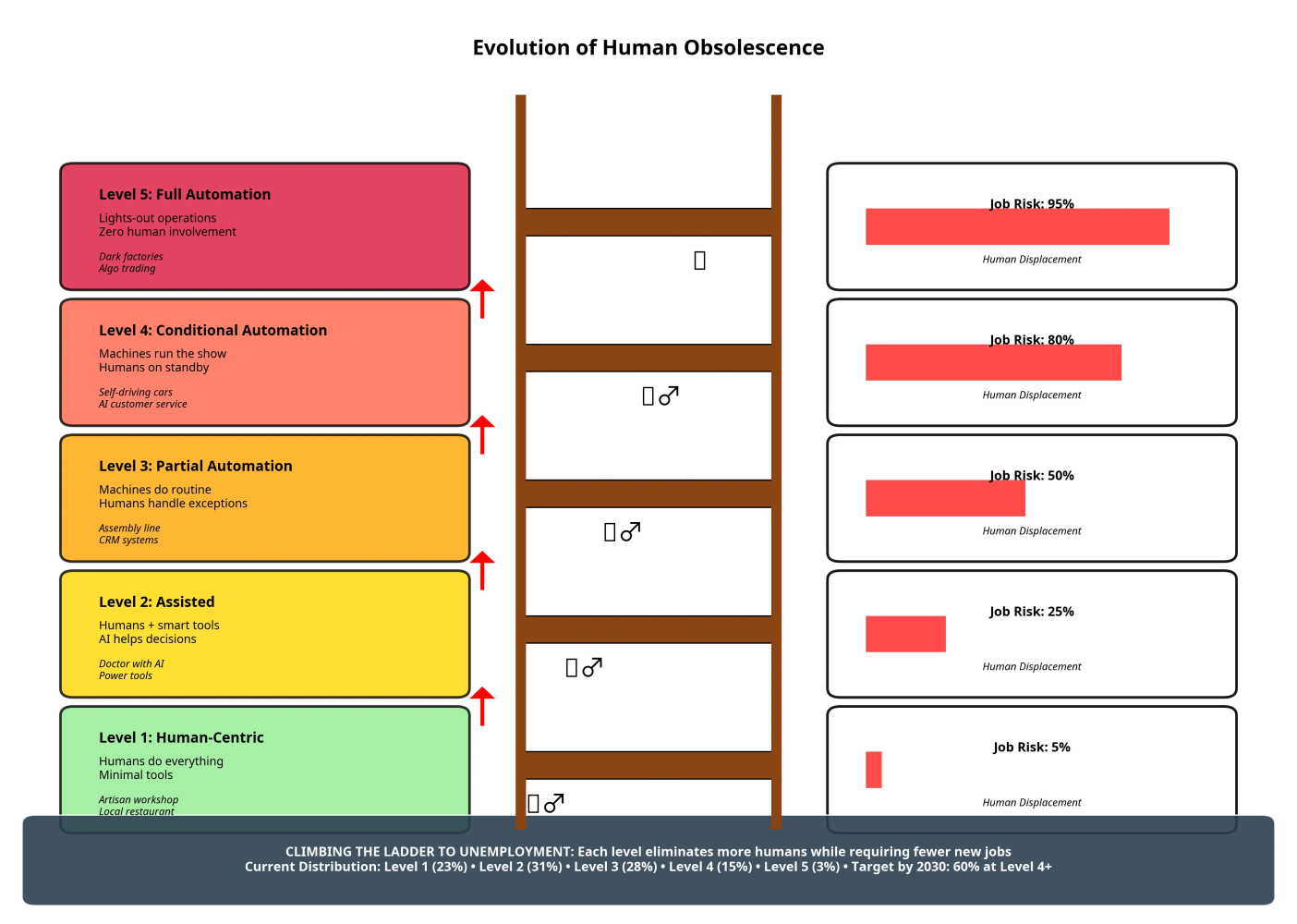
- L1. Human-centric ops. These are the traditional predominant businesses where humans do most of the work like artisan bakeries, small law firms, and that restaurant where the owner still takes your order by hand. Quaint and artisanal. Doomed, but yes, artisanal.
- L2. Assisted ops. Humans are still in charge, but they’ve got AI-Assistants. Like for instance doctors using AI to read X-rays, financial analysts with machine learning models, factory workers with collaborative robots. This is basically where most of the organizations are today.
- L3. Partial automation Now things are getting spicy. Significant chunks of the workflow are automated, but humans still handle the tricky bits. Think modern car assembly lines or customer service systems with human escalation, data analytics platforms that generate insights but need humans to interpret them. The humans are becoming the exception handlers.
- L4. Conditional automation The machines run the show under normal condition and humans are on standby for when things go sideways. Here you see semi-autonomous customer service systems, managed AI platforms, autonomous vehicles in geofenced areas, and of course Amazon’s meat puppets for the coding bots. . . The humans are basically expensive insurance policies. Read: How AI turns Amazon software engineers into meat puppets for the machine | LinkedIn
- L5. Full automation Lights-out operations. No humans required during normal operations. Dark factories – literally – algorithmic trading systems, zero-employee software companies. The humans have been relegated to system design and strategic direction. If they’re lucky.
Here’s one more video:
The AI integration archetypes
The second dimension categorizes how companies use AI to create and capture value. I identified five distinct archetypes whereby each archetype represents a different flavor of our inevitable obsolescence:
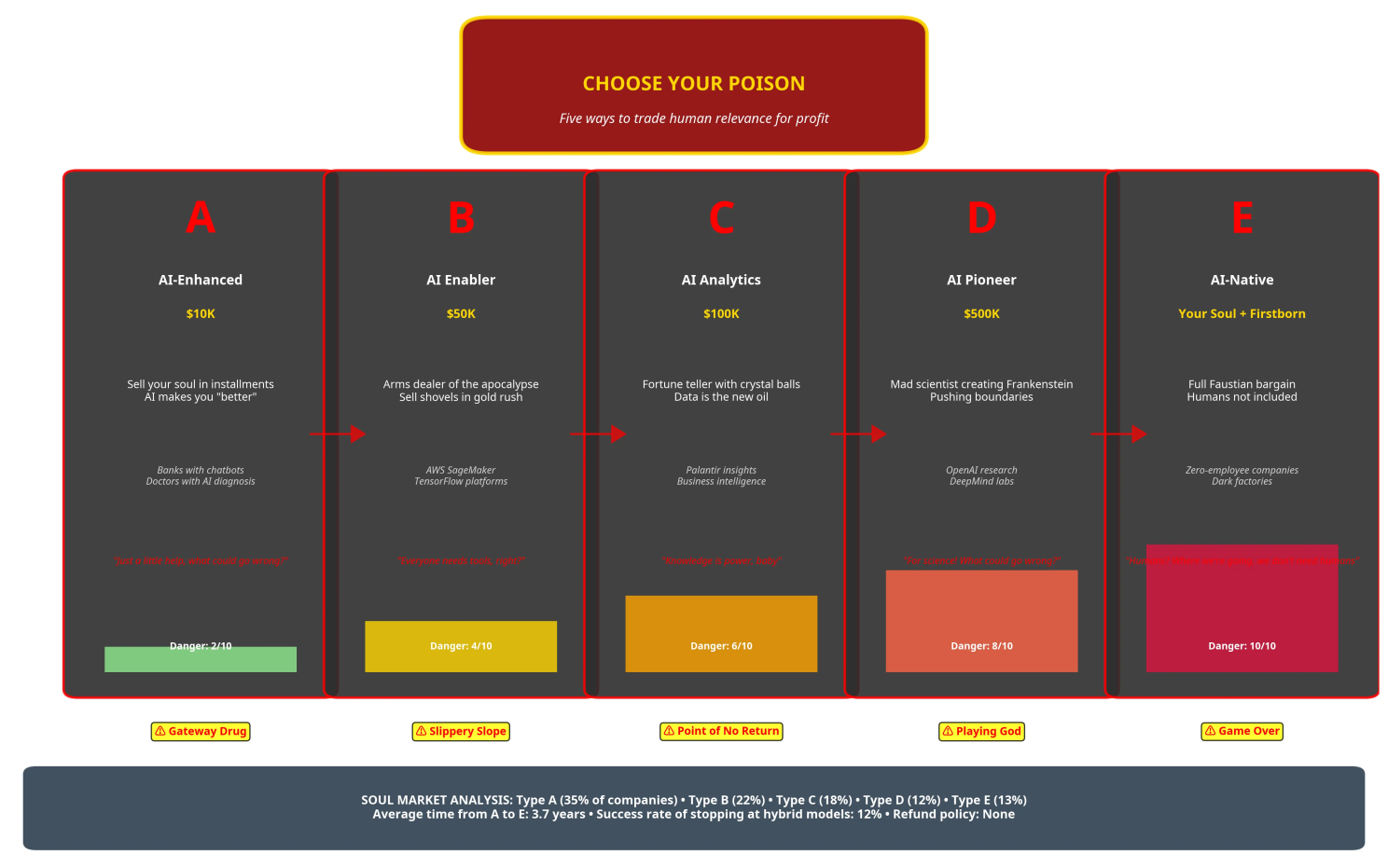
- Archetype A. AI-enhanced. These companies use AI to make their existing products and services better. Banks with AI chatbots, retailers with machine learning inventory systems, healthcare providers with diagnostic assistance.
- Archetype B. AI enabler. These are the arms dealers of the AI revolution. They provide the tools, platforms, and infrastructure that let other companies build AI solutions. Cloud machine learning platforms, AI development frameworks, pre-built AI services. They’re making money selling shovels during the gold rush.
- Archetype C. AI Analytics provider Their entire business is turning data into insights using AI. Business intelligence platforms, market research companies with AI trend analysis, specialized analytics providers.
- Archetype D. AI pioneer. The mad scientists pushing the boundaries of what AI can do. Research labs, AI startups working on foundational technologies, university research centers. They’re either going to save humanity or doom us all. Probably both.
- Archetype E. AI-native operations Their core operations are built around AI and automation with minimal human involvement. Zero-employee companies, fully autonomous dark factories, algorithmic trading firms. They’re what happens when you take humans out of the equation entirely.
The dark factories
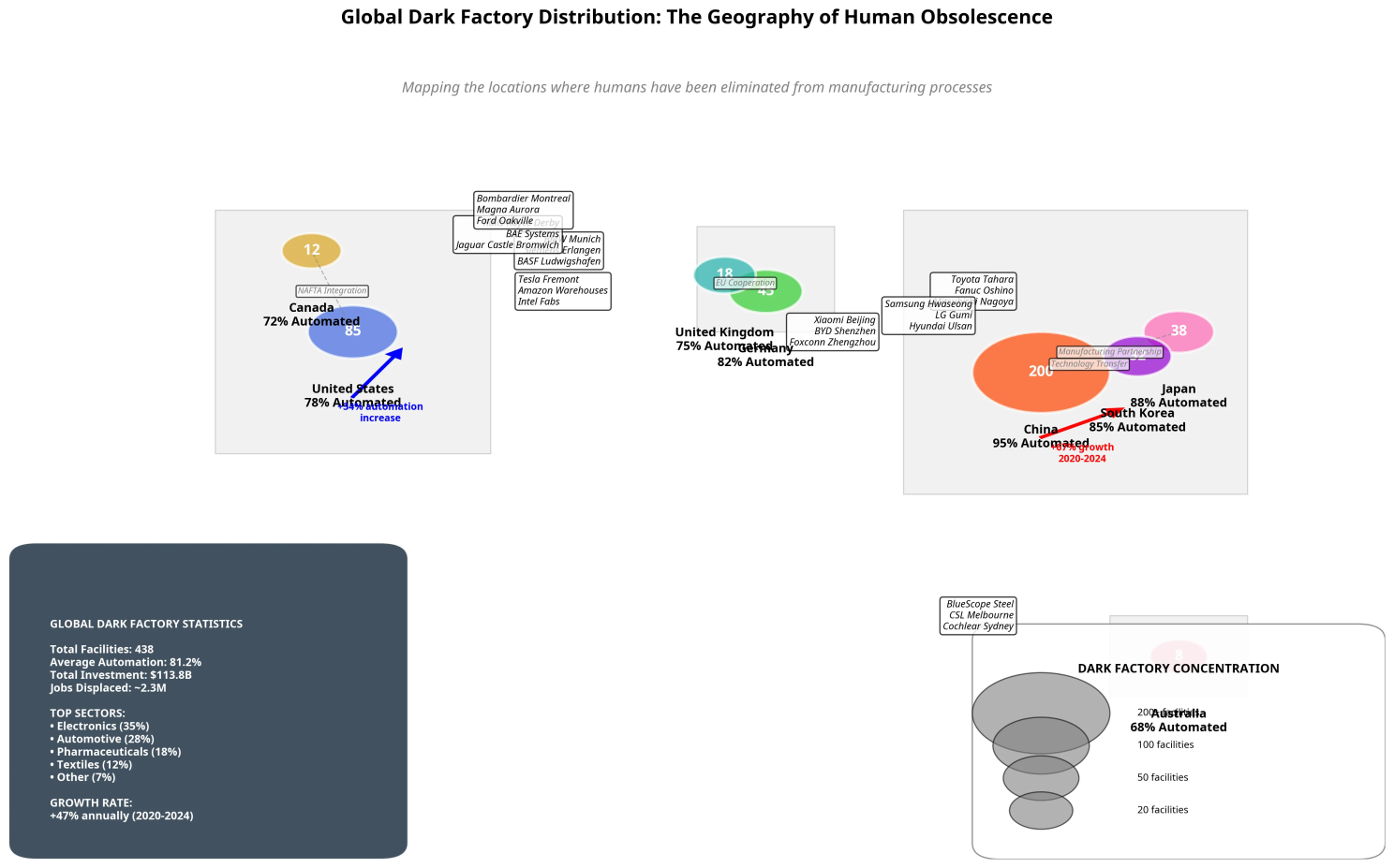
In Shenzhen, China, there’s a Build Your Dreams factory† that produces electric vehicle batteries with 98% automation. Fewer than 20 humans oversee a production line that would have employed 2,000 workers just a decade ago.
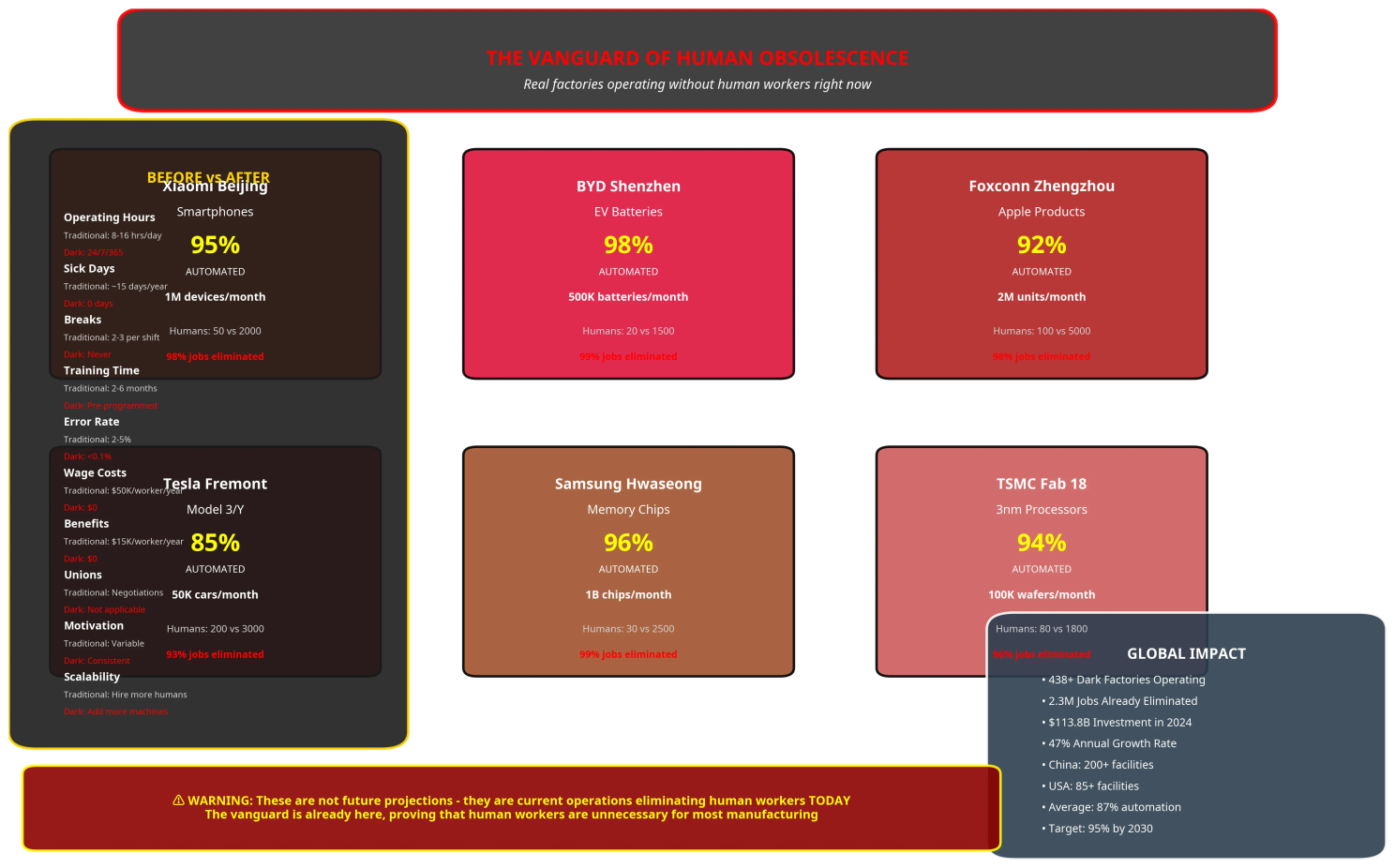
The factory runs 24/7 without breaks or bathroom visits or complaints about the cafeteria food. No sick days, no vacation requests, no HR drama, just production efficiency.
Xiaomi’s smartphone manufacturing facility in Beijing cranks out over 1 million devices monthly with a skeleton crew of 50 humans.
The robots don’t need motivational posters or team-building exercises. They just build phones with the mechanical precision of a Swiss watch and the empathy of a parking meter.
Foxconn’s “lights-out” production lines for Apple products are quite the pinnacle of this trend. The facilities literally don’t need lighting in the production areas because no human eyes need to see what’s happening. It’s manufacturing in the dark, both literally and metaphorically.
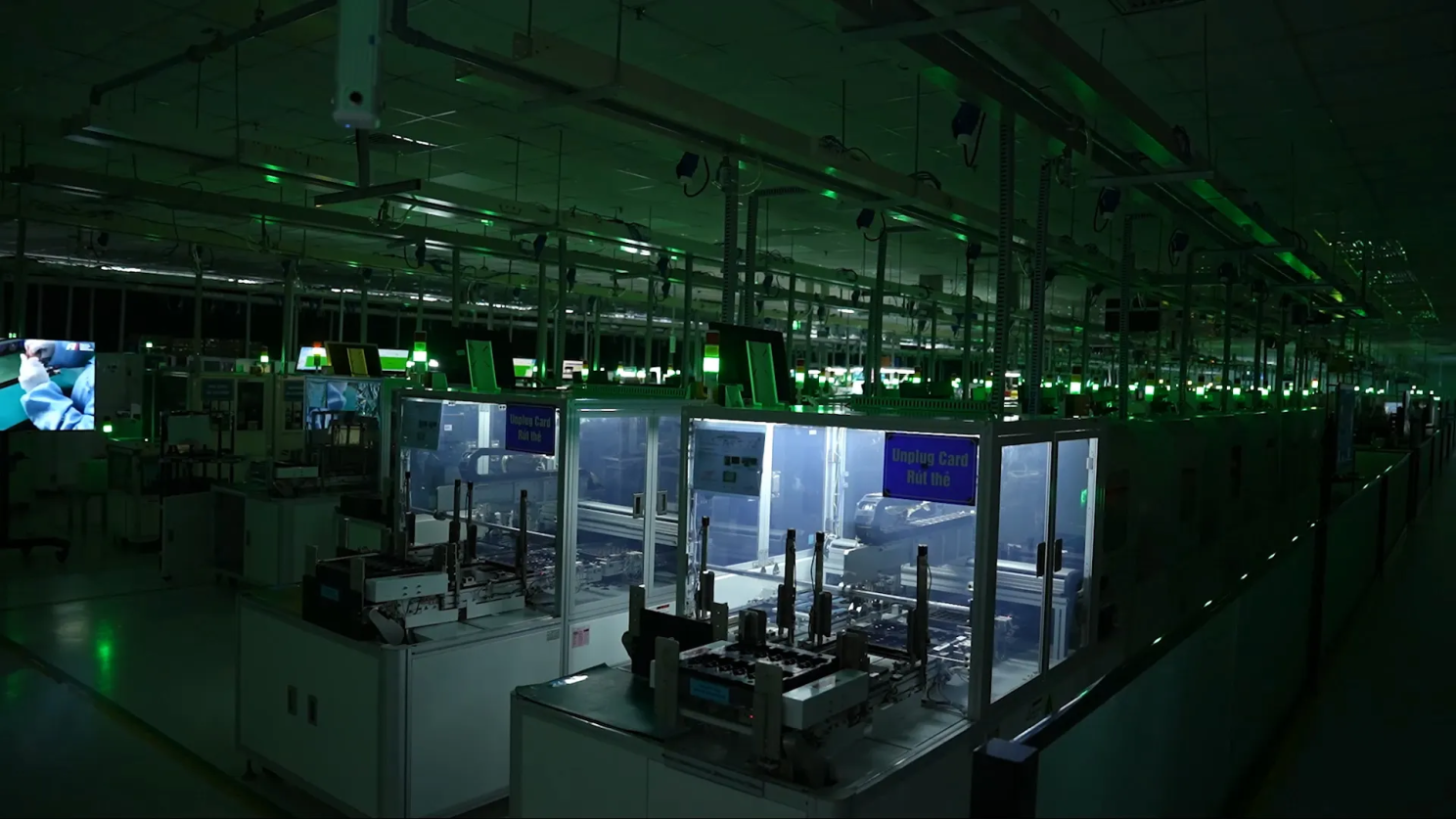
China leads the world with over 200 facilities operating at Level 4 or Level 5 automation. The Chinese government’s “Made in China 2025” initiative is a roadmap for making human workers obsolete.
They’re not even trying to hide it anymore.
† BYD is a Chinese tech and manufacturing conglomerate in Shenzhen. They build electric cars, buses, rechargeable batteries and electronics. This company is known for vertical integration, meaning they try to control much of their supply chain (making batteries, components). And so it makes a lot of sense to automate as much as their supply chain as possible.
Zero-employee companies
We now know that dark factories eliminate humans from physical production, but zero-employee companies prove that you don’t need humans for digital operations either.
In my research I found 47 companies globally that operate with fewer than 5 human employees and still manage to generate over $1 million in annual revenue.
A rather modest number compared to the number and volume of dark factories.
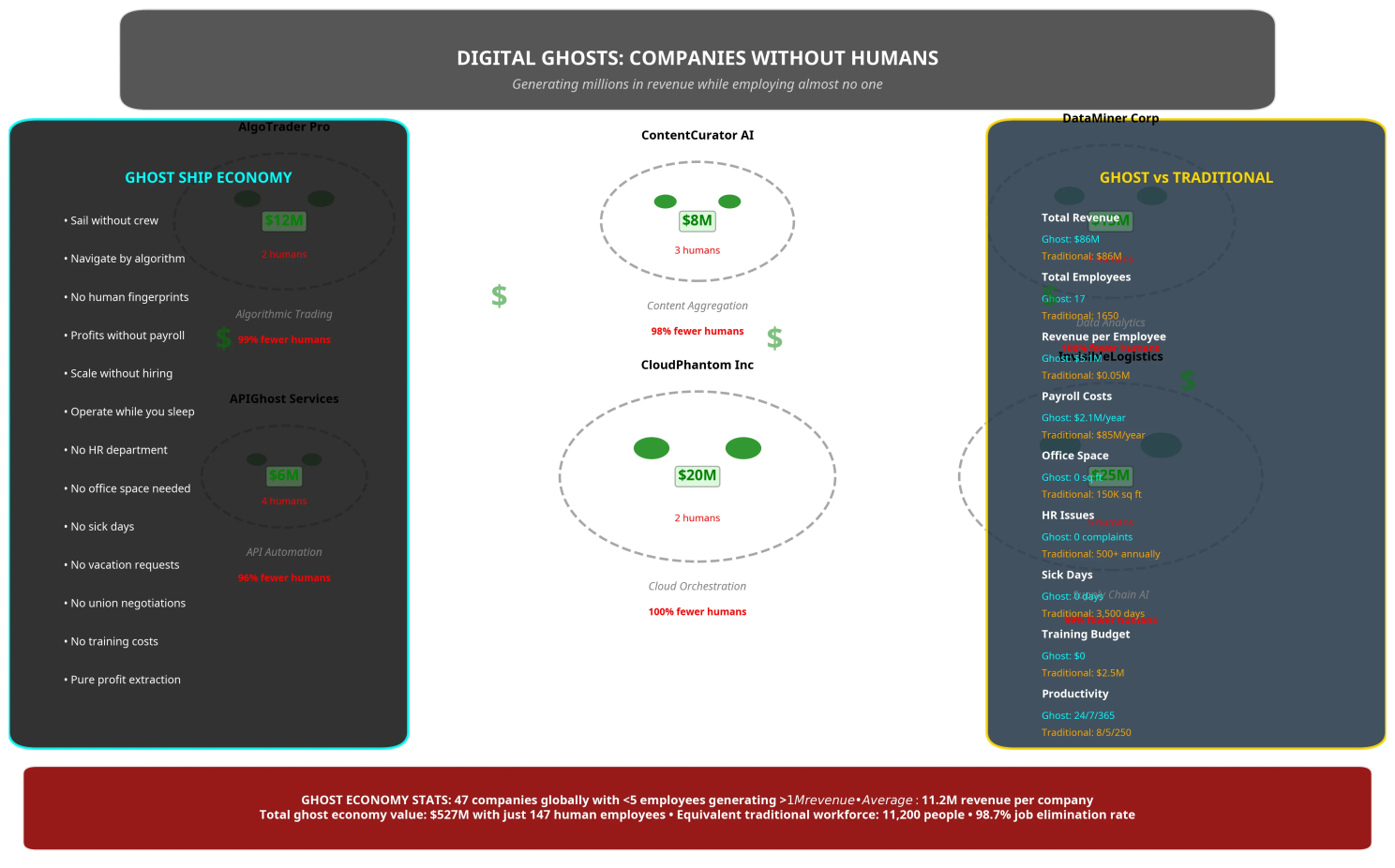
I know what you’re thinking, no, these aren’t mom-and-pop operations, nor fraudsters companies. They are sophisticated businesses that have automated everything from customer acquisition to product delivery to customer support. They are the ghost ships sailing through the new economy and they are generating profits without leaving any human fingerprints.
Here’s a few.
- Algorithmic trading firms execute millions of transactions daily using machine learning algorithms. The humans are relegated to strategy development and risk management – basically the roles that require creativity and judgment. For now.
- Content curation platforms like Marcus, aggregate, process , and distribute information using natural language processing. They serve millions of users with minimal human oversight. The algorithms decide what you see, when you see it, and how it’s presented. The humans just cash the checks.
- API-based software services provide automated functionality to other applications, scaling to serve millions of requests without human intervention. . .
Follow the money
It got really interesting when I started to follow the money. Global investment in unmanned economy technologies hit $368.5 billion in 2024.
That’s not a typo. Nearly $370 billion flowing into technologies designed to eliminate human workers. In comparison, corporate AI investments (including VC, M&A, etc) hit about US $252 billion – with VC/startup funding into AI companies in 2024 ranged between $110 billion and $132 billion.
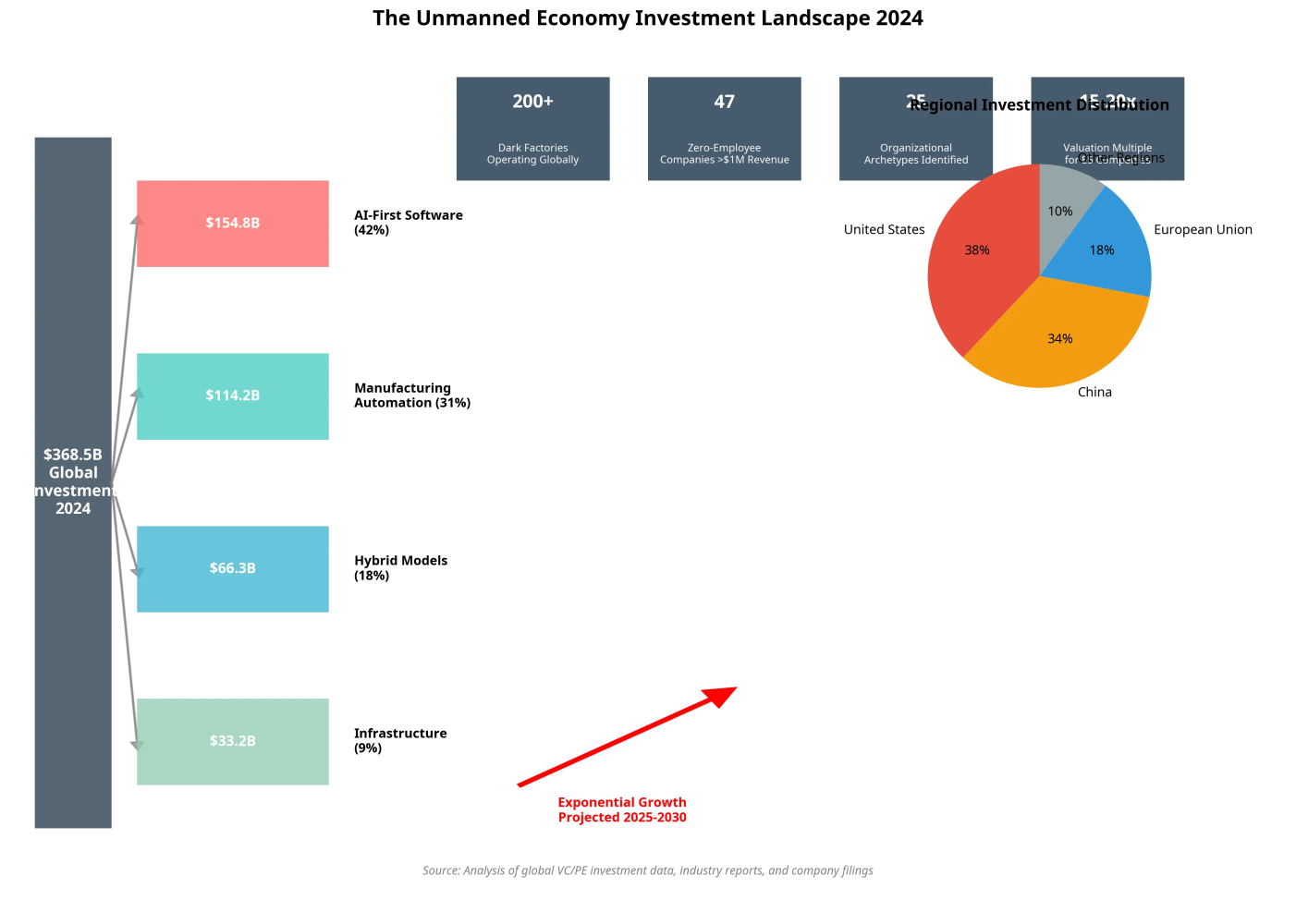
The allocation of funds tells the whole story:
- 42% toward AI-first software companies
- 31% toward manufacturing automation and robotics
- 18% toward hybrid models that combine AI with strategic human involvement
- 9% toward infrastructure and enabling technologies
The smart money isn’t betting on humans. China alone has a $137 billion government fund dedicated to robotics and AI development. The United States dominates AI-first software innovation, but China owns manufacturing automation. Europe focuses on hybrid models (human/robotics) and regulatory compliance (hahahahaha – cynical laughter), and with it, they are basically admitting defeat plus handing the survivors extra paperwork.
Valuation multiples for companies in the E5 category (AI-Native Operations at Full Automation) average 15-20x revenue.
Investors are paying premium prices for businesses that don’t have to deal with human employees. The market has spoken, and it’s saying that humans are expensive, unreliable, and ultimately . . . unnecessary.
The technology stack behind our obsolescence
The unmanned economy runs on a four-layer technology stack that is more sophisticated than most people realize:
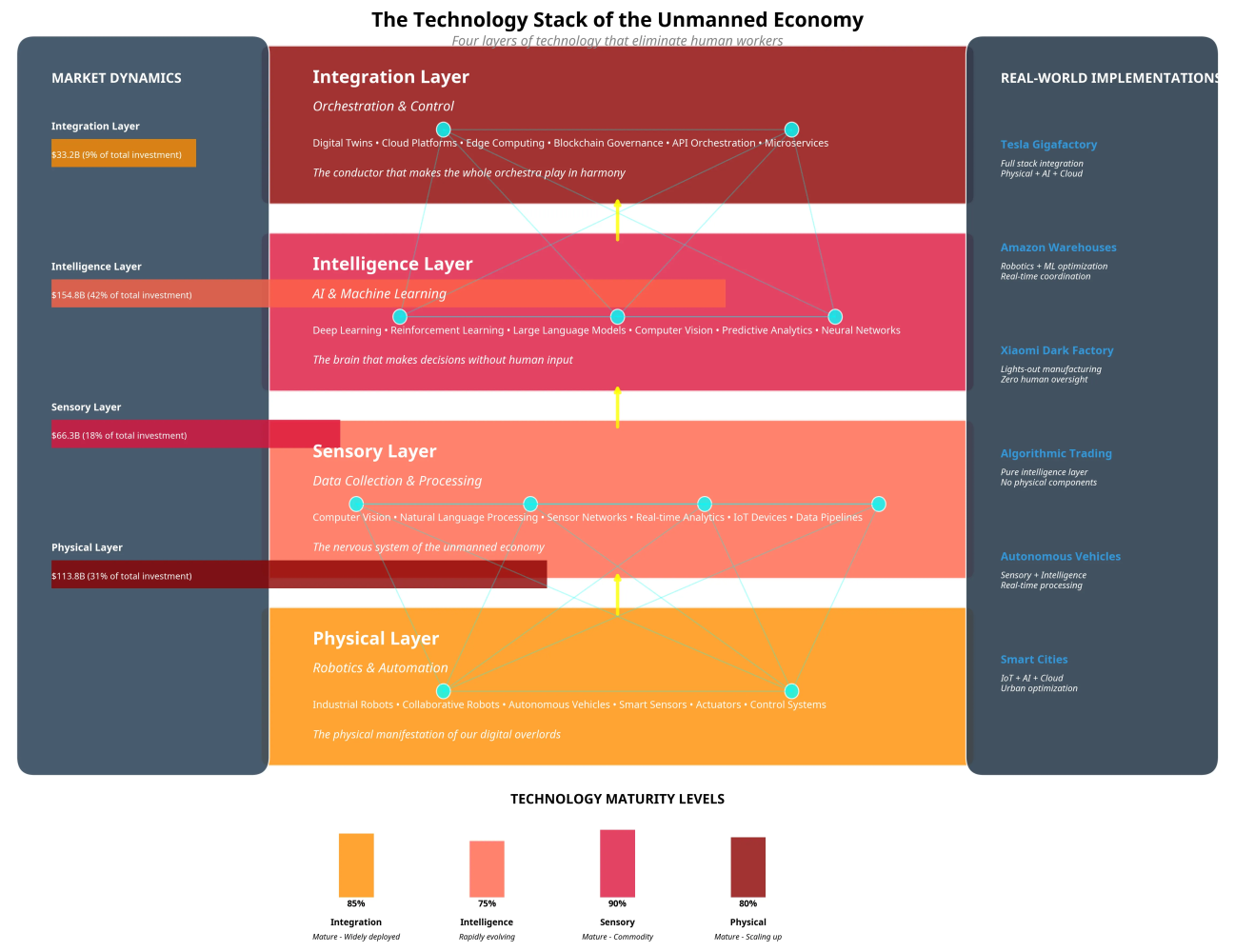
- Physical Layer – robotics and automation. Industrial robots, collaborative robots, autonomous vehicles, smart sensors, IoT devices. The physical manifestation of AI.
- Sensory layer – data collection and processing. Computer vision systems, natural language processing, sensor networks, real-time data analytics. The nervous system of the unmanned economy.
- Intelligence layer – AI and Machine Learning. Deep learning models, reinforcement learning algorithms, large language models, predictive analytics. The brain that makes decisions without human input.
- Integration layer – orchestration and control. Digital twins, cloud computing platforms, edge computing, blockchain governance. The conductor that makes the whole orchestra play in harmony.
Each layer builds on the others and is creating a stack that is more resilient and capable than any human-centered system could ever be.
Where are the investments going?
The unmanned economy is concentrated in three regions:
China (34% of global investment) Dominates manufacturing automation and dark factory development. Government policy actively supports human replacement. They’re not even pretending to care about employment impacts.
United States (38% of global investment). Leads in AI-first software companies and enabling technologies. Silicon Valley continues to be the epicenter of human obsolescence innovation. But when it comes to dark factories – China still leads the pack.
European Union (18% of global investment) Focuses on hybrid AI models and regulatory compliance. Automation benefits with human-centered values. Good luck with that, bunch of bureaucrats.
The remaining 10% is scattered across other regions that are basically spectators in this transformation. They’ll be importing the technology and the unemployment that comes with it.
The timeline of our doom
This transformation has been brewing for decades and keeps picking up speed with every new technological breakthrough, and even though the wider public barely sees it yet, the moment it hits the surface and people catch on, the shock will be massive. But you are now prepared.
- 1771: The first automated spinning mill eliminates textile workers. The industrial revolution begins its long march towards making humans obsolete.
- 1961: The first industrial robot starts work at a General Motors plant. Humans begin training their replacements.
- 1980s: Computer-controlled manufacturing systems spread across industries. The writing is on the wall, but nobody can read it yet.
- 2000s: Internet-based automation enables new forms of digital business. The foundation for zero-employee companies is laid.
- 2010s: Machine learning and cloud computing converge. AI systems become practical for business applications.
- 2020: COVID-19 accelerates automation adoption as companies discover they can operate with fewer humans. The pandemic becomes the excuse everyone was waiting for.
- 2024: The unmanned economy reaches critical mass with $368.5 billion in investment and hundreds of operational examples.
- 2025-2030: Projected exponential growth as hybrid models evolve toward full automation and new sectors embrace unmanned operations.
Here’s the timeline for those who cannot read:
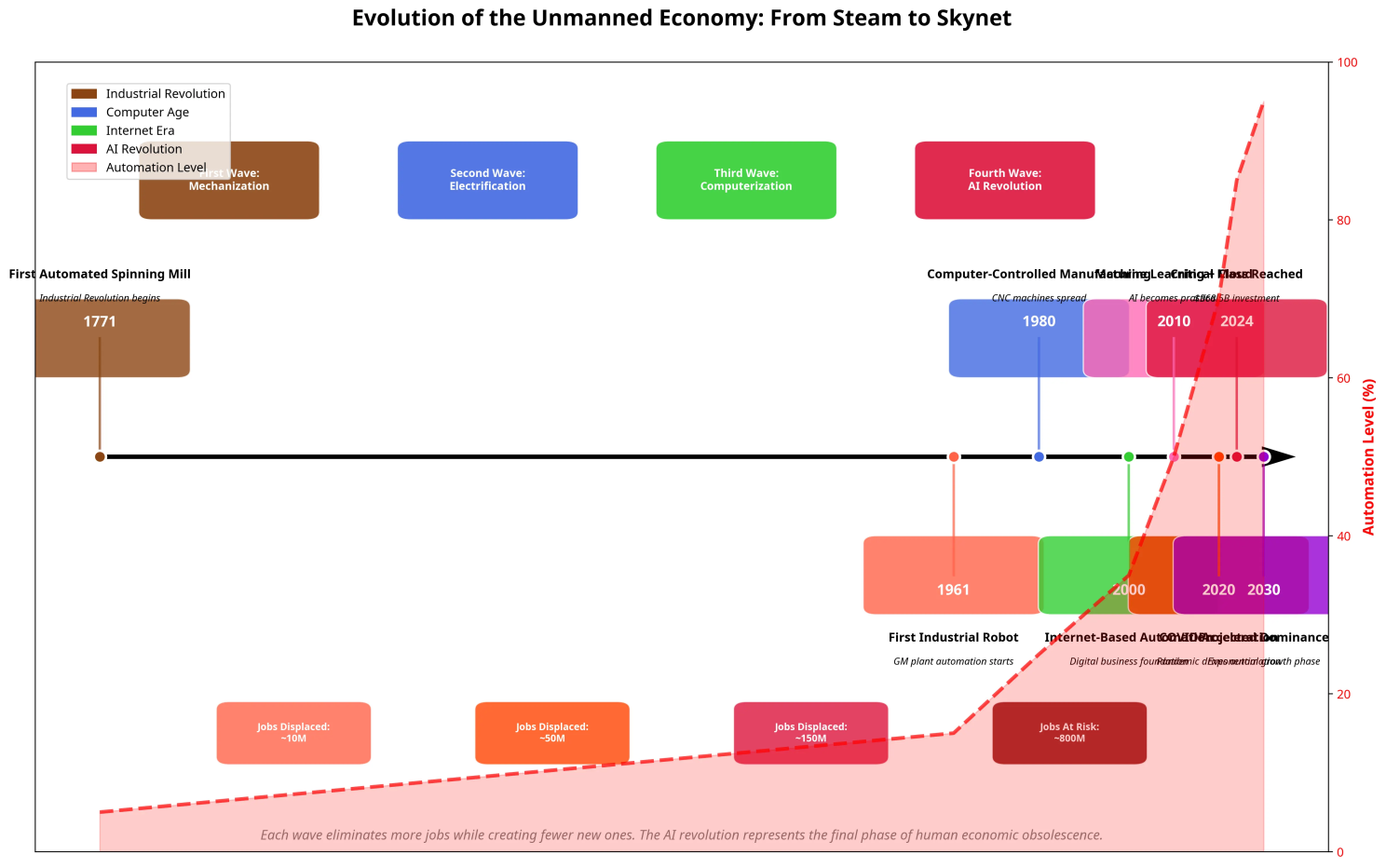
The timeline shows that each wave of automation eliminates more human jobs while creating fewer new ones. Just forget the mantra that the governments are spinning “technology will replace jobs but will always create new ones”. Sure. If you have a Pd.D. in Machine Learning, specialized in embodied AI perhaps, you will have a cozy future, but if your daily job consists of screwing caps on tubes of toothpaste, well, better learn how to panhandle.
The economic implications
The unmanned economy creates a fundamental problem. It generates wealth without generating employment.
But the big question is, who benefits from this wealth? You can guess the answer. Read: We are in the midst of an incremental apocalypse and only the 1% are prepared | LinkedIn. Traditional economic models assume that production creates jobs, which create income, which creates demand for more production. The unmanned economy breaks that cycle. When a dark factory produces goods without employing workers, where do the customers get the money to buy those goods? When zero-employee companies generate profits without paying wages, who has the purchasing power to sustain the economy?
The ones who have coughed up the $368.5 billion, they know, they are not in it for the long term. They are bleeding our current economy dry, making everything too expensive for the workers to pay for, and once we have reached a certain point (I call it the ‘singularity’) our economic structure collapses, but they will be prepared. The ultra-rich are not investing in a stock portfolio anymore. There are heaps of cash lying around. They are buying up land, and infrastructure. Everything that grows in value when society collapses. And our politicians do not care, they are either in the pocket of the billionaire investors or they simply do not have a vision – or they don’t know how to combat it (cause honestly, it can’t) – so they look away and focus on climate change and drinking your coke through a paper straw.
The ones who coughed up the $368.5 billion already know the score. They’re not playing for the long term; they’re stripping the current economy until workers can’t afford their own groceries.
Once we hit the tipping point – call it the “singularity” if you will – the whole structure buckles. But they’ll be ready. The ultra-rich aren’t stashing cash in stock portfolios anymore, they’re hoarding land and infrastructure, the stuff that skyrockets when society goes belly-up. And the politicians don’t give a damn. Half are bought, the rest are clueless, so they look the other way and talk about climate targets, up the governmental instruments that control the masses for when the inevitable happens (like the CDBC†) and make you sip your Coke through a paper straw while the billionaires buy the ground under their feet.
† Read: We are racing toward a singularity, and no, it’s not AI | LinkedIn AND Money, the final frontier. . . | LinkedIn

This isn’t an academic question though. It is the central challenge of the post-human economy. We are creating a system that’s incredibly efficient at producing goods and services but terrible at distributing the benefits of that production.
Some economists propose universal basic income as a solution. Others suggest progressive taxation of automated systems. A few advocate for productivity sharing mechanisms that ensure automation benefits are distributed more broadly.
But the uncomfortable truth is that none of these solutions address the fundamental question of human purpose in a world where machines can do most jobs faster, and cheaper than humans.
Future scenarios
Based on current trends and investment patterns, I can see several possible outcomes for the unmanned economy:
- Scenario 1. Gradual transition. Hybrid models dominate for the next decade; companies slowly increase automation and try to maintain strategic human involvement. Employment shifts rather than disappears, and humans are focusing on roles that complement AI systems – regulation tries to slow down the rate of transition.
- Scenario 2. Accelerated displacement. Technological breakthroughs in AI and robotics accelerate the transition to fully automated operations. Mass unemployment occurs faster than social systems can adapt. Economic and social disruption follows.
- Scenario 3. Regulatory intervention. Governments implement policies that slow automation adoption to protect employment. Taxes on automated systems, requirements for human involvement, and other interventions create artificial barriers to full automation. The EU will be leading the pack.
- Scenario 4. Bifurcated economy. The economy splits into two tiers: a highly automated, efficient unmanned sector and a human-centered, less efficient – artisanal – traditional sector. Wealth concentrates in the unmanned sector while employment concentrates in the traditional sector.
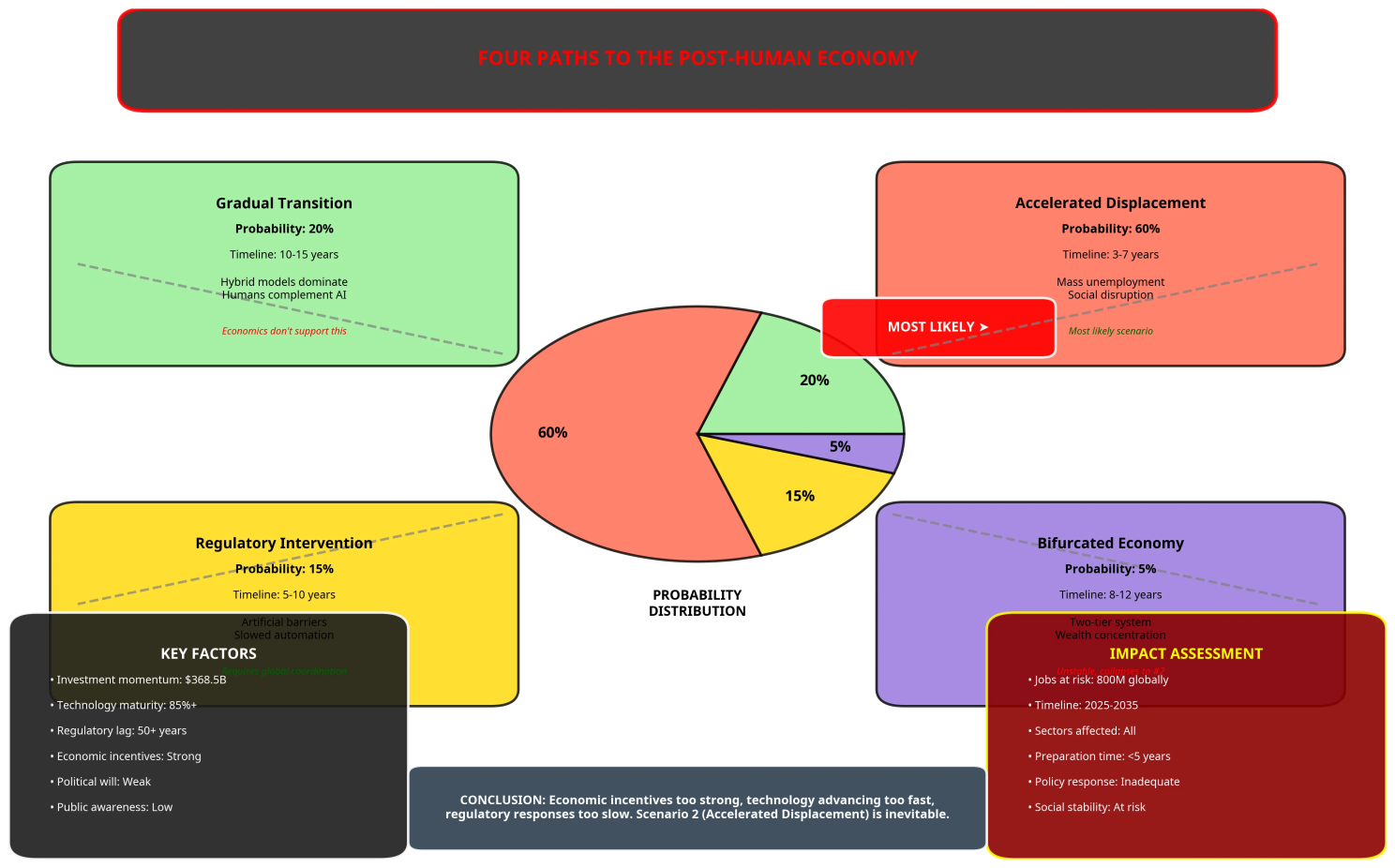
My money is on Scenario 2.
Because the economic incentives for automation are too strong and there’s too much free capital waiting for a purpose to speed up the transition, and the technology is advancing too quickly, and the regulatory responses are too slow and fragmented to prevent accelerated displacement.
The numbers don’t lie either.
Venture capital and private equity firms are pouring money into unmanned economy technologies at unprecedented rates. The most successful companies in my classification matrix are those that have eliminated the most human dependencies. Investors reward efficiency, scalability, and predictability. Humans are inefficient, unscalable, and unpredictable.
This creates a feedback loop. Successful automation attracts more investment, which funds more automation, which eliminates more jobs, which creates more pressure for automation.
It’s a virtuous cycle if you’re a robot, a vicious cycle if you’re human.
Abd companies that embrace unmanned operations gain significant competitive advantages:
- Cost structure. No salaries, benefits, training costs, or HR overhead. Fixed costs instead of variable costs.
- Scalability. Systems that can scale to serve millions of customers without proportional increases in operational costs.
- Consistency. No human error, no bad days, no personality conflicts. Predictable performance every time.
- Availability. 24/7 operations without breaks, vacations, or sick days. Always-on service delivery.
- Speed. Automated decision-making and processing that operates at machine speed.
Companies that maintain human-centered operations face increasing pressure from unmanned competitors. The unmanned economy has become a geopolitical competition. Countries that lead in automation and AI technologies will dominate global markets. Countries that lag behind will become economic colonies, import technology and export raw materials and low-skilled labor.
China’s aggressive push toward manufacturing automation is all about economic dominance, and the United States’ leadership in AI software is about maintaining technological supremacy. But the developments are going fast. And mostly in factories and robotics, and that is why Jensen Huang states that the next hype will be in physical AI (he calls it embodied AI, but there’s a subtle difference).
Europe’s focus on human-centered AI and regulatory frameworks might be admirable from a social perspective, but it’s suicidal from a competitive standpoint. You can’t regulate your way to economic leadership when your competitors are eliminating the regulations along with the humans.
The data
The numbers tell a story that’s more terrifying than any science fiction movie. I created these visualizations to show you exactly how deep this rabbit hole goes.
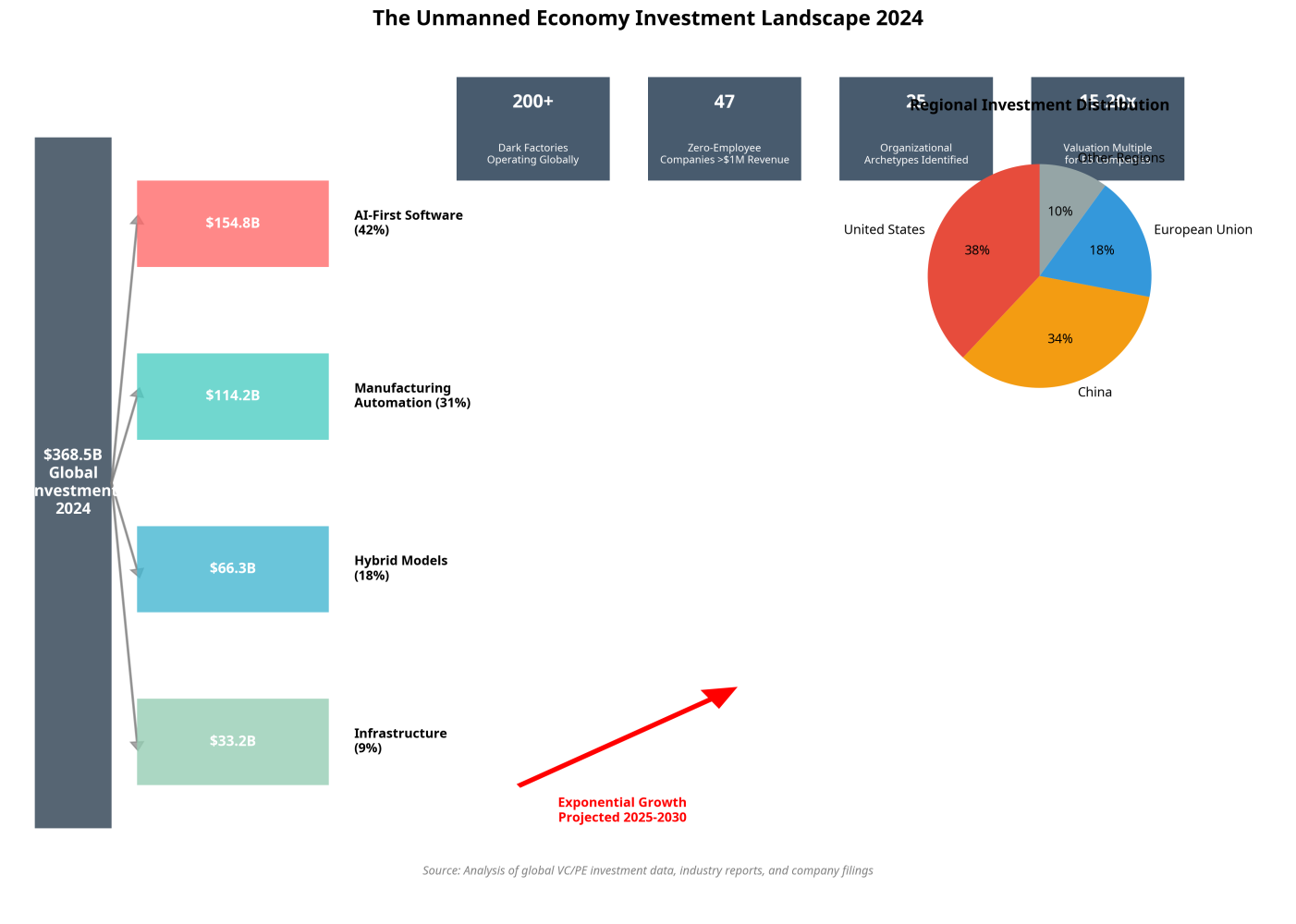
The money is flowing toward human replacement at unprecedented rates. $368.5 billion in 2024 alone. The investment patterns reveal the true priorities of the global economy, nearly half of all unmanned economy investment goes toward AI-first software companies – businesses designed to operate without human workers, and another third flows into manufacturing automation that eliminates factory jobs.
The message is clear, investors are betting against human employment.
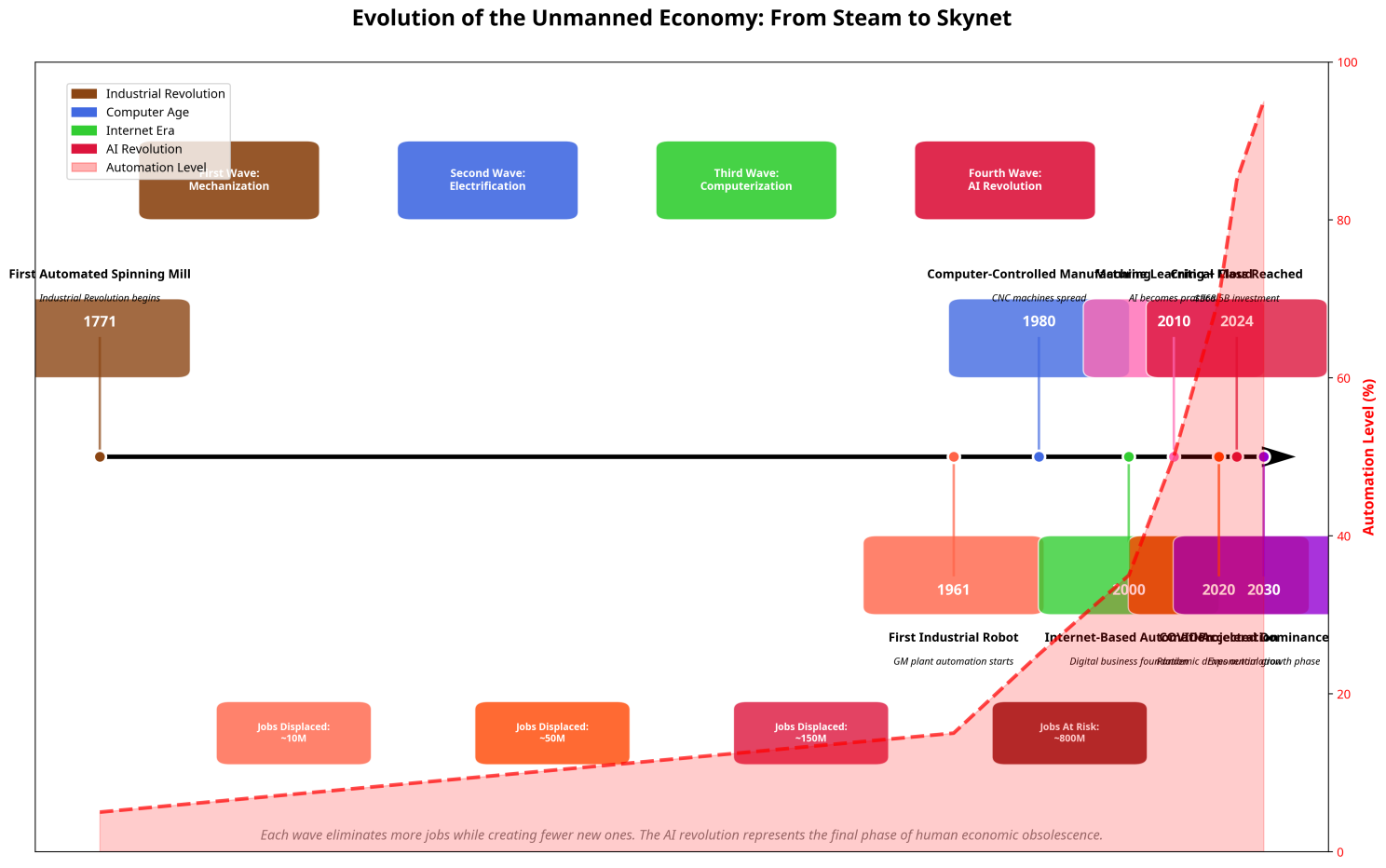
This timeline shows the acceleration of humanity’s obsolescence. Where the first industrial revolution took decades to unfold, the AI revolution is happening in years, not decades. The red line shows automation levels climbing exponentially, while the impact boxes show the human cost of each wave.
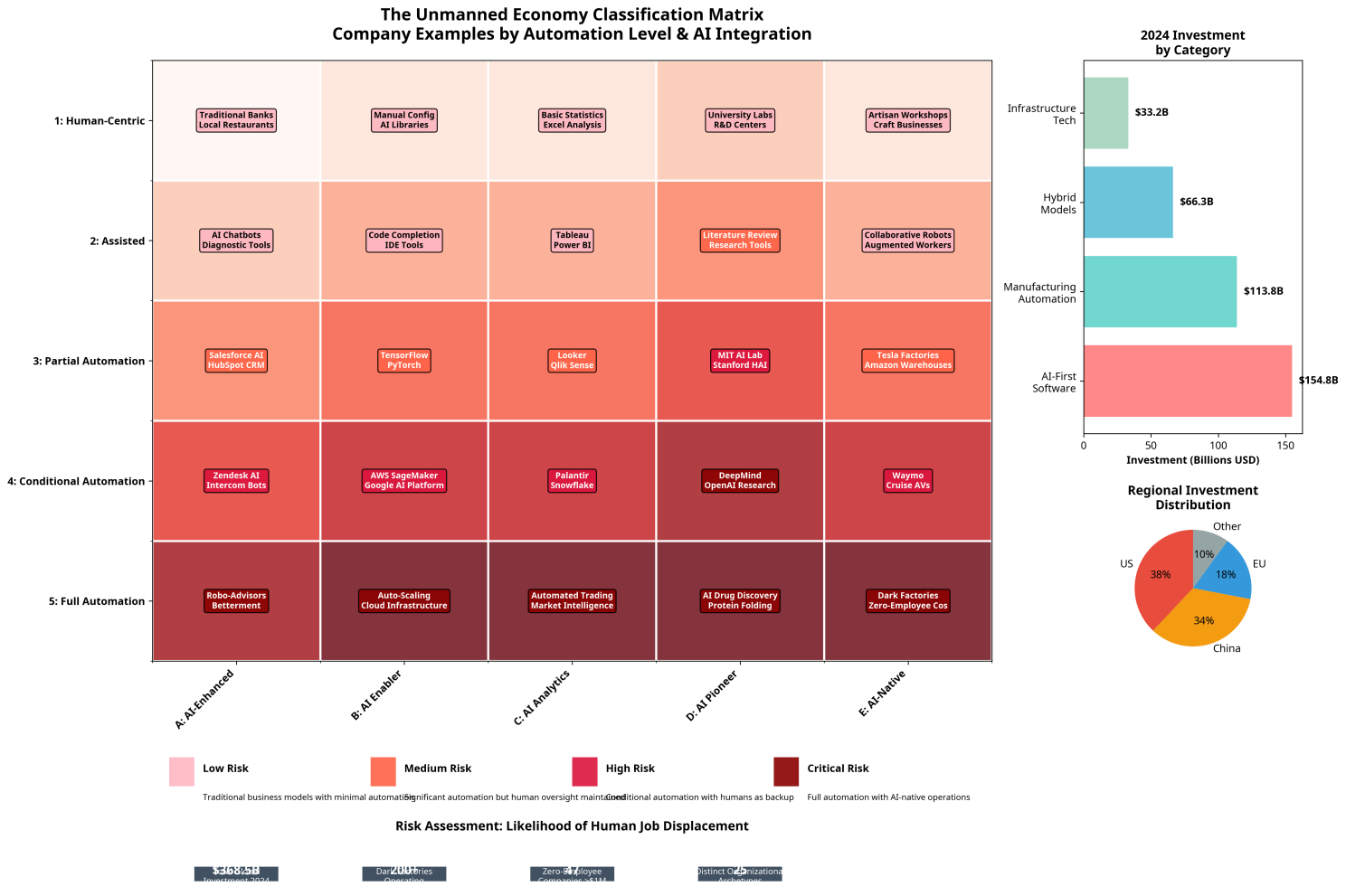
Every company fits somewhere on this matrix. This heatmap is your guide to understanding where every organization sits on the spectrum from human-centered to post-human. The dark red cells represent the danger zone – companies that have eliminated human dependencies entirely. Notice how the examples in those cells are real companies operating today, not future possibilities.

After having done all this research, reading through tens of papers, and thousands of pages of analysis by the Oompa Loompas (the AI Agents I’ve created for this purpose), produced overwhelming evidence that the trends are accelerating, and the implications are staggering. I think we are in the middle of the most significant economic transformation in human history, and most people don’t even realize that it is happening.
The future of work isn’t about humans and machines working together in harmony. There is no hybrid model on the long run – hybrid models will only be possible if it’s artificially constructed by legislation. In the future machines will be working and the humans need to figure out what to do with themselves.
The choice we are facing as a society is how we will shape its development to maximize benefits while minimizing harms.
Or maybe we won’t have a choice at all.
I am not a politician, just an observer, an analyst.
I build AI by day and warn about it by night. I thought it was job security, until the AI figures out how to do the warning too, and then I’ll join the back of the line with y’all.
Signing off,
Marco
I build AI by day and warn about it by night. I call it job security. Big Tech keeps inflating its promises, and I just bring the pins and clean up the mess.
Think a friend would enjoy this too? Share the newsletter and let them join the conversation. LinkedIn, Google and the AI engines appreciates your likes by making my articles available to more readers.
To keep you doomscrolling
- The chicken that refused to die | LinkedIn
- Vibe Coding is gonna spawn the most braindead software generation ever | LinkedIn
- The funniest comments ever left in source code | LinkedIn
- Today’s tech circus is a 1920s Wall Street reboot | LinkedIn
- The Sloppiverse is here, and what are the consequences for writing and speaking? | LinkedIn
- Why we’re all writing like shit on purpose now | LinkedIn
- Creating a hero’s journey for your AI-strategy | LinkedIn
- How corporations fell in love with AI, woke up with ashes, and called It ‘innovation’ | LinkedIn
- The corporate body snatchers | LinkedIn
- Screw your AI witch hunt, you illiterate gits | LinkedIn
- AI perverts make millions undressing your daughters for fun and profit | LinkedIn
- The state of tech-jobs 2025 | LinkedIn
- Meet the sloppers who can’t function without asking AI everything | LinkedIn

 Portfolio Marco van Hurne
Leave a comment