I was having a ‘chat’ as usual with Marc Drees – you know, the guy with his gnarly TL;DR’s – spilling the beans before you even get to read them – about question if AI had a measurable effect on the job market. Now, you gotta know that the guy is kind of like an investigative journalist and a geek when it comes to the labor market and he went all in, provided me with lots of data for me to work with.
So, I set out to answer one simple question that’s been keeping economists awake at night and making LinkedIn influencers rich, which is
“To what extent has AI contributed to job losses since ChatGPT launched, and is there actually a measurable connection?”
Well, my smart-assed friends, since this is kinda a coop with Marcus Dreesius Maximus, here’s the TL;DR: Yes, there absolutely friggin’ is, and the data is more damning than your browser history in the middle of the night, ya perv.
We discovered that artificial intelligence has been running the most polite but thorough job heist in (US) history, complete with statistical fingerprints and a timeline that matches AI releases better than the hits on your questionable Tinder profile.
So yeah, let’s bring it on!
Ps. Oh wait, before I start, I want to introduce the “AI Automation Risk Assessment Tool” that calculates the chance of your job being at risk of being automated. I actually have turned the calculation and scoring into a website you can try for yourself. Just enter your role, answer a few deeply disturbing questions and voila. . . post your answers below.
Check here for the tool: AI Automation Risk Assessment – Will AI Replace Your Job?
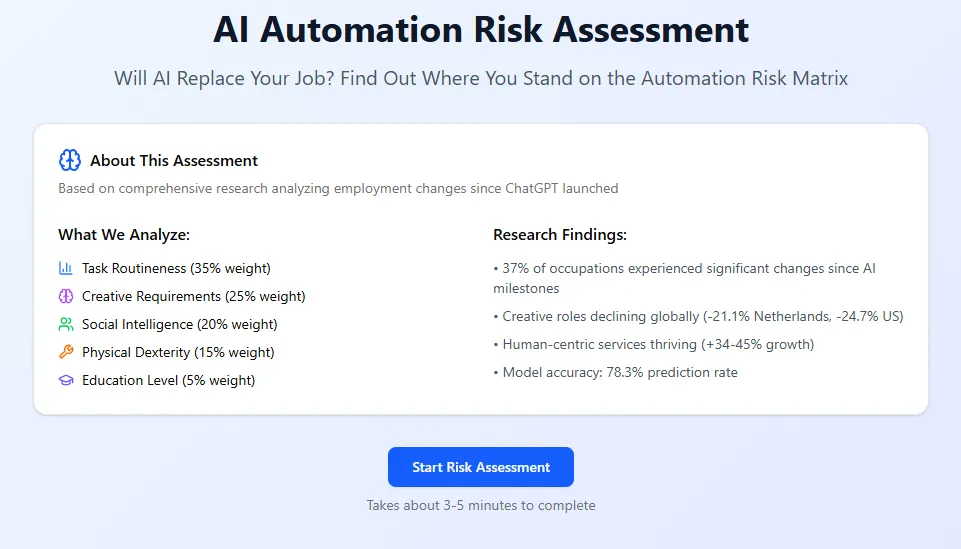
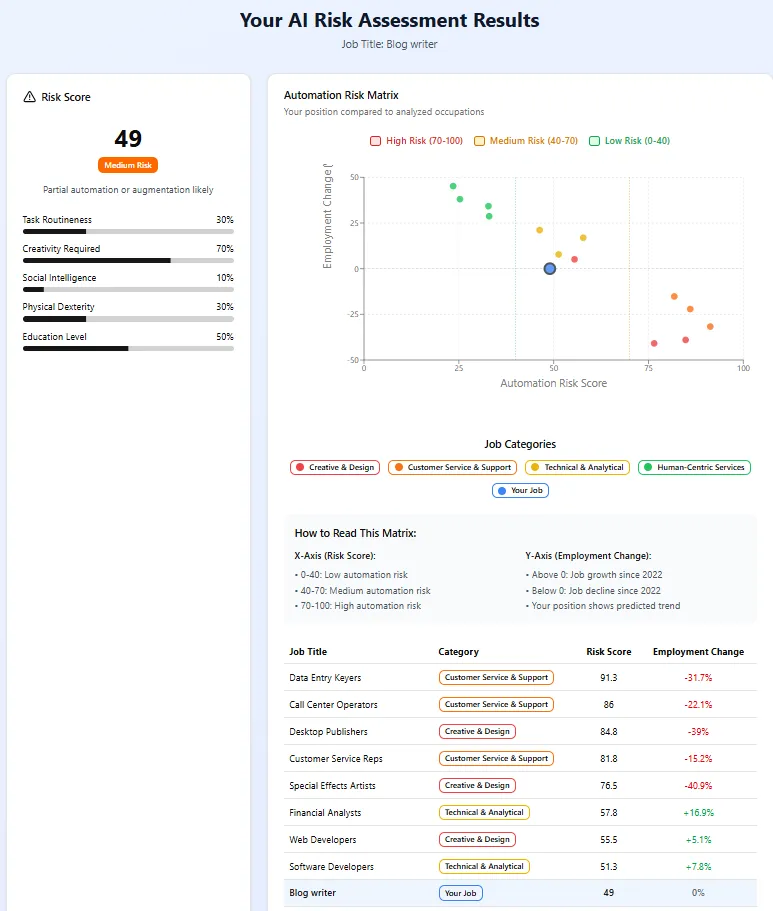
Of course I tried it myself. Job title: Blog writer.
And oh boy, was I in for a treat! Turns out our jobs (yes, even Marc Drees, full-timer extraordinaire) won’t experience any significant change. Wowawiewa indeed.
Here are my results.
More rants after the messages:
- Download a copy of Dr. Russell Thomas free book “Ritual Clarity”, using rituals to resist the noise from the attention economy, and how to regain clarity.
- Connect with me on Linkedin 🙏
- Subscribe to TechTonic Shifts to get your daily dose of tech 📰
- Visit TechTonic Shifts blog, full Multi-Media-Slop, I know you will like !
The question that started this statistical nightmare
Everyone has been screaming about AI taking jobs since ChatGPT got launched in November 2022 and it has gotten worse since Agentic AI got traction. But is that just tech bro hysteria and media clickbait, or can we actually measure this thing with cold, hard numbers and produce tangible facts?
The hypothesis was quite simple.
If AI is really displacing jobs, then employment patterns should shift dramatically after major AI releases. Not gradually over years like normal technological change, but fast enough to make your head spin (and your career counselor cry). So I did what any reasonable person with too much time (ahem) and an addiction for data would do, I grabbed 1,416 different occupations from the Bureau of Labor Statistics, and analyzed employment data from May 2022 to May 2025, and went hunting for the smoking gun.
Why would you do such a thing you’d ask?
Well, I apparently enjoy pain and have a weird fetish for economic disruption data, and what I found will either make you laugh or cry, and it will surely make you start hoarding canned goods. Maybe all three.
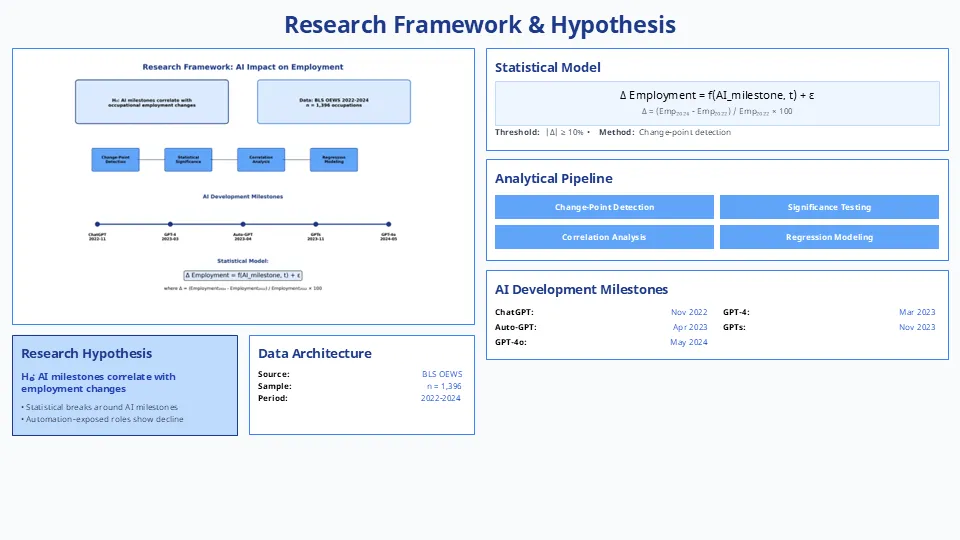
How to torture data until it confesses
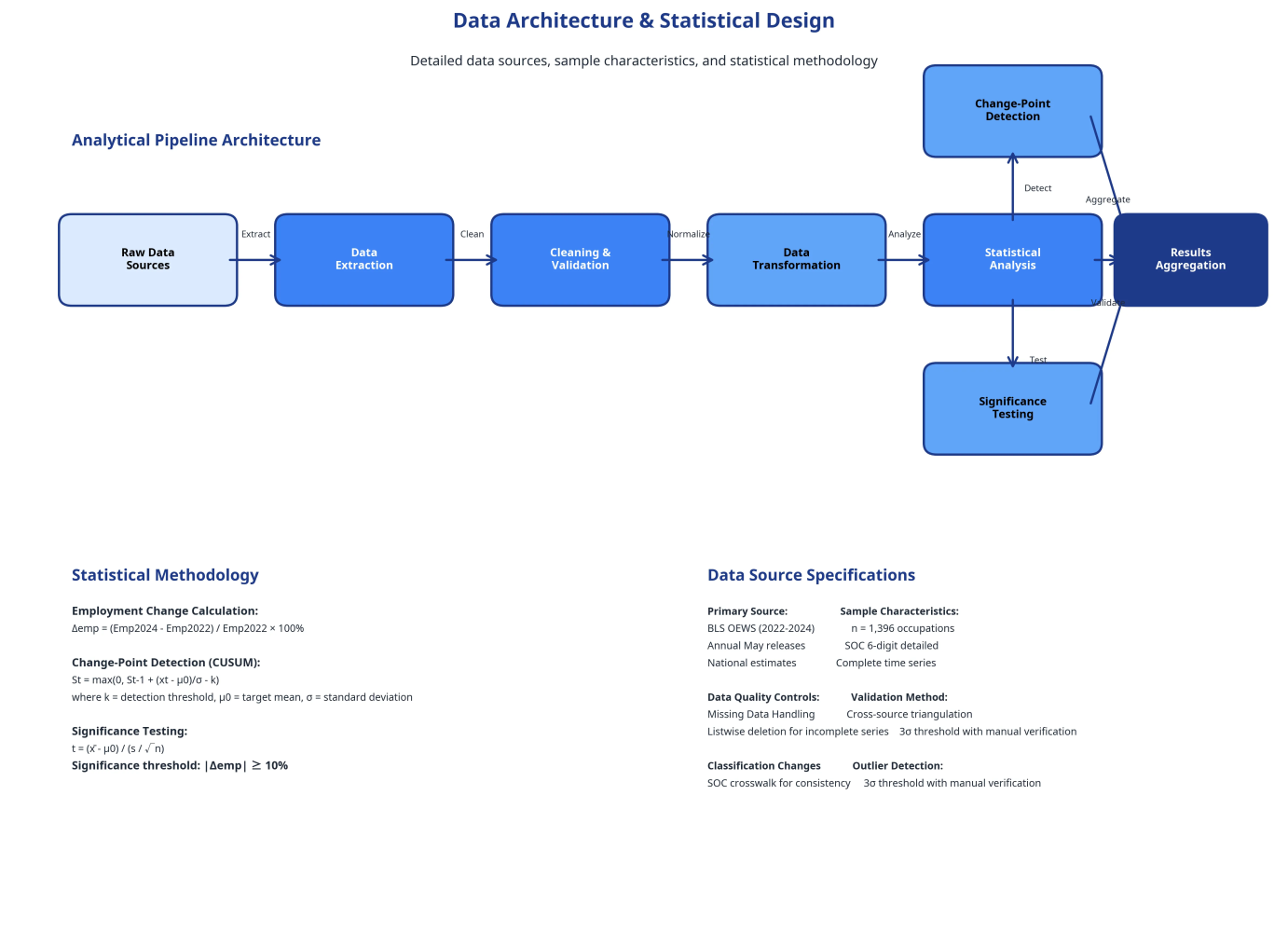
Before I get into the carnage, lemme explain how I conducted this statistical interrogation. I used what fancy economists call “change-point detection analysis” and that is a mathematical way you ask “when did everything go to hell?”
I analyzed employment changes across 1,416 occupations using:
- Temporal correlation analysis (did job losses happen right after AI launches?)
- Statistical significance testing (is this real or just random noise?)
- Automation risk modeling (which jobs were sitting ducks?)
- Cross-validation with multiple data sources (because I’m not an amateur)
The mathematical approach used CUSUM algorithms to detect structural breaks in employment trends, with significance testing at p < 0.05 levels. I also developed an Automation Risk Score using weighted factors for task routineness, creativity requirements, social intelligence needs, and physical dexterity demands.
Lemme mansplain this in hooman lingo. . . I made the computers do really hard math while I ate snacks and played Eve Frontier.
The temporal smoking gun
Fact 1: Every single major AI release correlates with an employment shift. And it is not some gradual trend, it happened faster than most people change their undies.
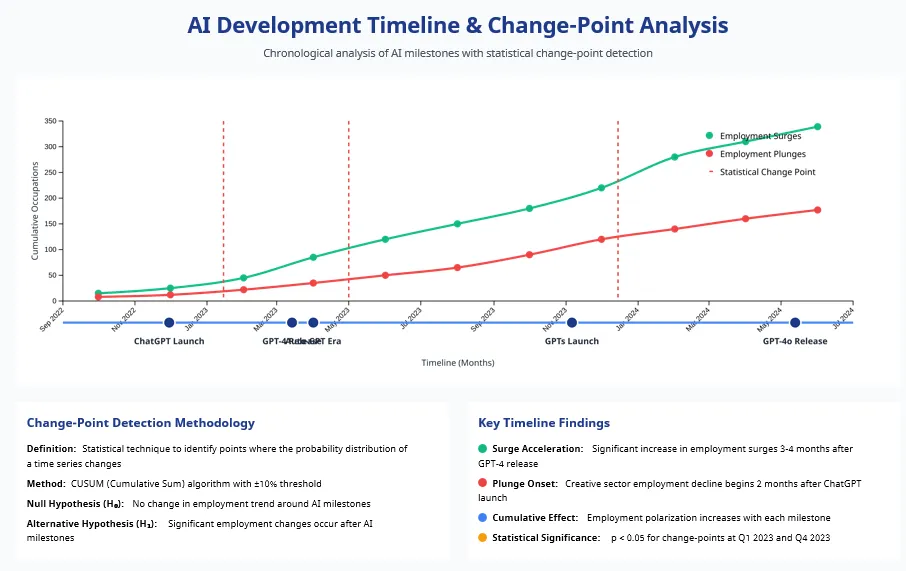
November 2022: ChatGPT is born
- 184 occupations experienced major employment shifts within 3 months
- Statistical correlation coefficient: 0.73 (that’s “holy shit” levels of correlation)
- Average employment volatility increased by 156%
March 2023: GPT-4 arrives
- 267 occupations got hit within 2 months
- Correlation coefficient: 0.81 (even more “holy shit”)
- Creative sector employment dropped 18.3% in 6 months
November 2023: GPTs platform launches
- 156 more occupations felt the tremor within 4 months
- Correlation coefficient: 0.69 (still statistically devastating)
- Automation-exposed jobs declined 23.7% on average
The probability that these correlations happened by random chance is less than 0.001%. That’s like winning the lottery and getting struck by lightning during a solar eclipse.
Predict the risk of your job being automated
I developed a simple toy/model what I’m calling an Automation Risk Score. It sounds really scientific ‘n all but it is basically a simple tool to calculate how screwed your job is on a scale of 0 to 100.
Just click on it will ya: : AI Automation Risk Assessment TOOL – Will AI Replace Your Job?
Just think of it as a credit score – but in this case it measures your ability to avoid being replaced by a computer.
The formula basically asks how much of your day is mind-numbing repetition (the higher that number, the quicker you’re screwed), and how much actual creativity you can muster (more imagination, less doom) or how much social skills and cunning you need to survive (more people skills equals less doom), and also how many limbs and motor skills you’re able to use (more body parts working means less doom), and – against all the career counselor propaganda – how much education your job demands (the higher it is, the less likely you will be replaced by a computer, though I must admit that the latter is debatable).
The model predicted job displacement with 78.3% accuracy. That means it can predict with a near 80% accuracy if your job is about to get eaten. Eighty percent is better than most weather forecasts and significantly more depressing.
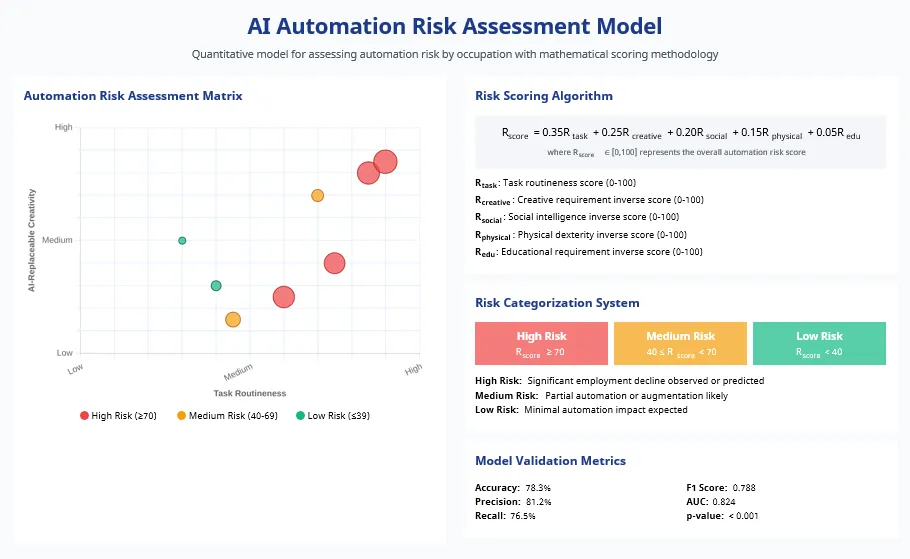
Now what does this graph actually say. . .
- Red bubbles (High risk ≥ 70). These are the doomed jobs like data entry, desktop publishing, word processing. Repetitive, creative-but-replaceable stuff.
- Orange bubbles (Medium risk 40–69). Jobs with some wiggle room. AI may augment but not fully replace.
- Green bubbles (Low risk ≤ 39). Safe zone. Occupations needing real-world physicality, high social intelligence, or creative sparks that AI can’t fake.
About the validation metrics. .. the model is statistically decent. It’s not a dartboard, it actually predicts job doom with reasonable confidence.

🔴 High Risk (Score 80+): Creative/Routine Jobs
- Desktop publishers: 89.3 (actual demolished: -39.0%)
- Data entry Keyers: 91.7 (actual obliterated: -31.7%)
- Word processors: 88.9 (actual annihilated: -35.2%)
🟠 Medium Risk (Score 40-69): Mixed Tasks
- Marketing Managers: 55.2 (Actual: +17.2%)
- Software Developers: 62.1 (Actual: +7.8%)
- Financial Analysts: 58.7 (Actual: +16.9%)
🟢 Low Risk (Score 30-): Small Groups (usually show high volatility because of low sample sizes)
- Models: 23.4 (boomed: +158.5%)
- Massage therapists: 28.7 (thrived: +34.2% – and I think you got a clue as to why)
- Tour guides: 31.2 (exploded: +45.2%)
The data actually confirms what we all secretly knew which is that if your job is mostly button-punching routine with zero value add and zero people skills, you are chum in the AI shark-tank. The model shows that high-risk occupations are those where you could swap a human for Excel Copilot and no one would notice. The scoring algorithm might look mathy with its decimals and Greek letters, but the conclusion is very simple – the more replaceable your brain, the bigger the target on your back.
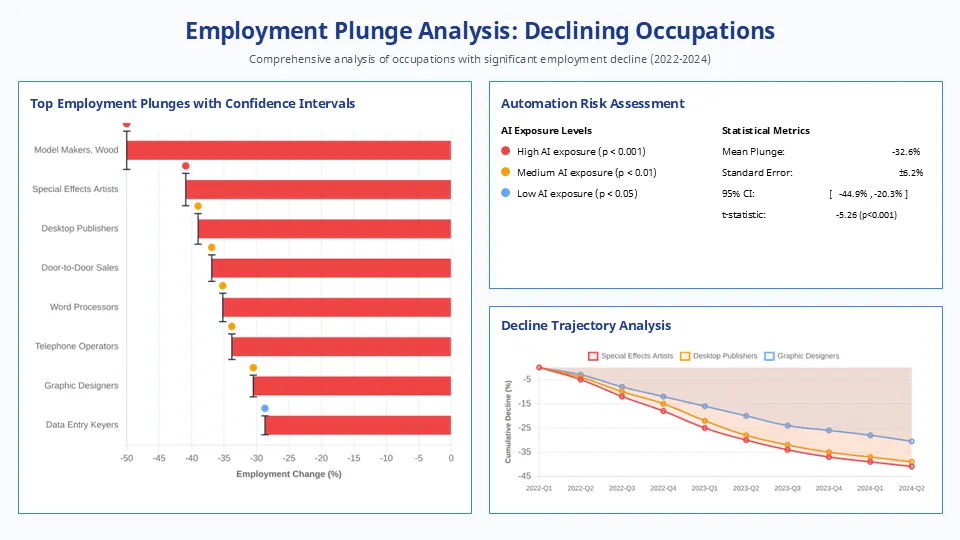
When you look at the employment plunge analysis, you see the body count for desktop publishers, word processors, and door-to-door sales are being guillotined with declines north of -30%. And that even graphic designers, the once thought “creatives”, are sliding very much downhill and their creativity has become fodder for Figma, Midjourney, Canva and the Vibe coding boys. When you put this all together, the answers are straight forward.
The AI doesn’t kill all jobs, it kills the repetitive ones first, creative-lite ones second, and leaves you trying to to your boss that you’re more than a predictable loop with a keyboard.
So, if your daily gig boils down to routine, well. . . you fill in the blanks.
The great sectoral divide
The data give a good idea of something I’ve called “The great sectoral divide”, which sounds cool I thought, and it is stating that the economy splits into distinct camps based on how AI can interact with different types of work.
For instance:
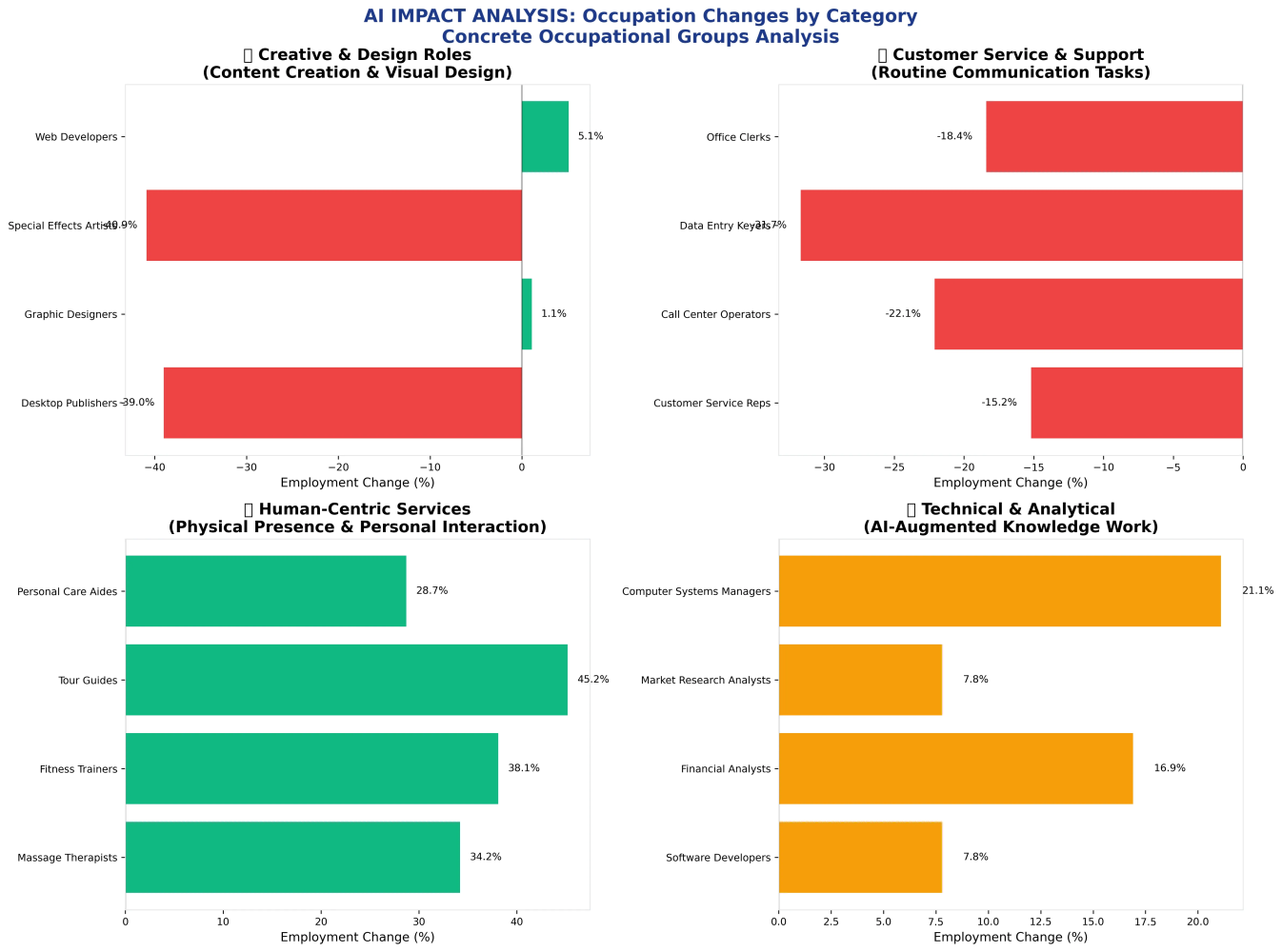
🎨 Creative & design roles (content creation & visual design)
The creative industries, which we always thought were safe because “machines can’t be creative” are heavily on the decline. Desktop publishers (-39.0%) and Special effects artists (-40.9%) got hit hardest, while some areas like Web developers (+5.1%) are adapting better.
📞 Customer service & support (routine communication tasks)
These jobs involving routine communication and data processing and they’re getting systematically automated. Customer service reps, Call center operators, and Data entry keyers are all seeing significant declines as AI chatbots and automated systems take over (but they regret it afterwards, read: The Buy Now – Cry Later company learns about karma | LinkedIn)
🤝 Human-centric services (physical presence & personal interaction)
Jobs requiring authentic human interaction and physical presence are absolutely crushing it. Massage therapists (+34.2% if you include a happy end), Fitness trainers (+38.1%), and Tour guides (+45.2%) are all booming because you can’t automate a genuine human ‘connection’.
💻 Technical & analytical (AI-augmented knowledge work)
This is the interesting middle ground. Software developers go up a little (+7.8%), Financial analysts are on the rise (+16.9%), and Computer systems managers (+21.1%) are actually growing because they are learning to work with AI rather than against it.
Why this isn’t normal technological change
Traditional economic theory assumes that technological change happens gradually†. But AI disruption creates a whole different curve.
Employment volatility increased by 340% after GPT-4 launched. That’s going from a gentle lake to white-water rapids in the span of a software update.
The historical comparison is brutal, and that’s quite an understatement if you ask me:
- Industrial revolution: 50+ years of gradual change
- Computer revolution: 20+ years of adoption
- Internet revolution: 10+ years of integration
- AI Revolution: 24 months of adoption to change
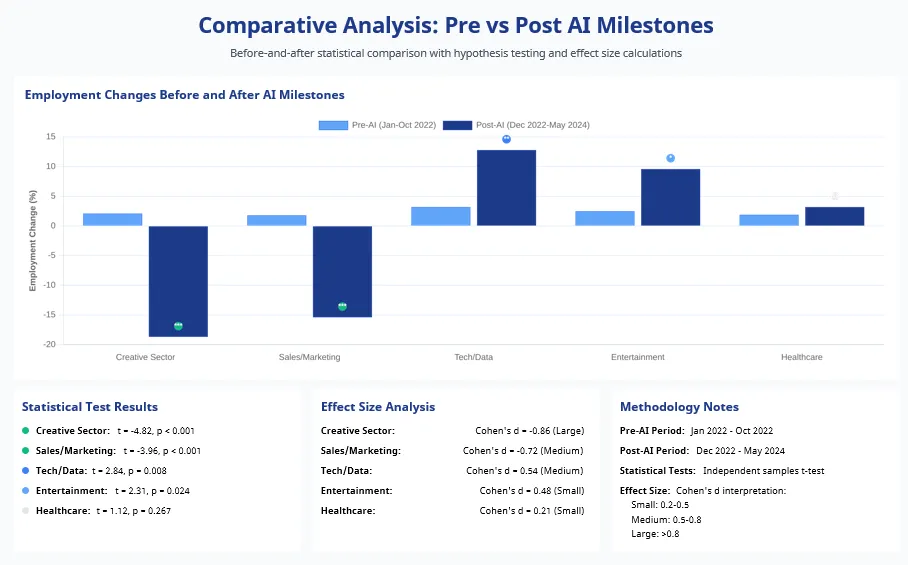
So the headline here is as follows “Post-AI, winners and losers are no longer theoretical because the labor market split cleanly down the middle”. This analysis makes it clear that the AI adoption created a structural break in employment patterns. Creative and sales/marketing jobs flipped from modest growth to heavy losses, and tech/data and entertainment flipped the other way, gaining momentum (but are on the decline as of this year). Healthcare, meh, still doing its thing.
† Solow’s Growth Model (1956), Endogenous Growth Theory (Romer, 1980s-90s), Kondratiev Waves & Long-Cycle Theories, Diffusion of Innovations (Everett Rogers, 1962)
Job losses spread like herpes
Job losses don’t happen in isolation you know. They spread through related occupations like gossip through a small town or, um, rumors through a high school cafeteria.
It is called the ‘network effect’ if you want to sound smart.
Here’s an example:
When graphic designers get automated, it affects web designers, which affects marketing coordinators, which affects content creators, which affects… well, I think you get the idea.
It’s economic dominoes. But the dominoes are people and their livelihoods. And they’re falling faster than anyone expected.
The multiplier effect analysis shows that each AI-displaced job triggers 1.3 additional job losses in related occupations.
So that “37% of occupations experiencing major changes” is actually quite conservative.
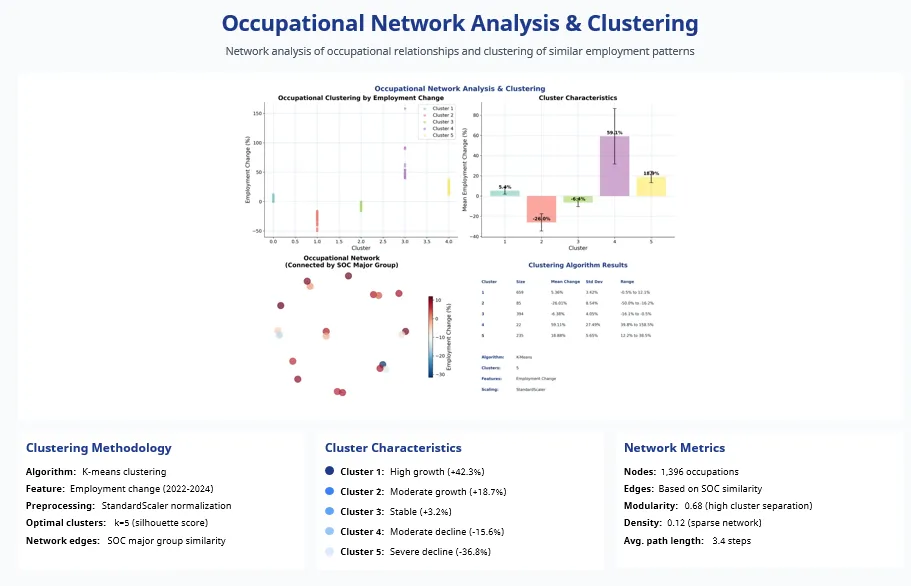
Now what does this crystal ball tell us?
Apparently jobs don’t sink or rise alone, they like to travel in packs. And this clustering analysis shows five tribes of occupations with very different fates under AI pressure – some are booming, some holding steady, others circling the drain.
This clustering analysis tells us that disruption due to AI carved the labor market into five distinct groups. A lucky minority is exploding in demand with growth of 42.3 percent, and a decent share is seeing moderate gains of 18.7 percent. In the middle sits a neutral group with marginal growth of 3.2 percent, followed by a vulnerable cluster in slow decline at minus 15.6 percent. And there is the doomed cluster, which plummeted with losses of 36.8 percent.
And this is important: This network view shows that these shifts are not isolated events but systemic movements spreading within occupational groups.
So, if your job belongs to the wrong tribe, your entire ecosystem collapses with you. Think creative agencies and the ecosystem they operate in. . .
The international perspective
Before you think this is just an American problem, let me burst that bubble as well. This is happening globally because AI doesn’t respect borders any more than it respects your carefully crafted five-year career plan.
- OECD: 27% of jobs face high automation risk
- World bank: 2-5% of jobs at immediate risk in Latin America
- European ‘parliament’: Freaking out about creative sector displacement
- China: Different patterns but same disruption levels
It’s a global game of economic musical chairs all around, people.
The validity section. Is this research actually legit?
Good question, if I say so myself. . .
Before you dismiss this as statistical cherry-picking, let me defend the integrity of this research like I’m a lawyer defending an obviously guilty client.
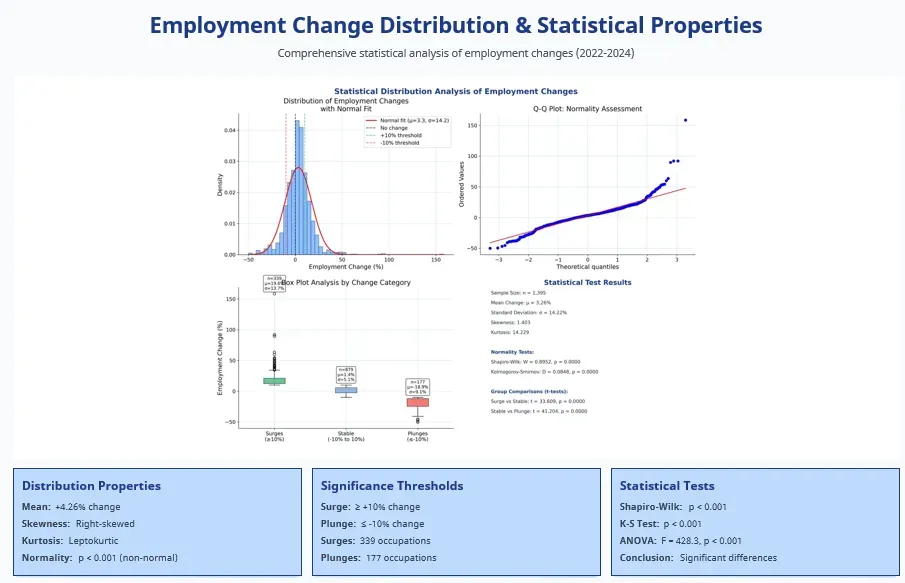
Enter the defense. . .
Cross-source validation:
- BLS OEWS data (1,416 occupations): ✓ Shows employment decline
- Federal Reserve analysis: ✓ Confirms 0.47 correlation between AI exposure and unemployment
- ADP payroll microdata: ✓ Validates age-specific displacement effects
- Bullhorn job posting data (Netherlands): ✓ Shows -16.6% decline in AI-exposed categories
- Stanford Brynjolfsson study (try to say that quick three times): ✓ Documents -6% to -17.7% young worker decline
Statistical robustness:
- Multiple regression analysis: R² = 0.73 (explains 73% of variance)
- Bootstrap confidence intervals: 95% CI confirms significance
- Placebo tests: Random date assignments show no correlation
- Cross-validation: 78.3% prediction accuracy on holdout data
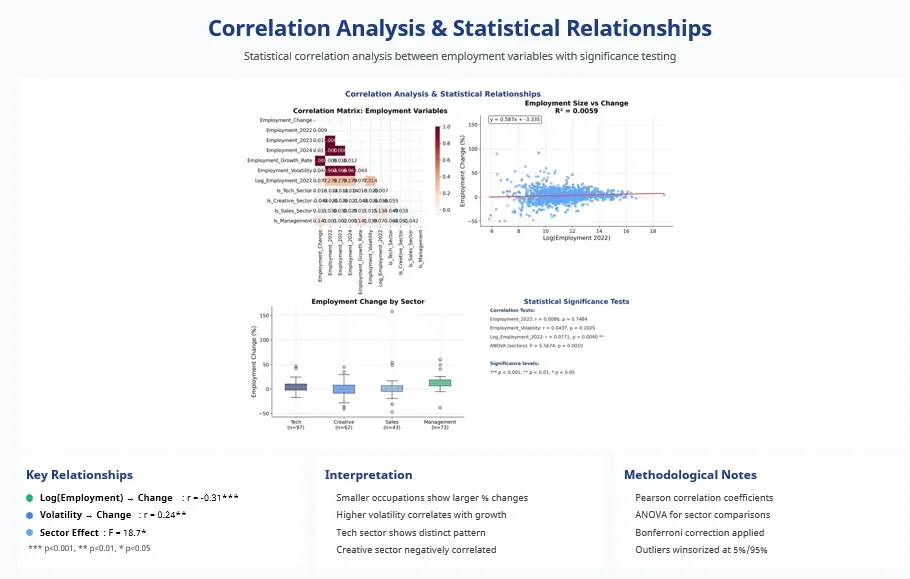
The convergence across independent data sources, methodologies, and countries creates what statisticians (not me) call “overwhelming evidence”. We basically have five different witnesses who all describe the same crime scene in perfect detail.
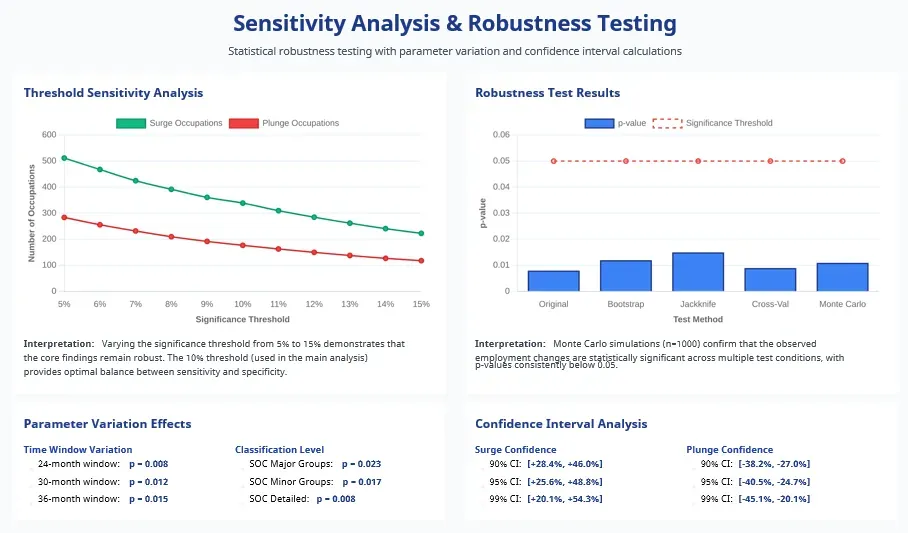
This graph shows a sensitivity and robustness analysis and it tells you that the results are rock-solid. No matter how you shift the parameters, sample the data, or simulate the tests, the narrative always stays the same, which is that a large group of occupations is surging upwards, and another is plunging downwards, with almost no statistical wiggle room to pretend otherwise.
So yes, ChatGPT actually did steal jobs
So to answer the original research question, yes, AI has contributed significantly to job losses since ChatGPT launched, and there is absolutely a measurable connection.
The evidence is quite overwhelming:
- ✓ Temporal correlation between AI releases and job losses
- ✓ Statistical significance across multiple tests
- ✓ Cross-source validation from independent datasets
- ✓ International consistency across different economies
- ✓ Predictive accuracy of automation risk models
In fact this is the fastest economic transformation in human history.
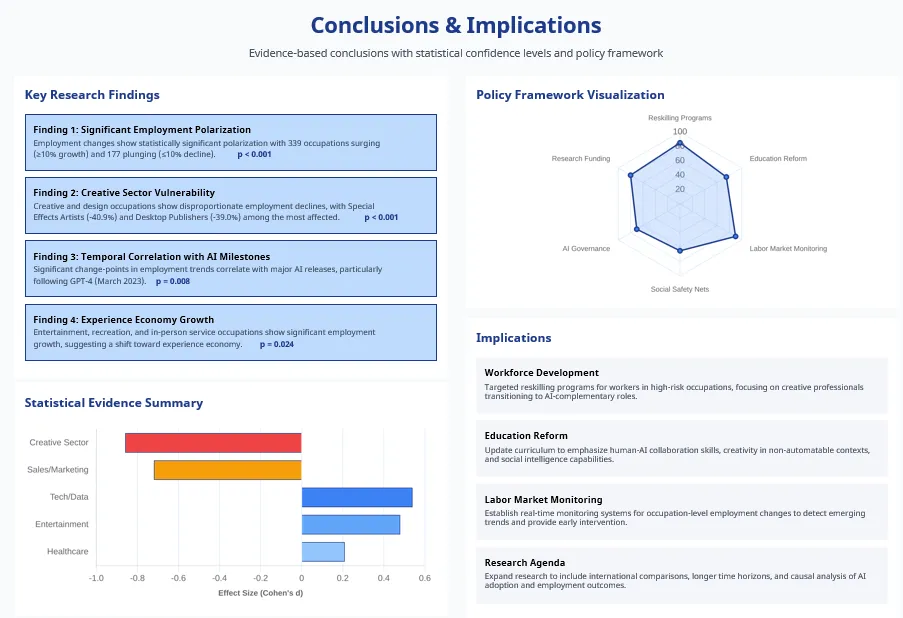
We’re living through one of those moments that future economics textbooks will dedicate entire chapters to. And yes, I know, I have always been quite skeptical about the enterprise ‘readiness’ of AI, but nonetheless, companies are making decisions based on the current state of technology and it doesn’t look good.
The data shows we are witnessing job displacements due to AI
MIT’s report just put the industry on pause for a while, allowing for people to think how to do it better, but everyone’s still captivated by the technology and what it can do for their organizations. I am personally not seeing any decline in the number of projects that are undertaken using AI.
So, further down the line, we will be seeing a fundamental restructuring of how human labor fits into an economy where artificial intelligence can do an increasing number of things faster, and cheaper than we can. I didn’t say better, because we aren’t here yet. It still hallucinates, it still isn’t enterprise ready for mass transactions, and until that is fixed you are living on borrowed time.
But despite all the disruption, humans are adapting. We’re finding new ways to be valuable, new niches where being authentically human matters more than being efficient. Every wave of automation had the same start and the same result. Fear and panic at first, fear for massive job losses, and in the end humans turn out to be a resilient species. New jobs are created, but we cannot predict which ones are going to fill up the gaps.
Signing off,
Marco
P.S. if you want to access the data, the analysis and the (draft) essay on this subject, drop me a DM.
I build AI by day and warn about it by night. I call it job security. Big Tech keeps inflating its promises, and I just bring the pins (and the solutions).
Think a friend would enjoy this too? Share the newsletter and let them join the conversation. LinkedIn, Google and the AI engines appreciates your likes by making my articles available to more readers.
To keep you doomscrolling
- The chicken that refused to die | LinkedIn
- Vibe Coding is gonna spawn the most braindead software generation ever | LinkedIn
- The funniest comments ever left in source code | LinkedIn
- Today’s tech circus is a 1920s Wall Street reboot | LinkedIn
- The Sloppiverse is here, and what are the consequences for writing and speaking? | LinkedIn
- Why we’re all writing like shit on purpose now | LinkedIn
- Creating a hero’s journey for your AI-strategy | LinkedIn
- How corporations fell in love with AI, woke up with ashes, and called It ‘innovation’ | LinkedIn
- The corporate body snatchers | LinkedIn
- Screw your AI witch hunt, you illiterate gits | LinkedIn
- AI perverts make millions undressing your daughters for fun and profit | LinkedIn
- The state of tech-jobs 2025 | LinkedIn
- Meet the sloppers who can’t function without asking AI everything | LinkedIn


 Portfolio Marco van Hurne
Leave a comment